Analyzing the macro-economic forces driving high-capacity polymer water tank production across municipal, agricultural, and industrial infrastructure worldwide.
The global demand for high-integrity liquid containment solutions has escalated rapidly over the past decade. Driven by intensifying climate variability, rapid urban expansion, and rigorous environmental compliance mandates, municipal utilities, commercial agricultural enterprises, and industrial chemical processors require robust, seamless, and stress-free storage vessels. Within this global macro environment, rotational moulding (rotomolding) has established itself as the definitive manufacturing process for hollow plastic containers ranging from 500 liters up to 50,000+ liters.
Unlike traditional extrusion blow moulding or multi-segment injection moulding—which introduce high residual stress, directional polymer chain orientation, and vulnerable weld seams—rotational moulding forms seamless, stress-free monolithic vessels. When evaluating an OEM Water Tank Rotational Moulding Machine, industrial buyers and global engineering procurement teams are not merely purchasing hardware; they are securing a reliable, high-yield manufacturing system designed to meet rigorous structural integrity requirements over a 30+ year product lifecycle.
Global exporters of rotomolding equipment face a complex landscape of regional regulatory frameworks, energy tariffs, and feedstock variations. From Linear Low-Density Polyethylene (LLDPE) and High-Density Polyethylene (HDPE) to specialized Cross-linked Polyethylene (XLPE), modern machinery must accommodate precise thermal transfer profiles to avoid polymer degradation, pinhole voiding, or structural warpage during the heating and controlled cooling phases.
Modern OEM water tank rotomolding lines integrate high-efficiency direct-gas combustion or eco-friendly electric arrays, reducing thermal losses by up to 28% per cycle.
Utilizing high-velocity internal cooling systems (water mist and forced air differential), cycle times for double- and triple-layer water tanks are cut by 15-22%.
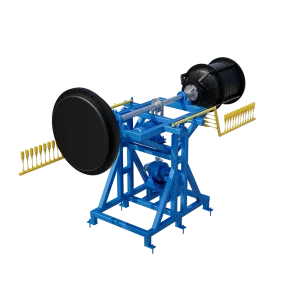
Biaxial rotation at low RPM (1 to 10 RPM) ensures tension-free resin accumulation, eliminating internal stress concentrations present in pressure-molded tanks.
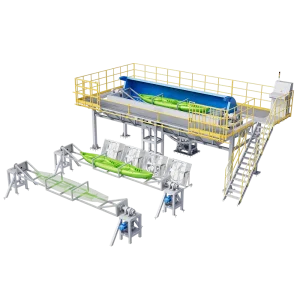
Selecting the optimal kinematic architecture: Carousel, Shuttle, and Rock & Roll systems engineered for industrial scale.
Choosing the correct equipment architecture is critical to maximizing yield and operational profitability. When evaluating OEM Water Tank Rotational Moulding Machine Quotes, global exporters evaluate three primary machine layout typologies based on volume requirements, space constraints, and mold geometry versatility.
Ideal for: High-volume standardized water tank manufacturing (e.g., 500L - 5,000L).
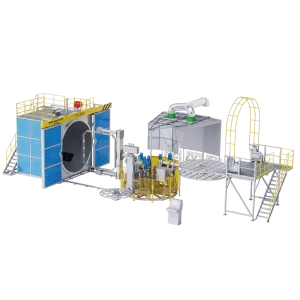
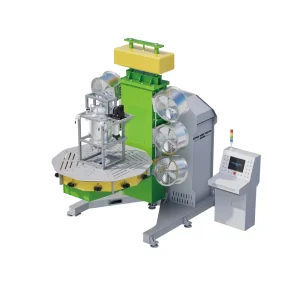
Operates on a 3-arm or 4-arm continuous rotary indexing layout (Heating -> Cooling -> Demolding/Loading). Independent arm movement allows variable thermal residence times per station, maximizing plant throughput.
Ideal for: Mixed-batch production and medium to large industrial vessels (up to 15,000L).
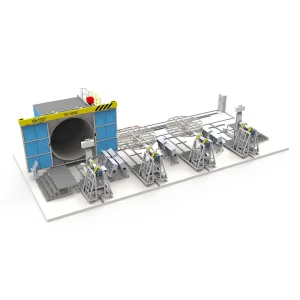
Features a central high-efficiency thermal chamber flanked by two linear shuttle carts. Enables simultaneous curing of one mold set while the opposite carriage undergoes demolding and material dosing.
Ideal for: Super-large, elongated, or cylindrical tanks (10,000L up to 50,000L+).
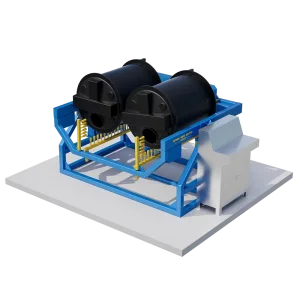
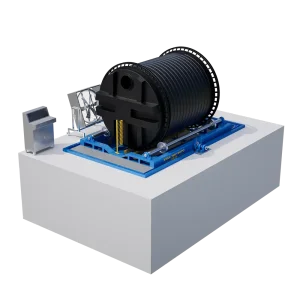
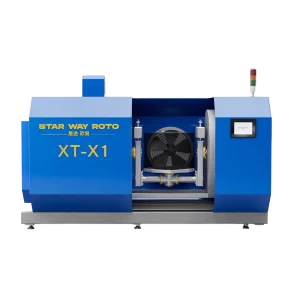
Utilizes a 360° longitudinal rotation paired with a high-angle rocking swing motion. Available in open-flame direct heating or enclosed insulated oven enclosures for maximum thermal efficiency.
| Machine Type | Optimal Tank Capacity | Heating Efficiency | Footprint Requirement | Automation Level |
|---|---|---|---|---|
| Carousel (Independent Arm) | 500L – 5,000L | High (Enclosed Forced Air) | Medium / Circular | Full PLC / SCADA Integrated |
| Linear Shuttle System | 1,000L – 15,000L | Very High (Direct Heat Exchange) | Linear / Modular Extended | Semi-Automated Dosing |
| Oven Rock & Roll | 5,000L – 30,000L | High (Insulated Rocker) | Compact Linear | Programmable Rock Ratios |
| Open Flame Rock & Roll | 10,000L – 50,000L+ | Moderate (Targeted Burner Array) | Minimal Height Overhead | Manual / PLC Burner Control |
OEM Engineering Benchmark: Advanced PLC-driven control systems monitor real-time internal air temperature (IAT) within the mold cavity, replacing traditional timer-based cycles with precise polymer phase-change triggers for optimal cross-linking density.
Adapting water tank rotomolding technologies to meet regional environmental, climate, and structural stresses.
A primary factor driving OEM customization requests is the operational environment of the finished water tank. Global exporters must tailor machine parameters and mold engineering to suit specific localized application requirements:
Geographies: Middle East, North Africa, Central Australia.
Tanks produced for desert environments require multi-layer co-extrusion/dosing capabilities. Machines must seamlessly coat an outer UV-20 stabilized shield layer, a middle black carbon thermal insulation barrier, and an inner virgin food-grade PE lining to eliminate micro-algal growth under intense solar radiation.
Geographies: Western Europe, North America, East Asia.
Demands heavy-wall rib-reinforced underground storage tanks capable of withstanding lateral soil pressures and high water tables. Molds engineered on our OEM lines feature deep structural corrugations and integrated baffle mounting points for modular storm-water management grid connection.
Geographies: Island Nations, Coastal Industrial Hubs, Offshore Platforms.
Requires steel-lined plastic composite tanks or high-density cross-linked polyethylene (XLPE) containment to prevent chemical oxidation and stress-cracking caused by concentrated brine solutions.
Geographies: Emergency Humanitarian Zones, Seismic-Active Regions.
Focuses on high-impact resistant, light-weight transportable tanks manufactured with anti-bacterial and antimicrobial inner layers complying with World Health Organization (WHO) potable water standards.
Ensuring absolute reliability, local safety compliance, and direct engineering support across international jurisdictions.
Sourcing large-scale industrial capital equipment across borders requires stringent compliance with international mechanical, electrical, and environmental safety standards. As a premier Water Tank Rotational Moulding Machine Exporter, maintaining transparent quality control frameworks and global field support networks is non-negotiable.
All machinery units comply with CE Safety Directives (2006/42/EC), ISO 9001:2015 Quality Management Standards, and UL/CSA electrical control panel specifications for North American power grids.
Deployment of certified field engineers for foundation layout, gas line integration, burner tuning, mold trial validation, and local operator safety training.
Integrated cloud-based remote telemetry enables real-time diagnostic monitoring, predictive burner maintenance, and instant software updates across 40+ countries.
Pioneering energy reduction, autonomous resin dispensing, and AI-driven thermal optimization.
The rotational moulding industry is undergoing a technological revolution. Legacy empirical trial-and-error operations are being replaced by automated closed-loop process controls. Our engineering roadmap focuses on four primary innovation pillars designed to maximize productivity and lower environmental footprints:
Integrating non-contact infrared pyrometer arrays inside oven chambers allows real-time mapping of mold surface thermal distribution. Automatic burner modulation dynamically compensates for wall thickness variance, eliminating cold spots and ensuring perfectly homogeneous resin fusion.
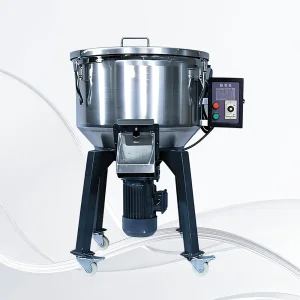
Eliminating manual resin loading, integrated pneumatic vacuum systems automatically weigh and dose multi-layer PE charges into molds at precise thermodynamic intervals during the rotation cycle.
Transitioning from traditional fossil fuel burners to hybrid electric radiant heaters powered by onsite industrial solar installations, cutting carbon intensity per produced tank by up to 45%.
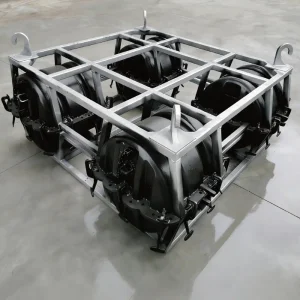
Utilizing high-grade A356 cast aluminum and CNC-milled forged steel mold tool sets equipped with automated quick-clamp systems, reducing mold changeover times from hours to minutes.
Key parameters for evaluating total cost of ownership (TCO), machine capabilities, and exporter transparency.
When requesting quotes from international exporters, comparing initial purchase price alone can lead to inaccurate budget forecasts. A comprehensive evaluation requires examining specific engineering parameters that dictate long-term operational costs (OPEX):
Expert answers to common engineering, procurement, and operational questions.