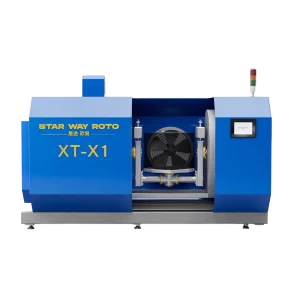
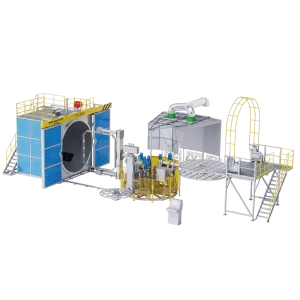
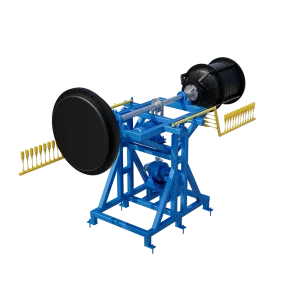
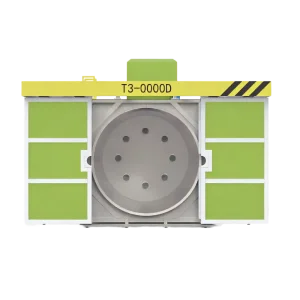
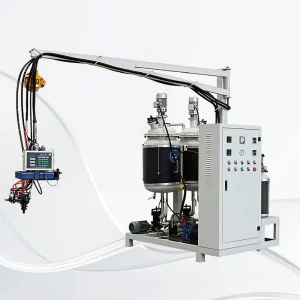
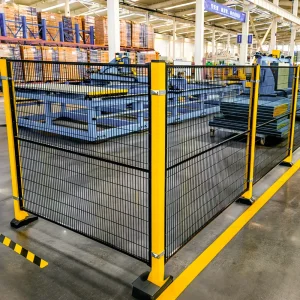
Explore our flagship OEM/ODM rotational molding machines, custom mold tooling assemblies, and precision automated systems manufactured to rigorous international standards.
Strategic analysis of market trends, polymer physics shift, and total cost of ownership (TCO) benchmarks for OEM procurement decision-makers.
The global polyethylene rotational molding industry is expanding at a CAGR of 6.8%, projected to surpass $7.2 Billion globally. Drivers include infrastructure modernization, agricultural automation, chemical containment, and marine floating assets demanding stress-free hollow parts.
Unlike injection molding or blow molding, rotational molding operates under zero shear stress. Polymer powders melt slowly against heated mold walls without high injection pressure, delivering uniform wall thickness, seamless structural strength, and zero residual stress.
Tooling capital expenditures for rotational molding are 60% to 80% lower than injection molding equivalents. This renders rotational molding ideal for low-to-medium production volumes, complex multi-wall geometry tanks, and massive hollow structures.
Choosing the correct polymer resin architecture is critical to achieving mechanical durability, UV protection, environmental stress-crack resistance (ESCR), and thermal stability.
Unlike standard thermal extrusion, rotomolding relies purely on gravity and conductive heat transfer to melt polyethylene powders (typically 35 mesh / 500 micron particle size). Melt Flow Index (MFI) must be precisely balanced between 2.0 and 6.0 g/10min to guarantee complete air bubble pinhole evacuation without triggering thermal degradation or sagging along complex inner ribs.
| Polymer Type | Density (g/cm³) | MFI (g/10min) | Tensile Yield (MPa) | ESCR F50 (Hours) | Primary Industrial Applications |
|---|---|---|---|---|---|
| LLDPE (Linear Low-Density) | 0.932 – 0.940 | 3.5 – 5.0 | 18.5 – 22.0 | > 1000 hrs | Water tanks, agricultural sprayers, septic systems, outdoor furniture. |
| HDPE (High-Density) | 0.941 – 0.958 | 2.0 – 4.0 | 24.0 – 29.0 | > 500 hrs | Industrial fuel tanks, chemical containment, heavy-duty pallets. |
| XLPE (Cross-linked PE) | 0.938 – 0.945 | N/A (Thermoset) | 21.0 – 25.0 | > 5000 hrs | Hazardous chemical storage, high-temp fluid vessels, aggressive solvents. |
| Foamed PE (Multi-layer) | 0.35 – 0.65 (Core) | 3.0 – 6.0 | Composite high stiffness | > 1000 hrs | Insulated cooler boxes, marine buoys, cryogenic transport containers. |
| Conductive / Antistatic PE | 0.945 – 0.960 | 2.5 – 4.5 | 22.0 – 26.0 | > 750 hrs | ATEX-certified fuel handling, underground mining ducting, electronics cases. |
StarWay Roto delivers customized rotational molding machinery configured for continuous multi-arm production, high load-bearing capacity, and energy-efficient thermal management.
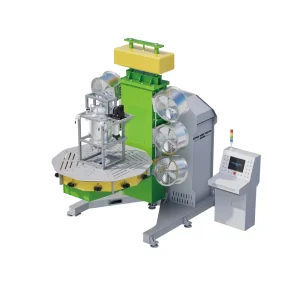
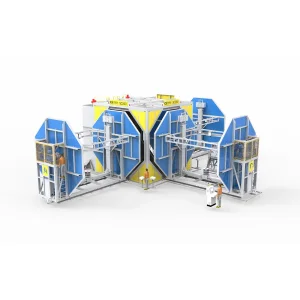
Engineered for high-volume automated production lines. Operating on 3-arm or 4-arm independent stations (Heating, Cooling, Loading/Unloading), Carousel machines maximize oven uptime while enabling independent cycle timing per arm.
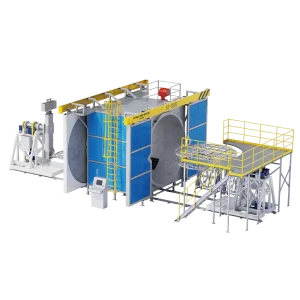
Flexible dual-shuttle cars moving linearly into a central thermal oven. Ideal for oversized hollow products (up to 20,000L tanks), rapid mold changeovers, and specialized OEM runs requiring customized heating regimes.
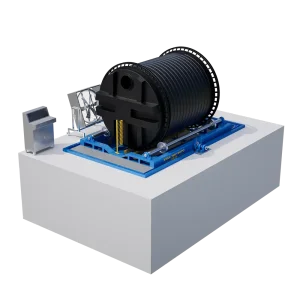
Specialized machines designed specifically for elongated cylindrical storage vessels, steel-lined tanks, and large water storage units. Features low fuel consumption, compact floor footprint, and direct flame thermal efficiency.
From initial 3D CAD DFM analysis to multi-axis CNC mold fabrication and full-scale factory output—our structural workflow guarantees perfect part precision.
Our R&D engineering team conducts rigorous Design for Manufacturability (DFM) analysis on customer drawings. Using Finite Element Analysis (FEA), we simulate stress concentrations, shrinkage rates (typically 2.5% to 3.0% for LLDPE), wall thickness gradients, and draft angle optimization (minimum 1.5° to 3° draft).
We manufacture custom molds using high-density Cast Aluminum (A356 grade for seamless heat transfer) or 5-Axis CNC Milled Aluminum (6061-T6 block for high aesthetic finish and micro-tolerances). Molds are equipped with engineered parting line seals, vent tubes, and quick-release drop boxes for multi-color or inserts.
During trial moldings, wireless inner-mold temperature sensors (IRT) track the precise melt temperature, crystallization peak, and cooling curves. Biaxial rotation speed ratios (major axis vs. minor axis speed ratio, typically 4:1) are dynamically calibrated for homogeneous powder distribution.
Mass production integrates automated powder dosing systems, PU foaming injection, CNC 5-axis trimming, spin welding of polyethylene couplings, pressure leak testing, and CMM wall thickness verification to ensure zero defects prior to global shipment.
StarWay Roto ensures all machinery and rotomolded products fulfill international regulatory frameworks, supporting seamless operational integration worldwide.
All rotomolding machinery complies with the European Union Machinery Directive 2006/42/EC and Low Voltage Directive 2014/35/EU. Factory manufacturing operations adhere to certified ISO 9001:2015 quality management procedures.
Polyethylene resin formulations used for water tanks, food storage, and livestock feeding systems utilize virgin raw materials compliant with FDA 21 CFR 177.1520 and EU REACH regulations for non-toxic safety.
Our smart machine control panels feature integrated IoT remote diagnostic modules. Global clients benefit from real-time PLC troubleshooting, remote firmware updates, and on-site engineering installation teams dispatched worldwide.
Discover how StarWay Roto is advancing sustainable green polymer engineering, electric induction oven technology, and AI-driven process modeling.
Integrating artificial intelligence into oven thermal management. Machine learning algorithms continuously adjust burner flame intensity, air recirculation velocity, and arm rotation speeds based on real-time internal mold temperature sensors, cutting thermal cycle times by 18%.
Developing specialized mold heating profiles optimized for Bio-LLDPE (derived from sugarcane bio-ethanol) and high-percentage Post-Consumer Recycled (PCR) polyethylene compounds, reducing carbon footprint while maintaining impact strength.
Replacing traditional gas burners with high-efficiency electric induction heating chambers powered by renewable microgrids. Eliminates combustion exhaust emissions inside production plants and offers precise thermal uniformity.
In-depth technical answers regarding rotomolding tooling lead times, wall thickness control, resin selection, and international OEM partnership workflows.
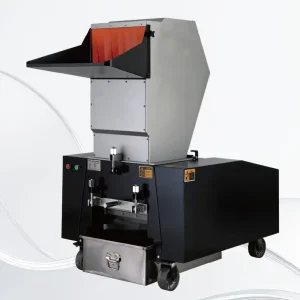
Explore our complete range of lab testing units, auxiliary crushers, carousel assemblies, and high-efficiency electric heating ovens.