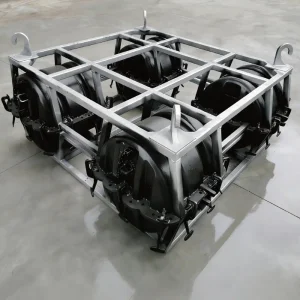
Explore our flagship industrial rotational molding solutions engineered for high performance, thermal efficiency, and long service life.
Analyzing the strategic nexus between regional distribution expertise and high-end industrial rotomolding equipment manufacturing.
In the rapidly evolving polymer manufacturing landscape of Southeast Asia and global industrial hubs, Famous Roto Moulding Sdn Bhd stands out as a key benchmark for operational excellence in rotational molding solutions. Operating at the intersection of heavy-duty polymer transformation and precise thermal processing, modern rotomolding operations demand zero tolerance for structural defects, wall-thickness inconsistency, or thermal degradation.
As global enterprises transition toward high-density polyethylene (HDPE), polypropylene (PP), and polyamide (PA/Nylon) applications, the reliance on high-precision machinery—equipped with closed-loop burner telemetry and multi-axis articulation—has become paramount.
Unlike conventional injection molding or blow molding, rotational molding relies on a biaxial low-pressure dynamic powder sintering process. Microfine polymer powders (typically 35.0 to 50.0 mesh size) are loaded into custom CNC-machined aluminum or fabricated steel molds. As the mold rotates simultaneously along major and minor axes inside a temperature-controlled heating chamber (ranging from 250°C to 380°C), the resin melts, coats the internal cavity, and forms a seamless, stress-free hollow structure.
Understanding these thermal mechanics allows Roto Moulding Sdn Bhd and international procurement teams to select machinery designed specifically for uniform heat dissipation, rapid cooling cycles, and structural integrity.
Combining Ningbo’s world-class manufacturing ecosystem with localized installation, field support, and compliance frameworks.
Headquartered in Ningbo, China—a premier global industrial hub—manufacturers like Ningbo StarWay Roto Co., Ltd. provide deep technical R&D, operating from sprawling facilities backed by over 40 specialized R&D engineers. This robust manufacturing backbone provides clients working with entities like Roto Moulding Sdn Bhd direct access to factory-direct equipment, high-grade CNC aluminum molds, and continuous technological upgrades.
By leveraging China's comprehensive supply chain for raw materials, heat exchangers, heavy gearboxes, and Siemens/Schneider automation components, equipment cost is dramatically optimized without sacrificing reliability. This enables procurement officers to realize up to a 40% reduction in upfront capital expenditures (CAPEX) compared to traditional European machinery suppliers.
For international buyers in Malaysia and Southeast Asia, local engineering support provided under the Roto Moulding Sdn Bhd framework ensures rapid on-site machine commissioning, preventative maintenance programs, locally stocked spare parts, and strict adherence to SIRIM, CE, and ISO 9001 compliance standards.
In-depth structural breakdown of specialized rotational molding machinery, auxiliary systems, and custom tooling.
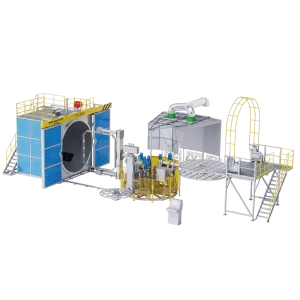
Engineered for high-volume, continuous industrial manufacturing. Carousel rotomolding systems utilize a central indexing hub with 3 to 5 independent arms moving molds through heating, cooling, and loading/unloading stations.
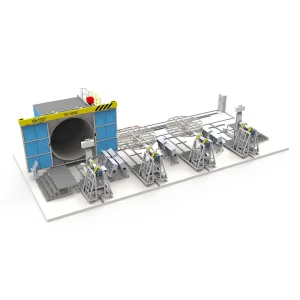
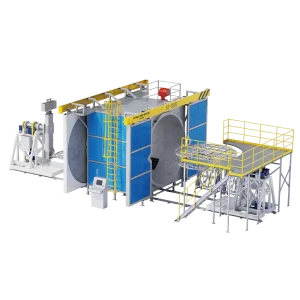
Designed for large-format products such as agricultural storage tanks, septic tanks, and heavy industrial containers. Shuttle machines operate with a central oven and two independent shuttle carts operating linearly.
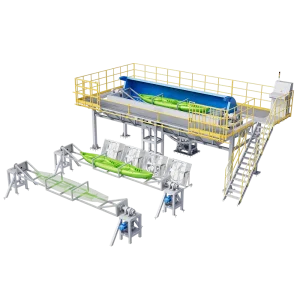
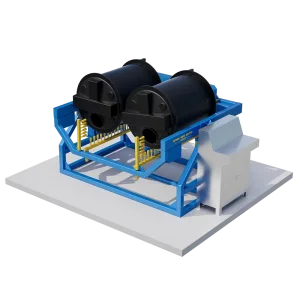
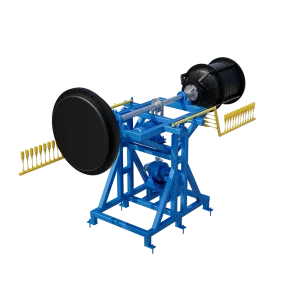
Specially engineered for elongated hollow products like kayaks, marine boat hulls, yacht fuel tanks, and long pipe fittings. The mold rocks back and forth along its longitudinal axis while continuously rotating 360 degrees on its minor axis.
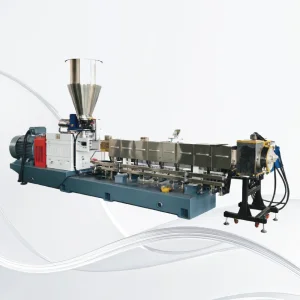
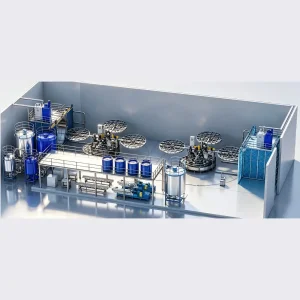
Complete rotomolding production ecosystem integration requires precise material preparation and finishing equipment.
| Machine Architecture | Primary Application | Arm Payload Capacity | Thermal Efficiency | Floor Space Requirement |
|---|---|---|---|---|
| Carousel (Independent Arm) | High-volume tanks, automotive components, bins | 1,000 kg – 4,500 kg | High (Closed Loop Recirculation) | Large (Circular footprint) |
| Lined / Straight Shuttle | Large chemical tanks, multi-cavity products | 2,000 kg – 10,000 kg | Very High (Dual cart alternate oven) | Medium (30% less space) |
| Rock & Roll / Swing Oven | Yacht hulls, kayaks, marine vessels, long pipes | 500 kg – 8,000 kg | Moderate to High | Long Linear layout |
| Open Flame Rock & Roll | Extra-large hollow vessels, budget setups | Up to 12,000 kg | Direct Gas Burner | Open Bay space |
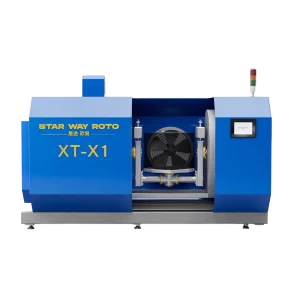
| R&D Intelligent Lab Unit | Resin testing, color masterbatch trial, polymer labs | 10 kg – 50 kg | Precision Micro-Control | Compact (Lab benchtop) |
Evaluating long-term economic advantages, thermal energy conservation, and operational ROI for industrial buyers.
Energy consumption accounts for over 30% of total operating expenses in rotational molding. Advanced machines feature multi-layer rock wool burner insulation, automated ducting dampers, and modulating burners (using natural gas, LPG, or diesel), reducing thermic energy waste by up to 28%.
By implementing universal mounting plates, pneumatic clamping assemblies, and pre-balanced spider frames, mold changeover times are reduced from hours to minutes. This dramatically decreases machine idle time during short-run production shifts.
Utilizing globally standardized industrial components—such as SEW reducers, Siemens PLC touch-screen controls, and Honeywell gas control valves—ensures that replacement parts are readily available worldwide, mitigating unexpected factory downtime.
Pioneering advancements reshaping rotational molding efficiency, sustainability, and quality assurance.
Modern rotomolding integrates wireless thermistor probes inside the mold cavity. Transmitting real-time internal air temperature (IAT) data directly to the central PLC allows automatic switching from heating to cooling phases precisely when the polymer reaches its optimal bubble-elimination state.
With global sustainability mandates expanding, modern machines are tuned to process PCR (Post-Consumer Recycled) PE blends and bio-based polyethylenes without structural degradation or pinhole formation, ensuring compliance with global carbon footprint targets.
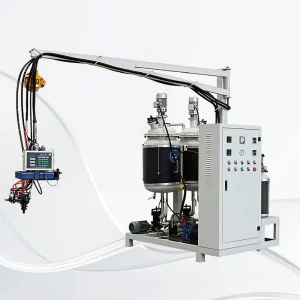
Automated robotic arms are increasingly replacing manual labor during mold demolding, cleaning, and secondary operations—such as multi-component polyurethane foam injection for insulated cold-chain boxes.
Demonstrating how high-precision rotational molding serves key industrial sectors across global markets.
In modern agricultural technology, automatic feeding and weighing systems require exceptionally durable, chemical-resistant, and hygienic feeding troughs and liquid silos. Rotomolded seamless LLDPE containers resist agricultural chemicals, impact, and UV exposure, providing a maintenance-free service life exceeding 15 years.
Marine environments demand zero-leakage assurance for fuel, potable water, and black-water storage tanks. Utilizing U-arm open-flame and rock-and-roll swing oven machines enables the production of thick-walled (10mm to 18mm), baffled marine tanks compliant with stringent USCG and CE marine safety regulations.
Heavy chemical storage tanks (up to 50,000 liters) manufactured via high-load shuttle rotomolding machines feature completely seamless walls with no stress concentrations. These tanks safely hold corrosive acids, alkalis, and industrial effluents.
Integrating rotomolded shells with automatic high-pressure PU foaming systems produces ultra-insulated cooler boxes, pharmaceutical transport containers, and seafood storage tubs capable of maintaining sub-zero temperatures for extended periods.
Ensuring complete manufacturing integrity, international compliance, and client peace of mind.
All machinery manufacturing complies with ISO 9001 quality management protocols and carries full CE certification for electrical safety, emergency stop circuits, interlocked safety fencing, and gas burner controls.
Finished molded parts undergo rigorous ultrasonic wall thickness testing to verify uniform material distribution across complex geometric corners, ribbing, and insert points.
Senior field engineers conduct full factory acceptance testing (FAT) prior to shipment, followed by on-site installation, operator training, and site acceptance testing (SAT) at the client's facility.
Addressing core engineering, operational, and purchasing inquiries from global plant managers and procurement officers.
Explore more specialized machinery, auxiliary pelletizers, foaming systems, and precision mold tooling.