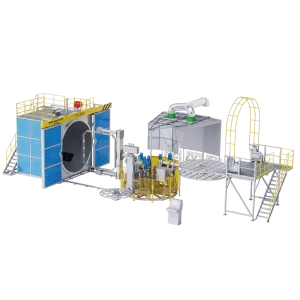
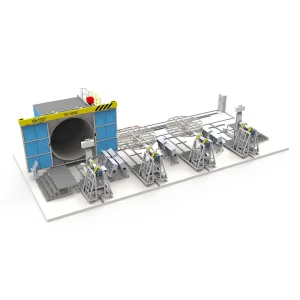
Direct factory machinery quotes, high-capacity shuttle rotomolding systems, and precision structural moulds engineered for large-scale liquid containment manufacturing.
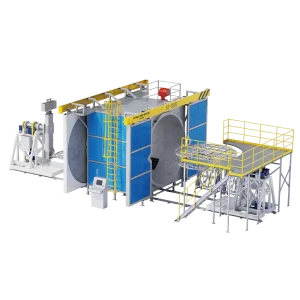
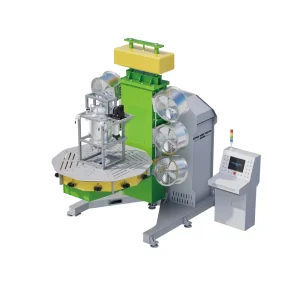
Understanding material density, Environmental Stress Crack Resistance (ESCR), biaxial thermal fusion, and zero-stress seamless manufacturing.
Rotational moulding (commonly designated as rotomolding) is a thermoplastic processing technique designed to produce hollow, seamless, stress-free liquid storage containment solutions. Unlike blow molding or injection molding—processes that subject molten polymers to intense hydraulic shear pressures—rotational moulding relies on low-pressure, biaxial rotation inside a heated oven chamber. When sourcing rotational moulded polyethylene water tanks from direct china factories, enterprise procurement directors and municipal engineers must evaluate polymer chemistry, thermal history during moulding, and wall thickness uniformity metrics.
The core material utilized in modern water tank manufacturing is Linear Low-Density Polyethylene (LLDPE) or High-Density Polyethylene (HDPE), frequently modified with hexene ($C_6$) or octene ($C_8$) co-monomers. Octene-based LLDPE resin (such as Dowlex or ExxonMobil Rotomolding grades) provides superior impact strength at sub-zero temperatures, exceptional Environmental Stress Crack Resistance (ESCR > 1,000 hours under ASTM D1693 Condition B), and long-term hydrostatic strain resistance.
The structural integrity of a rotomolded PE water tank depends on achieving a Peak Internal Air Temperature (PIAT) between 190°C and 215°C inside the mould cavity during the oven cycle. Undercooking results in un-fused resin powder boundary layers and poor impact strength; overcooking triggers thermal-oxidative degradation of the polymer backbone, leading to embrittlement. Top-tier Chinese OEM factories utilize wireless multi-channel dataloggers (e.g., K-Kord technology) to measure realtime IAT curves for every batch.
From large-scale agricultural fertigation to off-grid municipal potable distribution and harsh marine environments.
Rotomolded conical bottom tanks and vertical liquid fertilizer tanks allow complete drainage of high-viscosity liquid suspensions, urea ammonium nitrate (UAN) solutions, and agricultural chemicals. Smooth interior non-stick walls prevent crystallization crusting.
Certified food-grade PE resins complying with NSF/ANSI Standard 61 and FDA 21 CFR 177.1520 ensure zero leaching of heavy metals, plasticizers, or VOCs into municipal drinking supply grids, rural reservoir storage, and rainwater harvesting installations.
For high-risk environments storing sodium hypochlorite, sulfuric acid, or industrial effluents, double-walled (bunded) rotomolded polyethylene tanks provide 110% secondary containment capacity, guarding against primary tank breaches without external masonry bunds.
Offshore vessels and aquaculture platforms deploy heavy-wall rotomolded polyethylene tanks for marine ballast, diesel fuel storage, and freshwater purification buffer tanks. Compounded with UV-24 Hindered Amine Light Stabilizers (HALS), they endure extreme salt spray and solar radiation.
Lightweight, impact-resistant modular rotomolded water tanks can be air-dropped or rapidly trucked into disaster zones. Impact toughness tested at -40°C guarantees zero catastrophic cracking even during transport over extreme terrain.
Used in commercial high-rises for graywater recycling, chilled water buffer storage, and dedicated emergency fire sprinkler supply reserves. The non-corrosive nature of polyethylene eliminates rust scale clogging downstream pump valves.
How Chinese precision factories are revolutionizing polymer containment through automated telemetry, multi-layer micro-foaming, and carbon-neutral production machinery.
The global rotational molding sector is undergoing a rapid technological transition driven by energy cost optimization, automation, and strict sustainability directives. Leading Chinese OEMs are pioneering several technical advancements:
Modern shuttle and carousel machines now feature automated drop-box systems allowing 3-layer tank wall architecture: an inner virgin food-grade smooth LLDPE lining, a central foamed PE insulation core (reducing structural tank weight by up to 25% while maintaining stiffness), and an exterior UV-stablized carbon-black enriched shield layer.
Transitioning away from crude open-flame systems, next-generation Rock and Roll and Shuttle machines employ recirculating high-velocity forced hot air with direct digital gas burner modulating valves, reducing natural gas consumption by 32% per cycle while guaranteeing uniform wall thickness.
Smart rotomolded tanks are embedded during the molding process with internal structural sensor bosses. Hydrostatic pressure transmitters and ultrasonic level monitors seamlessly transmit tank fluid levels, ambient temperature, and structural strain data directly to enterprise SCADA cloud systems.
| Material Parameter | Rotomolded LLDPE (Hexene) | Rotomolded XLPE (Cross-linked) | Fiberglass Reinforced (FRP) | Stainless Steel (316L) |
|---|---|---|---|---|
| Density / Specific Gravity | 0.935 - 0.940 g/cm³ | 0.942 - 0.945 g/cm³ | 1.50 - 1.80 g/cm³ | 7.98 g/cm³ |
| Tensile Strength at Yield | 18 - 22 MPa | 24 - 28 MPa | 120 - 250 MPa | 290 - 310 MPa |
| Impact Resistance (-40°C) | High (> 90 J/mm) | Exceptional (> 140 J/mm) | Brittle Failure Risk | High Structural Deformation |
| ESCR (Condition B, 100% Igepal) | > 1,000 Hours | > 10,000 Hours | N/A (Resin Degradation) | Pitting/Crevice Risk in Chlorides |
| Joint / Seam Vulnerability | 100% Seamless Monolithic | 100% Seamless Monolithic | Bonded Joint Failures | Welding Heat-Affected Zone Corrosion |
| Estimated Operational Lifespan | 25 - 35 Years | 35 - 50 Years | 15 - 20 Years | 20 - 30 Years |
How Chinese manufacturing hubs in Zhejiang, Ningbo, and Jiangsu deliver unbeatable cost-per-liter value, vertical integration, and rapid mold prototyping.
Procuring rotational moulded PE water tanks or purchasing high-tonnage rotomolding equipment directly from China offers strategic global buyers unmatched scale and economic efficiencies. China’s industrial ecosystem clusters—specifically in Ningbo, Taizhou, and Changzhou—unify raw material compounding, CNC mold fabrication, machine assembly, and rigorous testing within a 50-kilometer radius.
Chinese direct factories operate in-house cryogenic pulverizers (pellet-to-powder grinding mills) capable of refining virgin LLDPE resins into uniform 35-mesh (500-micron) powders with high bulk density and fluidability. In-house compounding of UV additives and color masterbatches eliminates third-party markups.
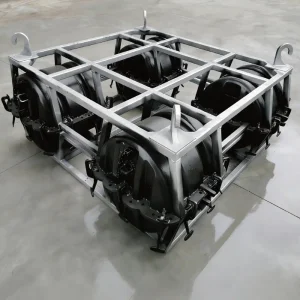
Leading suppliers manufacture custom tank molds using CNC-machined forged A356 aluminum or heavy plate structural steel weldments. Tooling cycle times from initial 3D CAD design approval to first off-tool sample are compressed to 25–35 days—half the industry average in Western markets.
Before ocean freight shipment, top Chinese water tank factories execute 100% hydrostatic water pressure testing, ultrasonic non-destructive wall thickness mapping across top dome, sidewalls, and knuckle radiuses, and Low-Temperature Dart Drop Impact Testing (per ARM standards).
Navigating regional water tank standards, transport logistics efficiency, and international certification demands.
Global demand for high-capacity polyethylene water storage tanks is expanding at a CAGR of 6.8% annually, driven by water security initiatives, agricultural expansion in arid regions, and industrial chemical processing needs. However, compliance standards vary significantly by destination region:
Procurement for North American markets demands strict adherence to ASTM D1998 (Standard Specification for Polyethylene Upright Storage Tanks). Wall thickness design factors must account for liquid specific gravity (ranging from 1.2 to 1.9) with mandatory minimum hoop stress ratings.
European buyers mandate EN 13341 certification for static thermoplastic tanks. Focus centers on fire retardancy, eco-design recyclability under EU REACH standards, and strict zero-flotation ground anchoring requirements for underground tanks.
Tanks deployed in GCC desert climates experience ambient temperatures exceeding 50°C and severe UV radiation. Quotes must explicitly verify UV-20+ stabilizer compounding and light-blocking inner black carbon layers to inhibit algae growth inside potable tanks.
Answers to essential technical, logistics, and pricing queries when requesting factory quotes for rotomolded water tanks and machinery.
Factory pricing is primarily derived from resin weight (kg of virgin LLDPE/HDPE powder required per tank), oven heat cycle time (energy consumption), specialized color/UV additive loading percentage, wall thickness complexity, and packaging volume. For machinery buyers, pricing reflects arm loading capacity, oven diameter, burner thermal rating, and PLC automation features.
Fabricated steel tank moulds typically take 20–30 days, while precision CNC cast aluminum moulds require 30–40 days. Standard Shuttle or Carousel rotomolding machines require 45–60 days for assembly, wiring, PLC programming, and factory dry-run testing before ocean shipment.
Rotational moulding requires significantly lower tooling costs (often 60–80% less than injection or large blow molds) because the process operates under atmospheric pressure. Furthermore, rotomolding creates continuous, stress-free wall corners with increased wall thickness at external radii, where stress concentration is highest.
Engineers optimize the biaxial rotation ratio (major to minor axis speed, typically set between 4:1 and 3:1) and apply strategic external thermal insulation jackets or heat deflectors on the mould surface during rotation to balance heat transfer across thick and thin sections.
For liquid with a specific gravity of 1.0 (potable water), a 10,000L vertical tank typically requires a nominal wall thickness of 8.0 mm to 10.0 mm at the base knuckle region, tapered gradually toward the top roof dome per ASTM D1998 hoop stress calculations.
Leading manufacturers design "nestable" conical tank geometries or offer modular split-mold solutions that nest together inside sea containers (40ft High Cube), maximizing container volumetric filling efficiency by up to 300% compared to rigid cylindrical tanks.
Explore our extended portfolio of CE-certified Rock & Roll ovens, automated feeding systems, pelletizing machinery, and custom industrial moulds.