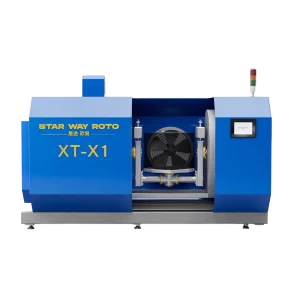
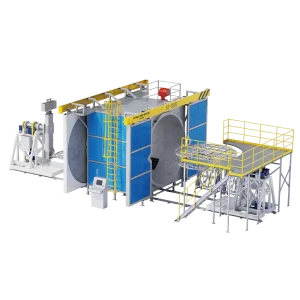
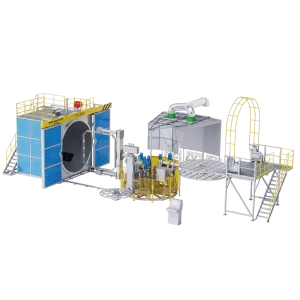
Explore our core machinery lineup engineered for seamless integration into high-volume plastic manufacturing plants.
Understanding the mechanical physics, arm index dynamics, and heating transfer efficiency of modern rotational molding carousel machinery.
Rotational molding (rotomolding) has evolved from a niche hollow-part manufacturing technique into a dominant global technology for producing large-scale, stress-free, seamless plastic components. When industrial processors intend to buy rotational molding carousel machine equipment from qualified manufacturers, they are making a strategic capital investment designed to maximize throughput, optimize thermal energy consumption, and guarantee dimensional uniformity across multi-cavity toolings.
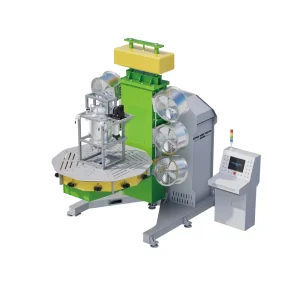
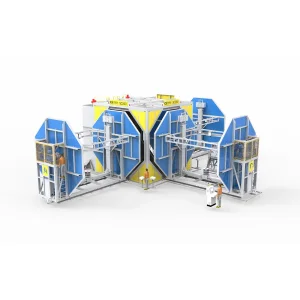
At the center of high-volume rotomolding operations is the Carousel Rotomolding Machine. Unlike shuttle or swing-type systems, carousel machinery utilizes a central indexing pivot around which multiple mechanical arms (typically 3 to 5 independent or fixed arms) rotate sequentially through distinct operational stations: Heating (Oven), Pre-Cooling, Secondary Cooling, and Loading/Unloading/Servicing.
When selecting a manufacturer, global procurement teams must distinguish between two primary structural methodologies:
Each arm is driven by dedicated servo motors and indexing drives. Arm A can remain inside the heating oven for 14 minutes running heavy wall-thickness water tanks, while Arm B completes cooling in 10 minutes, and Arm C undergoes demolding. This eliminates bottle-necking caused by symmetrical cycle times and optimizes overall thermal throughput.
All arms move simultaneously at identical intervals. While fixed arm designs feature lower initial machinery acquisition costs, they require precise mold pairing so that heating and cooling times across all arms match perfectly. Fixed systems are ideal for high-volume, single-product manufacturing runs (e.g., standard 1000L septic tanks or traffic cones).
| Machine Type | Production Throughput | Mold Flexibility | Energy Efficiency | Ideal Application Profile |
|---|---|---|---|---|
| Independent Arm Carousel | Maximum (Continuous 24/7) | Very High (Different mold sizes/arm) | High (Sealed thermal chamber) | Mass production of varied commercial/industrial plastic goods. |
| Fixed Arm Carousel | High (Synchronized rotation) | Moderate (Requires uniform cycle times) | High (Optimized oven utilization) | Standardized mass production with uniform mold sets. |
| Shuttle Machine | Moderate (2 arms, linear motion) | High (Independent shuttle speed) | Moderate (Oven doors open frequently) | Large custom hollow parts, short-run custom projects. |
| Rock & Roll Machine | Low to Moderate | Low (Single narrow axis) | Moderate to Low | Extremely long, cylindrical items (Pipes, large kayaks, fuel tanks). |
Analyzing the macro-economic benefits, engineering precision, and supply chain integration available when sourcing from leading Chinese equipment builders.
Chinese manufacturing hubs—such as Ningbo and Changzhou—host complete rotomolding industrial clusters. Within a 50-kilometer radius, machine builders source high-torque Italian-designed reducers, custom CNC machined aluminum molds, burner technology (Riello/Weishaupt), and specialized PE resin micronizing systems, drastically reducing production lead times.
Leading Chinese rotomolding machinery companies hold tens of national invention patents covering pneumatic oven door seals, internal wireless temperature monitoring tools (TPM systems), direct-electric heating chambers, and heavy-load arm offset balancing counterweights that ensure vibration-free bi-axial rotation.
Direct procurement from established Chinese original equipment manufacturers (OEMs) provides global buyers with a 35% to 50% cost advantage over North American or European machine makers. This allows processors to achieve payback on capital expenditure (CapEx) in under 18 months while acquiring top-tier machinery components.
From custom arm offset configurations to complete factory floor automation (including automatic polymer powder weighing, vacuum loading systems, cooling chamber airflow regulators, and automated part ejectors), Chinese suppliers deliver customized turnkey processing lines tailored to precise operational goals.
How automation, sustainable heating energy, and advanced polymer thermodynamics are reshaping the rotational molding industry globally.
Modern carousel machinery integrates Siemens or Allen-Bradley PLCs coupled with internal mold temperature sensors (TPM). Real-time telemetry measures air temperature inside the hollow mold cavity, identifying exact polymer melt, crystallization, and peak internal air temperature (PIAT) phases. This eliminates guesswork and ensures consistent physical properties in polyolefin components.
In response to stringent environmental regulations and carbon emission compliance standards in Europe and North America, advanced manufacturers have pioneered clean electric heating ovens. Utilizing high-efficiency infrared heating element arrays and forced thermal convection loops, these machines reduce energy consumption by up to 25% compared to legacy natural gas or diesel burners.
Demand for specialized multi-layer hollow products—such as fuel tanks with low-permeability barrier layers, insulated ice boxes with polyurethane/PE foam cores, and antimicrobial water tanks—is rising. Modern carousel rotomolding equipment accommodates automated drop-box systems mounted directly on the rotating arms for precise multi-material dosing during processing.
From municipal water storage to military-grade transit cases, carousel machines power diverse product sectors worldwide.
Vertical and horizontal storage tanks ranging from 500 liters up to 20,000 liters. Carousel systems ensure wall thickness uniformity at tank ribs and threaded outlet points, preventing environmental stress cracking (ESCR) under long-term hydrostatic pressure.
Large double-chamber underground septic tanks, inspection wells, grease traps, and heavy-duty waste management containers. The continuous rotation cycle of carousel machinery allows massive steel mold assemblies to cure evenly.
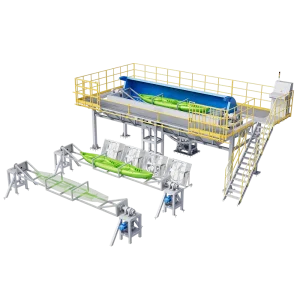
High-end double-walled kayaks, canoes, dock floats, marine navigation buoys, and heavy-duty insulated cooler boxes. High aesthetic surface finishes are achieved through precision cast-aluminum tooling mounted on independent carousel arms.
Diesel fuel tanks for tractors and heavy excavators, cabin roofs, air intake ducts, ad-blue tanks, and impact-resistant military transport cases certified for extreme climate durability.
Essential engineering standards and validation protocols for global procurement teams evaluating rotational molding machinery vendors.
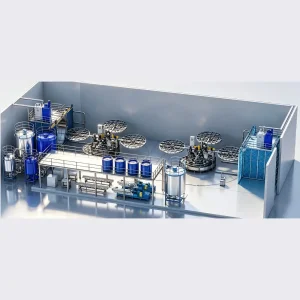
Implementing a new rotomolding line requires structured plant architecture to maintain workflow safety and operational efficiency:
Before issuing a Purchase Order (PO) to any international rotomolding machinery manufacturer, confirm the following technical benchmarks:
Discover specialized laboratory testing machines, shuttle systems, and custom tooling designed to complete your production facility.
Clear, engineering-backed answers addressing critical procurement queries regarding rotational molding carousel equipment.