StarWayRoto
Request a Catalog

OEM Watertight Tester Companies, Products

Product Description

I. Product Applications

The automatic watertight testing system is purpose-built for end-of-line sealing inspection of rotationally molded (roto-molded) PE fuel tanks and other hollow roto-molded parts.
It quickly and reliably detects defects such as micro-pores, parting-line leaks, and leaks at embedded threaded inserts on the production line, ensuring products are free from leakage and seepage.
The system supports mainstream test methods:

Bubble-Test Method

(Immersion leak test) Low-pressure compressed air is injected into the tank, which is then fully submerged in a water tank; escaping bubbles visually pinpoint the leak location.

Hydrostatic Pressure Test

Water is filled and pressurized inside the tank to verify pressure resistance and watertight performance; suitable for standard tests such as marine fuel tanks.

Dry Leak Test (Optional)

An optional differential-pressure airtightness tester enables dry leak testing without immersion, meeting high-cleanliness requirements.

II. Core Advantages

  • Solves Flexible-Shell Expansion Challenge: A built-in anti-bulge support frame limits tank swelling and prevents rupture during air/pressure loading - essential for large marine roto-molded fuel tanks.
  • Reliable, Quick-Change Port Sealing: Quick-clamp sealing plugs with oil-resistant silicone O-rings and integrated air/water channels; plug modules are interchangeable for multiple tank sizes, so one fixture covers many products.
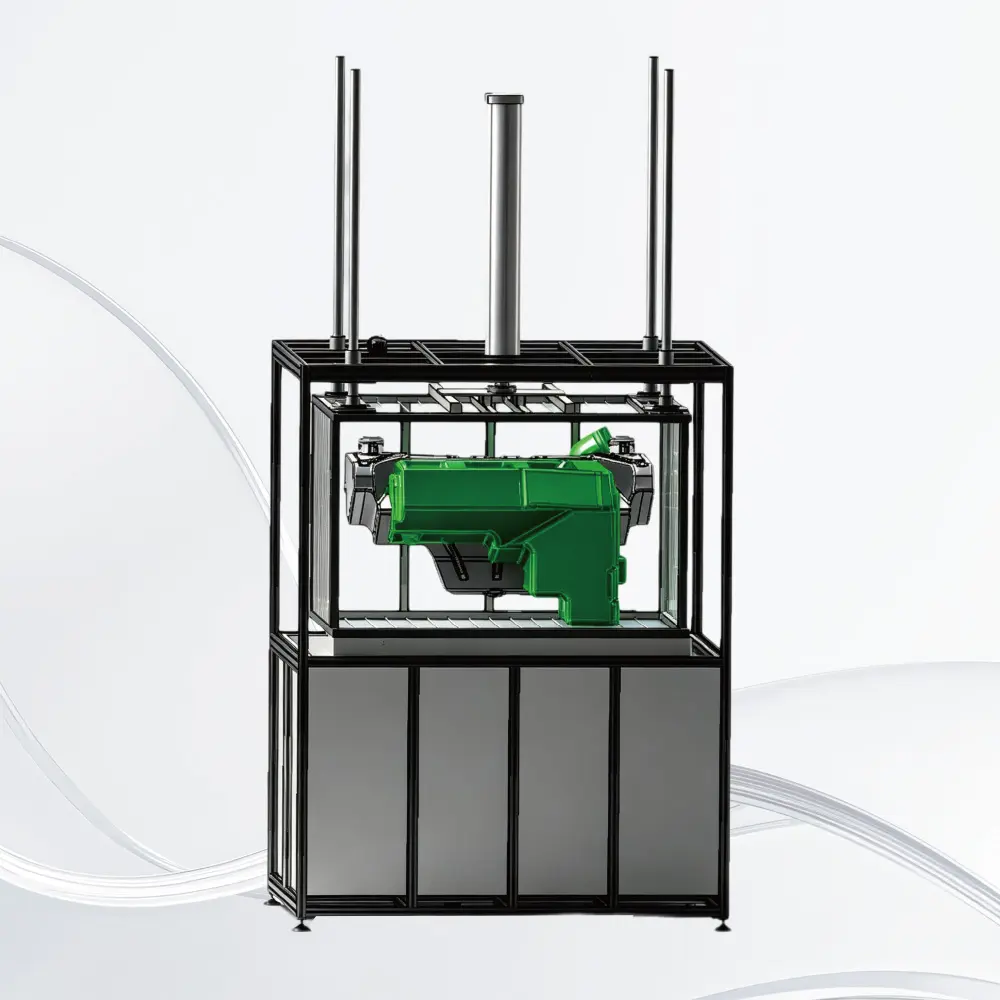
  • Automated Immersion Solution: Two frame layouts - "fixture descends into water" and "water tank rises to submerge" - paired with overflow troughs, water circulation, and waterproof lighting for clearer bubble observation and easier operation.
  • Multi-Method Compatibility: Integrated bubble (airtight immersion), hydrostatic (pressure), and differential-pressure (dry) leak testing, flexibly selectable as needed.
  • Complies with Marine Standards: Standard test pressure 0.02-0.05 MPa (20-50 kPa); marine fuel tanks can be tested per ABYC at 3.5 PSI; the test process is recordable and traceable.
  • Modular and Expandable: Plugs, frames, racks, and control units can be flexibly combined to match production tact time and product specs, allowing easy future expansion and upgrades.

III. Standard Configuration

1. Port Sealing Plugs (Key Wear Parts)

Adapt to filler necks, sensor flanges, inlet/outlet ports, and vent ports; quick-clamp structure with oil-resistant silicone O-rings and integrated air/water channels, connected to external air supply or booster pump; optional quick-couple (eccentric/cam or pneumatic clamp) or threaded plugs.

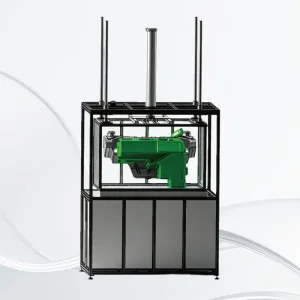
2. Anti-Bulge Tank Support Frame

The basic version is an external limiting frame (square-tube welded with limit blocks); the premium version is a profiled clamping cavity (upper/lower dies conforming to tank shape, pneumatically clamped) that effectively limits expansion deformation. Mandatory for large marine roto-molded fuel tanks.

3. Rack and Water Tank System

Option A: Fixed water tank + lifting bracket - the fixture clamps the tank and descends into the water.
Option B: The tank is fixed while the water tank rises to submerge the product. Equipped with overflow trough, water circulation, and waterproof lighting for bubble observation.

4. Power and Control Unit

For bubble (airtight immersion) testing: pressure regulator, pressure gauge, and hold-time timer.
For hydrostatic/pressure testing: electric booster pump, pressure acquisition, and relief protection.
Optional differential-pressure airtightness tester (dry leak testing).
GET IN TOUCH WITH US
+86-13566388950

Frequently Asked Questions (FAQ)

1. What test methods are supported by this automatic watertight testing system?
The system supports bubble-test immersion leak testing, hydrostatic pressure testing, and an optional differential-pressure dry leak testing method for applications requiring high cleanliness.
2. How does the system prevent large PE fuel tanks from deforming during pressure testing?
It features a built-in anti-bulge tank support frame available in standard welded limit structures or profiled pneumatic clamping cavities. This restrains tank swelling and prevents rupture during pressure loading.
3. Can a single testing rig handle multiple sizes of roto-molded products?
Yes. The system utilizes quick-change port sealing plugs with interchangeable modules, allowing one setup to accommodate multiple tank models and port configurations easily.
4. Does the testing system meet marine industry standards?
Yes, it supports standard test pressures from 0.02 to 0.05 MPa (20-50 kPa) and complies with ABYC testing standards at 3.5 PSI for marine fuel tanks, complete with traceable test data.
5. What automated immersion options are available for bubble testing?
We offer two structural options: one where the product fixture descends into the water tank, and another where the water tank elevates to submerge the fixed product. Both include automated circulation and waterproof lighting.

Related Products