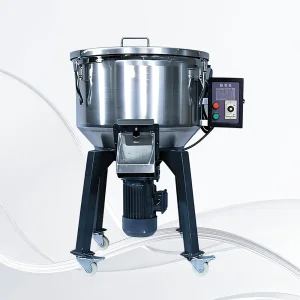
Explore engineered shuttle, carousel, and Rock N Roll machinery directly exported from leading manufacturing facilities.
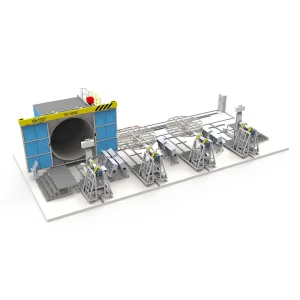
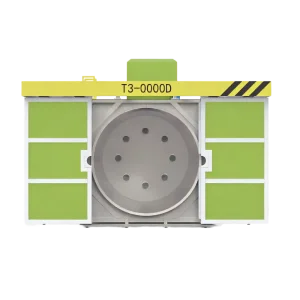
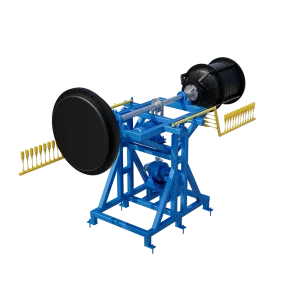
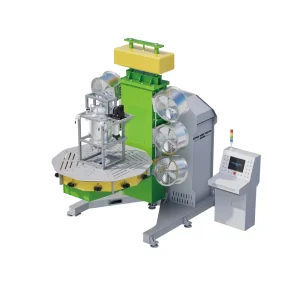
Evaluating structural advantages, spatial efficiency, and total cost of ownership for heavy industrial polymer processing.
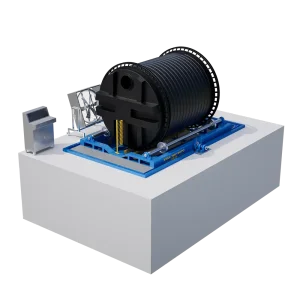
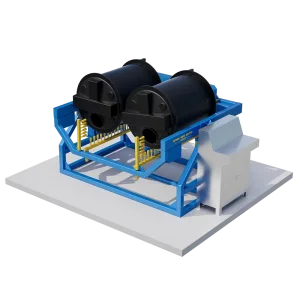
In the specialized domain of rotational molding (rotomolding), the Rock N Roll machine occupies a critical technological niche. Unlike traditional carousel or multi-arm independent shuttle systems that execute full 360-degree rotations on both major and minor axes, Rock N Roll machinery utilizes a full 360-degree rotational movement on the longitudinal axis combined with a rocking (tilting) action along the transverse axis (typically swinging within an arc of ±45° to ±90°). This unique kinematic configuration makes Rock N Roll machines uniquely suited for manufacturing long, slender, large-scale hollow plastic articles such as chemical storage tanks, septic systems, kayaks, drainage culverts, fuel cells, and agricultural liquid vessels.
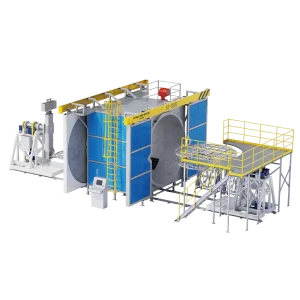
From an engineering and asset management standpoint, procuring an OEM Rock N Roll Machine provides global buyers with an unparalleled ratio of volumetric capacity to capital expenditure. Traditional carousel machines capable of housing a 10,000-liter or 20,000-liter tank mold require massive vertical headroom (often exceeding 10 to 12 meters) and a sprawling floor footprint. Conversely, a Rock N Roll machine operates horizontally, drastically cutting building height requirements and lowering facility construction costs by up to 35%.
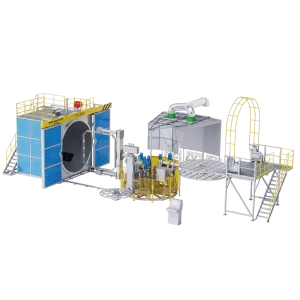
Traditional carousel rotomolding machines generate uniform wall thickness by continually rotating molds across two perpendicular axes in a spherical path. However, when molding high-aspect-ratio objects (length-to-diameter ratio > 3:1), two-axis rotation wastes immense energy heating empty oven space. Rock N Roll systems utilize targeted directional rocking to move liquid resin along the length of the cylinder while rolling coats the perimeter, saving up to 42% in heating gas consumption.
Globally, demand for industrial-grade Rock N Roll rotomolding equipment is accelerating. Regional infrastructure projects across North America, Latin America, Southeast Asia, and the Middle East are placing heavy orders for steel-lined plastic storage vessels, chemical transport containers, and agricultural water management tanks. As international buyers seek accurate OEM Rock N Roll machine quotes, understanding the underlying technical specifications, manufacturing standards, and direct factory exporter pricing structures becomes vital for procurement success.
An in-depth breakdown of heating methods, rocking mechanics, PLC automation, and polymer melt kinematics.
OEM Rock N Roll exporters supply two main heating configurations: Open-Flame direct gas burner systems for economical manufacturing of large tanks/liners, and Enclosed Insulated Oven systems for high-precision polymers (LLDPE, HDPE, XLPE, PP, PA6/PA12) requiring tightly regulated thermal environments.
Variable frequency drive (VFD) motors power the primary rolling spindle (0 to 12 RPM precision adjustment) and the heavy-duty hydraulic or gear-driven tilting mechanism (+/- 45° to +/- 90°). Synchronized motion profile prevents resin pooling and eliminates thin spots along tank heads and sidewalls.
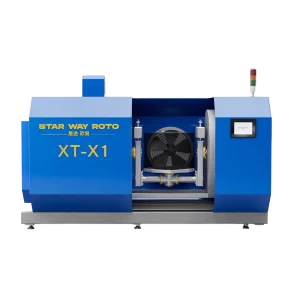
Modern OEM units integrate Siemens or Schneider PLC systems with intuitive multi-language Touchscreen HMI interfaces. Features include multi-stage heating curves, internal mold temperature monitoring (wireless thermocouples), automated burner modulating control, and real-time fault diagnostics.
When requesting quotes from a machinery exporter, engineering teams must evaluate structural and thermal metrics across machine series:
| Machine Parameter | Standard Open Flame (RNR-OF) | Enclosed Smart Oven (RNR-SO) | Heavy-Duty Tank Line (RNR-HD) |
|---|---|---|---|
| Max Product Length | 3,000 mm – 12,000 mm | 2,000 mm – 8,000 mm | 6,000 mm – 16,000 mm |
| Max Product Diameter | 1,500 mm – 3,500 mm | 1,200 mm – 3,000 mm | 2,500 mm – 5,000 mm |
| Maximum Mold Weight | 2,500 kg | 3,500 kg | 8,000 kg – 15,000 kg |
| Heating Source Options | Natural Gas / LPG / Diesel | Natural Gas / LPG / Electric / Infrared | Dual-Fuel Heavy Burner Systems |
| Rocking Angle Range | 0° to ± 45° (Hydraulic) | 0° to ± 60° (Servo Controlled) | 0° to ± 90° (Heavy-Duty Gear Drive) |
| Rotation Speed Range | 0 – 10 RPM (VFD) | 0 – 14 RPM (VFD) | 0 – 8 RPM (High Torque VFD) |
| Cooling System | Ambient Air + High Velocity Fan | Enclosed Cooling Chamber + Water Mist | Dual Industrial Blower + Internal Air Injection |
Why global polymer fabricators choose direct OEM partnership with Ningbo and Zhejiang industrial hubs.
When sourcing industrial machinery globally, procurement managers must weigh machinery purchase cost, build quality, customization speed, and long-term aftermarket support. China has established itself as the world's preeminent manufacturing hub for rotational molding equipment, led by high-density industrial clusters in Ningbo and Zhejiang province.
Top-tier Chinese OEM exporters operate within dense industrial ecosystems. Steel plate cutting, precision CNC mold machining, drive spindle forging, burner system assembly, and PLC panel building are executed within close geographic proximity, reducing production lead times by 40% compared to Western manufacturers.
Purchasing an OEM Rock N Roll machine directly from China factory suppliers yields up to 45% initial CapEx savings. Lower capital outlay allows plastic processors to expand factory floor capacity, invest in automated resin pulverizers/mixers, and achieve faster ROI break-even milestones.
Chinese OEM exporters specialize in tailored machinery configurations. Whether a client requires ultra-long structural frames for 15-meter pipes, specialized dual-burner heads for ultra-thick tank walls, or custom spider frames for rapid mold changeovers, Chinese engineering teams deliver bespoke solutions without exorbitant custom engineering fees.
Furthermore, accredited exporters maintain strict alignment with global quality standards, offering CE Certification, ISO 9001:2015 Quality Management, and UL/CSA compliant electrical enclosures. Remote IoT diagnostics modules installed on exported machines allow factory engineers in China to monitor sensor telemetry, update PLC software, and assist local maintenance crews in real-time across time zones.
How Rock N Roll rotational molding technology powers critical industrial, agricultural, and civil sectors.
Primary Use Case: Fabrication of vertical and horizontal polyethylene (PE) storage tanks ranging from 1,000 liters up to 50,000 liters.
Technical Edge: Rock N Roll machines allow precise resin flow during heating, resulting in seamless, stress-free double-wall chemical tanks resistant to aggressive acids and alkalis.
Primary Use Case: Single, tandem, and fishing kayaks, canoes, floating pontoons, and marine marker buoys.
Technical Edge: Slender hull profiles are ideally matched to the long horizontal chamber of Rock N Roll machines, ensuring uniform keel thickness and high impact resistance.
Primary Use Case: Heavy-duty ribbed underground wastewater septic tanks, inspection chambers, and stormwater culverts.
Technical Edge: Deep rib structures require controlled rocking cycles to ensure resin fills high-stress rib corners without void formation or wall thinning.
Primary Use Case: Heavy-duty road safety barriers, large traffic cones, industrial ducting, and refuse containers.
Technical Edge: Ability to run multi-cavity molds simultaneously on a single Rock N Roll spindle frame, maximizing hourly output while keeping operational labor minimal.
Next-generation innovations transforming energy efficiency, automation, and material compatibility.
The global rotational molding sector is experiencing a technological evolution driven by sustainability mandates, rising energy costs, and the demand for Industry 4.0 smart factory integration. OEM exporters are actively embedding cutting-edge advancements into Rock N Roll equipment lines:
Transitioning from traditional hydraulic rocking systems to direct-drive high-torque servo motors reduces electrical power consumption by up to 28%. Additionally, eco-friendly electric burner ovens and ceramic infrared heating cowls eliminate direct carbon emissions, enabling factories to meet stringent ISO 14001 environmental targets.
By embedding wireless RF thermocouples directly inside mold cavities during the rocking cycle, operators get real-time data on polymer powder melt, peak internal air temperature (PIAT), and crystallization cooling windows. This eliminates guessing games, reduces cycle times by 15%, and prevents thermal degradation of resin.
Next-gen OEM export lines feature automated resin loading hoppers and pneumatic/hydraulic mold clamping mechanisms. Automatic clamping cuts mold loading and unloading times from 30 minutes to under 4 minutes, significantly increasing daily throughput for large-scale tank production.
A systematic step-by-step roadmap for global purchasing teams to secure optimal machine specifications and pricing.
Procuring heavy industrial machinery across international borders requires rigorous vendor vetting and accurate RFQ (Request for Quotation) documentation. Global buyers should follow this structured purchasing checklist when contacting OEM machinery exporters:
A competitive initial machine quote is only one component of lifetime machinery asset cost. Procurement teams should evaluate total lifecycle investment using the following framework:
TCO = CapEx (Machine + Freight + Import Duty) + OpEx (Gas/Electric kWh + Labor + Maintenance) - Residual Machine Asset Value
By partnering with established Chinese OEM exporters, buyers achieve a lower initial CapEx, reducing interest expense on capital loans while benefiting from readily available, low-cost replacement spare parts (burners, sensors, bearings, VFD drives).
Detailed answers to essential technical, operational, and commercial questions from prospective global buyers.
Direct access to specialized lab machines, open flame units, steel-lined tank systems, and custom shuttle equipment.