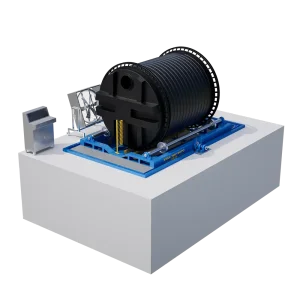

Rotational moulding platforms, rock-and-roll tooling systems, laboratory QA stations, and hydrostatic testing apparatus engineered for large-volume subterranean tank manufacturing.
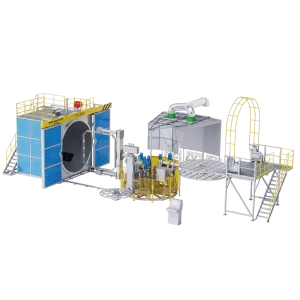
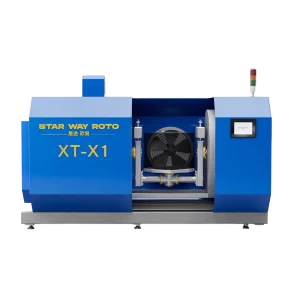
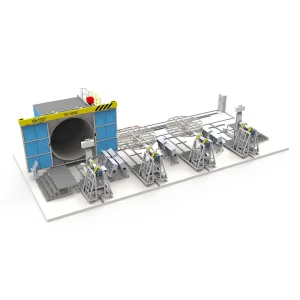
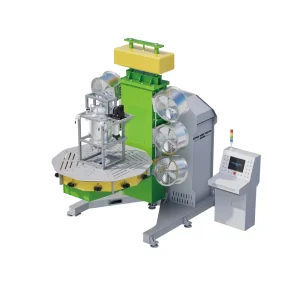
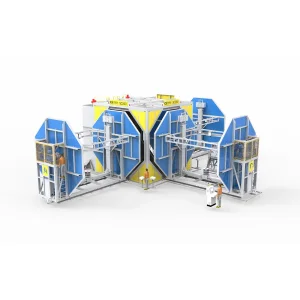
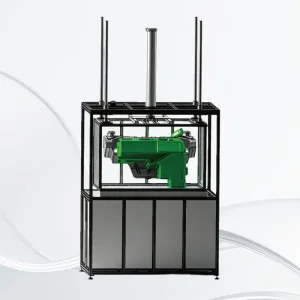
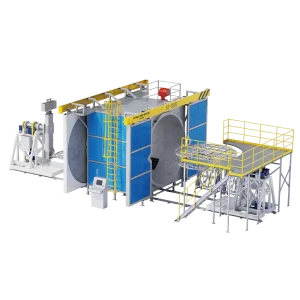
Subterranean septic tanks endure severe environmental stresses: lateral hydrostatic earth pressure, soil settlement shear forces, dynamic surface wheel loads, and internal biogenic sulfuric acid corrosion. Mould design is the decisive factor determining wall thickness distribution, rib structural rigidity, and cycle efficiency.
Fabricated carbon steel tooling delivers an economical initial investment for cylindrical holding vessels but suffers from localized hot spots, differential shrinkage, and welding fatigue. Cast aluminum A356 tooling, CNC-machined on multi-axis gantries, offers superior thermal conductivity (160 W/m·K vs 50 W/m·K for mild steel), cutting oven dwell times by up to 28% and eliminating warp-inducing temperature gradients.
A septic tank's hoop stiffness depends on structural corrugation geometry rather than raw wall thickness. Top-tier mould makers utilize Finite Element Analysis (FEA) to engineer continuous deep-rib arches with sinusoidal or trapezoidal geometries. Maintaining a minimum draft angle of 3° to 5° along rib valleys ensures smooth demoulding while preserving structural depth to resist underground soil overburden.
Large hollow polyethylene septic shells (1,000L to 10,000L) generate high internal gas pressures during the resin curing phase. Moulds engineered with high-temperature PTFE-packed breather pipes and multi-stage venting prevent backpressure blowouts, pinholes, and thin spots in deep rib roots, ensuring airtight polymer skin consolidation.
| Tooling Metric | Cast Aluminum A356-T6 Tooling | Fabricated Structural Steel Tooling | CNC Billet 6061-T6 Aluminum |
|---|---|---|---|
| Thermal Conductivity | 150–170 W/(m·K) (Rapid heat dissipation) | 45–55 W/(m·K) (Uneven thermal cycles) | 170–190 W/(m·K) (Maximum uniformity) |
| Geometric Complexity | Extremely High: Integrated ribs, baffle slots, manholes | Moderate: Simple cylinders & welded stiffeners | Ultra-High: Complex parting lines & textures |
| Cycle Time Efficiency | Fast 22–32 min curing cycle | Standard 35–50 min curing cycle | Optimal 20–28 min curing cycle |
| Lifespan & Durability | 8,000 to 15,000 moulding cycles | 3,000 to 6,000 cycles (weld fatigue prone) | 15,000+ cycles (high capital outlay) |
| Target Application | High-volume ribbed residential & commercial tanks | Low-budget industrial holding vessels (>10,000L) | Precision components, multi-chamber modular tanks |
Combining vertically integrated CNC pattern-making, robotic casting foundries, and the world's largest rotational machine manufacturing capabilities to deliver industrial septic tank tooling at scale.
Procuring rotational moulds for large-scale wastewater vessels requires more than basic foundry casting. It demands rigorous mechanical calculations, precise shrinkage compensation algorithms, and integrated machine compatibility. Headquartered in Ningbo, China, Ningbo StarWay Roto Co., Ltd. (operating from a modern 20-acre production plant) stands at the pinnacle of this industry sector. With over 23 proprietary patents and an engineering leadership team bringing more than 23 years of rotational moulding experience, StarWay Roto delivers a vertically integrated manufacturing ecosystem.
The Ningbo marine and plastic machinery industrial cluster provides StarWay Roto with an unmatched supply chain advantage. From high-grade A356 aluminum ingot smelting to 5-axis gantry CNC machining centers capable of milling 12-meter mould split lines in a single setup, tooling development lead times are cut from European industry averages of 16–24 weeks down to just 6–8 weeks. Global buyers achieve a 40% to 55% reduction in total capital expenditure without sacrificing dimensional stability, wall thickness consistency, or parting-line sealing tolerances.
Establishment of Jinlei Rotomolding Co., Ltd., laying the foundation for StarWayRoto's precision engineering.
Delivered the first proprietary industrial rock-and-roll machine for seamless fluid storage tanks.
Founded Changzhou Yuanhuai Rotational Molding Co., Ltd., expanding tooling automation and CNC pattern shops.
Established Taizhou OE Technology Co., Ltd., integrating advanced smart heating sensors and laboratory test rigs.
Engineered and commissioned the S2-8500, officially recognized as the world's largest rotomoulding machine.
Accredited as a National High-Tech Enterprise, holding 23 proprietary rotomoulding invention patents.
Municipal wastewater utilities and environmental protection agencies enforce zero-tolerance thresholds for septic tank leakage, sidewall buckling, and joint rupture. Tooling accuracy directly governs compliance testing success.
Mandates rigorous hydraulic efficiency, water-tightness (vacuum and hydrostatic pressure tests), and structural crushed-gravel backfill stability. Moulds built by StarWay Roto incorporate computer-modeled chamfer radii along external rib corners, mitigating the notch stress concentrations that typically trigger failure during CE-mandated pit-drop and pit-fill load tests.
Governs prefabricated septic tanks regarding minimum wall thickness distributions, load-bearing risers, and negative pressure integrity. Precision mould design ensures that integrated access turrets, baffle wall slots, and rubber gasket sealing profiles maintain concentricity tolerances within ±0.75mm across the entire circumference.
Focuses on long-term creep performance under high ground-water tables and intense ultraviolet exposure. Mould architectures engineered for this market feature modular wall-thickness adjusters, reinforced rib stiffeners, and specialized lifting lug cavities capable of withstanding lateral soil creep loads exceeding 50 years.
From three-layer foam co-extrusion tooling to smart IoT-enabled thermal cycle monitors, modern rotational moulding is transitioning from artisanal craftsmanship to automated industrial science.
Traditional monolithic polyethylene septic tanks require heavy wall thicknesses (12mm to 18mm) to withstand underground earth pressure, driving up raw material resin costs. Leading factories now utilize multi-layer drop-box moulds that form an outer solid PE shell, a foamed microcellular PE insulating/stiffening core, and a smooth anti-fouling inner skin. This sandwich architecture increases flexural rigidity by up to 300% while cutting total resin consumption by 22%.
Over-curing results in brittle polyethylene with diminished impact resistance; under-curing leads to residual porosity and stress cracks. StarWay Roto integrates wireless telemetry sensors directly into mould cavities, monitoring real-time PIAT curves. Operators optimize oven cycles dynamically, ejecting the tank at the precise polymer crystallization window (typically 195°C to 205°C for linear low-density polyethylene).
Rather than commissioning separate moulds for 1,500L, 3,000L, and 5,000L tanks, modern procurement favors modular sectional tooling. Interchangeable middle barrel rings allow a single set of end domes to produce varying holding capacities, slashing capital investment and optimizing factory floor footprint by 40%.
Manual mould opening using impact wrenches slows cycle times and damages mating flange surfaces. StarWay Roto equips industrial moulds with integrated pneumatic clamps, perimeter air-injection ports, and hydraulic push-rods that pop large cured tanks cleanly from deep female rib pockets in under two minutes.
Rotomoulded septic tanks face radically different operational hazards across global installation sites. Mould geometry must adapt to local hydrological and geological conditions.
In coastal zones and flood-prone floodplains, empty septic tanks act as buoyancy vessels, vulnerable to popping out of saturated ground. Moulds engineered for these markets feature wide, horizontal anti-flotation anchoring wings along the bottom perimeter, enabling soil backfill ballasting without the need for expensive concrete deadman anchors.
Northern European and Canadian sites subject underground vessels to severe cyclical frost heave. Tooling configurations produce spherical or parabolic end domes that dissipate compressive lateral ice expansion forces, preventing tank collapse and crack propagation at inlet/outlet pipe penetration seals.
In developing rural infrastructure and off-grid remote projects, water conservation is paramount. StarWay Roto designs specialized dual-chamber and three-chamber septic moulds featuring integrated anaerobic filter compartments, aerobic microbial media baffles, and conical sludge sumps for streamlined effluent digestion.
A rigorous technical checklist for sourcing directors, municipal procurement committees, and plant managers evaluating rotomoulding tooling suppliers.
Direct, engineering-backed answers addressing the most critical semantic search queries in septic tank mould manufacturing.
For Linear Low-Density Polyethylene (LLDPE) and High-Density Polyethylene (HDPE) commonly utilized in rotomoulding underground septic vessels, volumetric shrinkage typically spans 2.8% to 3.5%. Tooling CAD models generated by StarWay Roto incorporate non-linear, anisotropic shrinkage compensation algorithms—applying varying scale factors across vertical corrugation ribs versus horizontal flat manhole risers to prevent dimensional warping.
Localized wall thinning in deep corrugation ribs occurs when resin powder fails to roll freely into narrow channels before sintering begins. To resolve this, StarWay Roto applies a minimum rib-root radius of 15mm–25mm, opens draft angles to at least 4 degrees, and incorporates localized thermal-insulating coatings or external heating assist baffles on the mould exterior to ensure balanced powder adhesion.
For large cylindrical or horizontal septic tanks exceeding 3,000L, an Open-Flame Rock-and-Roll machine or an Enclosed Oven Shuttle rotomoulding machine is ideal. Rock-and-roll systems provide low capital expenditure and excellent heating efficiency for long tubular tanks, while large shuttle machines (such as StarWay's heavy-duty arm units) provide closed-loop digital recipe control and high output consistency.
All septic tank moulds undergo a rigorous multi-stage validation: initial CNC contact profile measurement, laser CMM scan verification, and a dry clamp-seal pressure check. Furthermore, first-article production units undergo full hydrostatic hold tests using OEM Watertight Testers, filled with water for 24 hours under negative and positive pressure heads according to ASTM C1227 guidelines.
Yes. StarWay Roto designs dual-configuration septic moulds featuring internal divider baffle insert systems. Plants can mould a seamless monolithic outer shell with molded-in internal slide grooves, allowing modular drop-in baffle walls, or utilize convertible tooling that rotates with the internal divider already in place for true multi-compartment digestion.
When constructed with premium A356-T6 grade aluminum alloy and maintained with proper mould release agents (semi-permanent siloxanes), a StarWay Roto cast aluminum mould delivers between 10,000 and 15,000 continuous moulding cycles. Fabricated steel frames and spring-loaded clamping lugs are engineered for high-duty operational longevity.
Explore heavy-capacity rotational moulding ovens, rock-and-roll platforms, and testing setups built for high-throughput tank manufacturing.
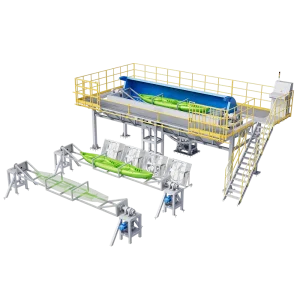
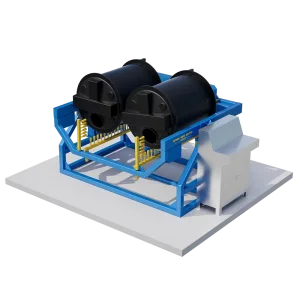
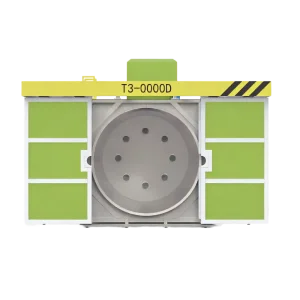
Why initial mould acquisition cost represents merely 15% of your manufacturing cost structure, and how thermal precision drives sustainable operational profitability.
In high-throughput rotational moulding plants, raw material resin consumption and oven heating energy dominate operational expenditures. Procuring a low-cost, substandard mould with uneven casting thickness creates structural cold spots, forcing plant managers to extend oven cooking times by 8 to 12 minutes per shot. Over an annual run of 3,000 cycles, this thermal inefficiency burns tens of thousands of dollars in surplus natural gas or electric power, while accelerating resin degradation.
By contrast, Ningbo StarWay Roto Co., Ltd. builds moulds with uniform wall sections, precision-machined parting lines, and balanced cooling channels. The result is a tank with predictable resin distribution, zero structural voids, and the shortest possible cycle time. With comprehensive after-sales commissioning, global engineering field support, and one-stop turnkey machine-mould integration, StarWay Roto empowers wastewater infrastructure manufacturers across North America, Europe, Australia, and 40+ countries to lead their domestic markets with certified, cost-effective septic solutions.