
Explore our state-of-the-art rotational molding machinery and engineered mold solutions deployed across global industrial infrastructure.
An authoritative analysis of the global rotational tooling supply chain, market economics, and enterprise manufacturing demand.
Rotational molding (rotomolding) has evolved from a niche plastic fabrication method into a core pillar of modern global manufacturing. At the heart of this process lies precision tooling—custom roto molded molds. Unlike high-pressure injection molding or blow molding tooling, rotational molds operate under low ambient pressure while subjecting polymers to continuous bi-axial rotation and rigorous thermal cycling (heating up to 300°C–350°C and forced air/water cooling down to room temperature). Consequently, the engineering parameters for custom rotomolding tools require an unyielding focus on thermal diffusivity, structural fatigue resistance, parting-line integrity, and micro-porosity control.
The global market for custom rotational molds is experiencing structural expansion, driven by accelerating demand across municipal infrastructure, agriculture, heavy automotive, marine vessels, and chemical logistics. Enterprise Original Equipment Manufacturers (OEMs) and Tier-1 suppliers are increasingly transitioning complex, multi-piece metal assemblies into seamless, hollow, single-piece plastic structures. This transition reduces assembly overhead, eliminates leak-prone weld lines, and radically improves corrosion resistance.
A comparative technical matrix evaluated from an operational procurement perspective: Cast Aluminum vs CNC Billet vs Fabricated Steel vs Electroformed Nickel.
| Tooling Technology | Primary Metallurgy | Thermal Conductivity | Dimensional Accuracy | Surface Finish Capabilities | Target Industrial Application |
|---|---|---|---|---|---|
| Cast Aluminum Molds | A356 / A357 Alloy | 160–180 W/m·K | ±0.5 mm | Cast texture, shot blast, fine satin | Complex 3D geometries, coolers, kayaks, playground equipment |
| 5-Axis CNC Billet Aluminum | 6061-T6 / 7075-T6 Alloy | 170–200 W/m·K | ±0.05 mm | Mirror polish (SPI A1), textured optical graining | High-precision automotive ducts, medical housings, defense enclosures |
| Fabricated Steel Molds | Q235 / SS304 / SS316 | 45–50 W/m·K | ±1.5 mm | Hand polished, Teflon (PTFE) coated | Large cylindrical tanks, IBC containers, septic vessels (>5,000L) |
| Electroformed Nickel Molds | Pure Micro-crystalline Nickel | 90 W/m·K | ±0.1 mm | Flawless micro-grained leather/wood reproduction | Automotive instrument panels, luxury armrests, grain-critical skins |
In high-performance rotomolding, standard thermal expansion of internal mold cavity air can cause pinhole defects, severe blow-out along parting lines, and wall thickness variance. Professional mold design incorporates dynamic, PTFE-lined fluoropolymer breather vents with calculated volumetric air-flow ratios ($V_{vent} \propto V_{cavity} \times \Delta T$). This prevents vacuum collapse during the cooling stage while guaranteeing zero pinhole formation in XLPE chemical tanks and multi-layer boat hulls.
Key technological transformations driving the next decade of rotational tooling innovation and smart factory integration.
Custom rotational mold engineering tailored to regional industrial demands across global markets.
From preliminary CAD mold-flow analysis to full-scale automated production lines—backed by 23+ patents and 15+ years of export excellence.
Ningbo StarWay Roto Co., Ltd. (established in 2009) operates a 20-acre modern manufacturing facility supported by an elite engineering team of over 40 technical experts. StarWay Roto offers enterprise clients a seamless, single-source ecosystem covering preliminary product design consulting, CAD/CAM surface modeling, Finite Element Analysis (FEA) thermal simulation, precision CNC mold casting, arm framework fabrication, and machine integration.
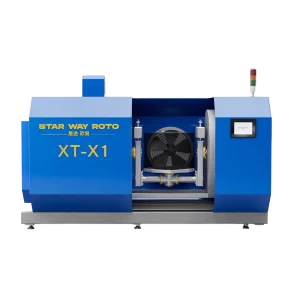
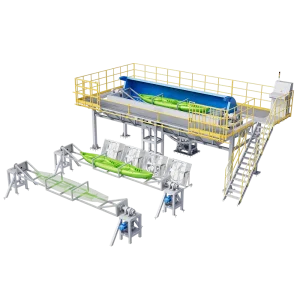
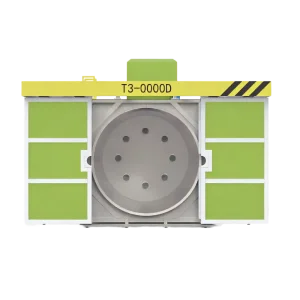
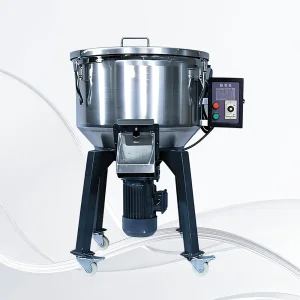
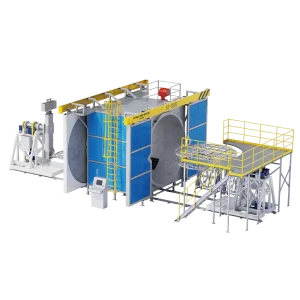
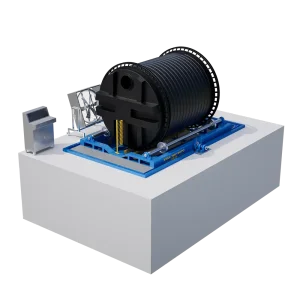
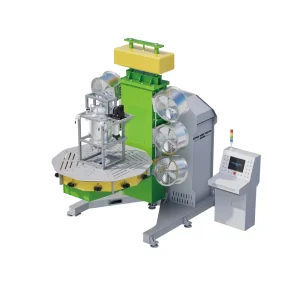
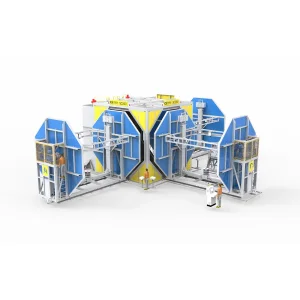
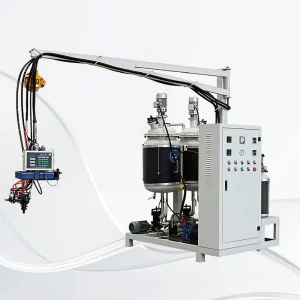
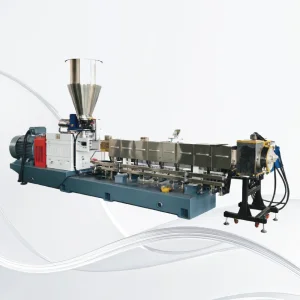
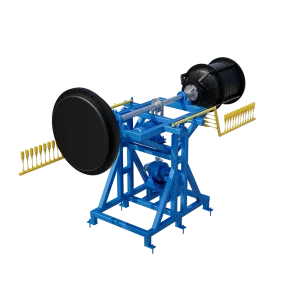
Explore our specialized shuttle machinery, heating ovens, pulverizers, and auxiliary processing units.

Expert answers to critical engineering, tooling metallurgy, and global export questions.
Standard production lead time for CNC cast aluminum rotational molds typically ranges from 45 to 65 calendar days depending on geometry complexity and mold dimensions. The process includes 3D CAD parameterization, pattern modeling, foundry A356 alloy casting, 5-axis CNC parting line milling, surface shot blasting or texture etching, and preliminary trial sampling (T1 testing).
Volumetric shrinkage varies by polymer grade: LLDPE shrinks approximately 1.5%–3.0%, Polypropylene (PP) 1.5%–2.5%, while Nylon (PA6/PA12) can shrink up to 3.5%. StarWay Roto's CAD design system incorporates non-uniform isotropic scaling factors along X, Y, and Z axes, adjusting wall angles and internal rib spacing to guarantee post-cooling dimensional conformance to ISO 20457 tolerances.
Fabricated steel molds (constructed from carbon steel Q235 or stainless steel SS304) offer exceptional structural integrity and cost efficiency for large-scale, low-complexity shapes. Steel sheet welding avoids the massive pattern and furnace casting costs associated with giant aluminum blocks, making it the most economical choice for heavy agricultural tanks and vertical chemical storage vessels.
A minimum draft angle of 1.5° to 2.0° is recommended for smooth untextured internal walls. If the mold surface incorporates sandblast graining, leather textures, or heavy geometric ribs, the draft angle should be expanded to 3.0°–5.0° to prevent scraping or surface stress whitening during demolding.
All StarWay Roto cast aluminum molds utilize virgin A356 alloy subjected to T6 thermal precipitation hardening. Parting-line frames are reinforced with heavy-duty forged steel rims and hardened dowel alignment pins, preventing thermal warp, clamp fatigue, and seam deformation even after tens of thousands of production cycles.