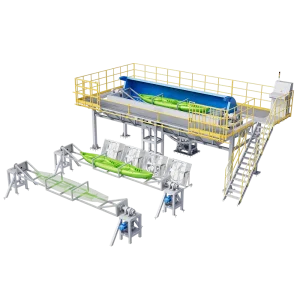
Explore our flagship customized rotational casting machines, rock-and-roll systems, and specialized laboratory equipment precision-engineered for heavy-duty, stress-free hollow plastic manufacturing.
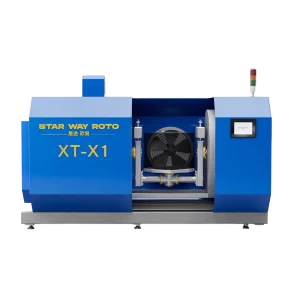
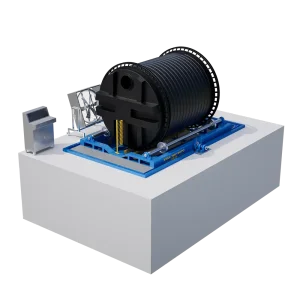
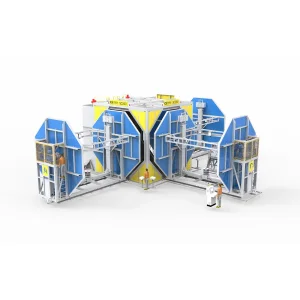
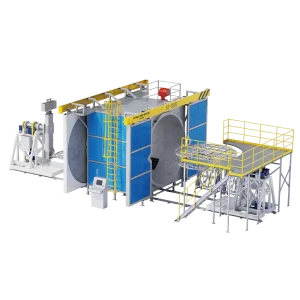
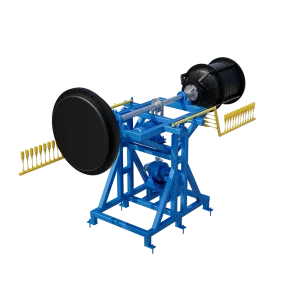
Rotational casting (commonly referred to as rotational molding or rotomolding) is a zero-pressure thermoplastic processing technology engineered for manufacturing seamless, stress-free, hollow polymer structures. Unlike high-pressure injection molding or extrusion blow molding, rotational casting relies on thermal convection, conduction, and continuous multi-axis rotation to fuse resin powders inside an enclosed mold cavity.
Micro-pelletized polymer resins (LLDPE, HDPE, XLPE, PP, PA) tumble inside heated metallic molds. As the temperature rises past the melting point ($160^\circ\text{C} - 220^\circ\text{C}$), particles coalesce without shear stress, ensuring maximal mechanical integrity.
Precision servo drives govern major and minor axis rotational speed ratios (typically 4:1 to 1:1). Controlled speed variation ensures uniform wall thickness distribution, even across complex, asymmetric structural geometries.
Because plastic liquefaction and cooling take place under normal atmospheric pressure, finished products display zero molecular orientation stress, rendering them virtually immune to environmental stress cracking (ESCR).
Over the past decade, Chinese rotational molding equipment manufacturers have transformed from basic machine suppliers into high-end global automation partners. Operating within fully integrated industrial clusters, premier exporters offer unprecedented technical agility and total cost of ownership (TCO) efficiency.
From in-house steel forging and 5-axis CNC mold machining to assembly of proprietary gas burners and PLC software, Chinese export factories control every link, reducing project lead times by 35% compared to Western counterparts.
By leveraging robust domestic material networks and optimized modular designs, Chinese manufacturers offer state-of-the-art Carousel and Shuttle machines at a fraction of North American or European capital costs, drastically reducing ROI payback periods.
Whether configuring offset straight arms, L-arms, C-arms, or multi-zone direct-fired heating chambers, leading Chinese factories provide bespoke mechanical adaptations tailored to specific factory footprints and floor heights.
The global rotational molding sector is experiencing a massive shift toward energy efficiency, process repeatability, and smart digital control systems. Modern buyers are replacing legacy open-flame systems with intelligent thermal management units.
| Technology Vector | Legacy Rotomolding System | Next-Gen Chinese Export Standard | Operational Impact |
|---|---|---|---|
| Heating Medium Control | Manual timer-based burner shutdown | Real-time Internal Air Temperature (TP) Wireless Sensors | Eliminates under-curing & bubble degradation; saves 18% fuel. |
| Arm Drive Motors | AC Induction with mechanical gearbox | Precision Servo Motors with Variable Frequency Drives (VFD) | Micro-accurate axis positioning and 25% lower energy draw. |
| Oven Air Duct Design | Static directional thermal airflow | Dynamic Recirculating Dual-Vane CFD Heated Air Circulation | Achieves $\pm 2^\circ\text{C}$ temperature uniform distribution across mold surfaces. |
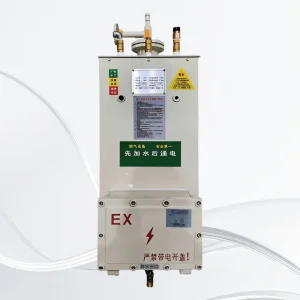
| Eco Gasification | Direct raw gas combustion | Integrated OEM Gasifiers & Flameless Catalytic Burners | Reduces carbon emissions by 30% while satisfying CE / UL safety standards. |
Selecting the proper rotational casting platform is driven by volume demands, product scale, and mold variety. Leading exporters offer four primary structural configurations tailored for global plant operations:
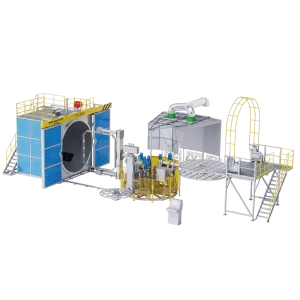
Engineered for high-volume continuous mass production. Featuring 3 to 5 independent indexing arms moving between heating, precooling, cooling, and servicing stations. Ideal for standardized items like IBC totes and road barriers.
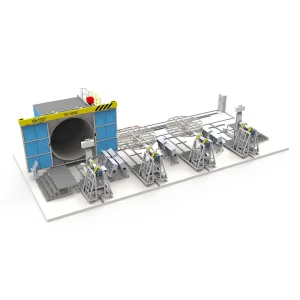
Designed for multi-product flexibility and plants with floor-space constraints. Molds ride on linear tracks entering a central oven from opposite ends. Allows different cycle times and mold weights without slowing down parallel arms.
Purpose-built for massive, elongated hollow containers such as 20,000L chemical storage tanks, agricultural troughs, and canoes. The mold rocks back and forth along its longitudinal axis while rotating full $360^\circ$ radially.
Compact, scaled-down units optimized for resin compound testing, masterbatch color development, thermal cycle profiling, and academic polymer analysis prior to full-scale commercial mold investment.
Procuring industrial rotomolding plant equipment requires rigorous alignment with global technical standards. Procurement directors must evaluate machines against strict mechanical, electrical, and thermal criteria:
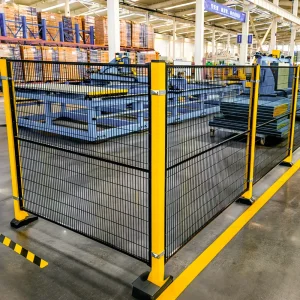
Top-tier exporters configure electrical enclosures with Siemens or Schneider components, complying with CE directives, UL 508A cabinet standards, and ISO 12100 mechanical safety guarding regulations, including perimeter safety fencing and light curtains.
Oven walls constructed with minimum 150mm high-density mineral wool insulation and pneumatic door sealing gaskets minimize heat radiation loss, maintaining external skin temperatures under $45^\circ\text{C}$ to safeguard machine operators.
Machine arms (straight, offset, or drop-arm) undergo Finite Element Analysis (FEA) to verify structural rigidity under maximum mold and resin weight conditions (ranging from 500kg up to 10,000kg load capacities).
Rotational casting machines supply crucial hollow plastic components to critical infrastructure, agriculture, transport, and consumer sectors worldwide:
Vertical and horizontal tanks (500L to 50,000L) for agricultural irrigation, rainwater harvesting, and industrial acid storage manufactured with multi-layer LLDPE/XLPE resin systems.
Heavy-duty underground septic tanks, grease traps, stormwater management chambers, and modular drainage sumps built to withstand high earth pressures without cracking.
Unsinkable kayaks, canoes, commercial dock floats, navigation buoys, and pontoons featuring foam-filled hollow walls for maximum buoyancy and UV resistance.
Diesel fuel tanks, air intake ducts, tractor cabs, wheel arches, fender liners, and fluid reservoirs engineered to replace costly welded sheet metal assemblies.
Expert answers to critical technical questions encountered during machinery evaluation, process setup, and supplier vetting:
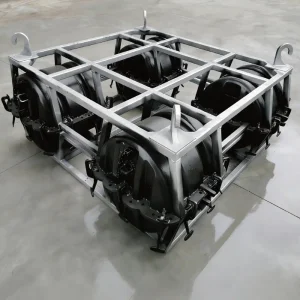
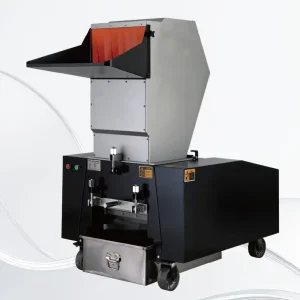
Complete your manufacturing line with our precision steel moulds, energy-efficient gasifiers, high-efficiency carousel lines, and industrial resin crushers.