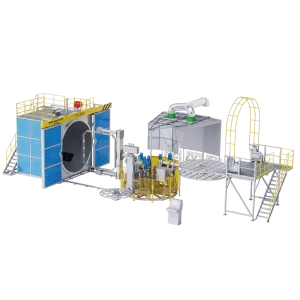
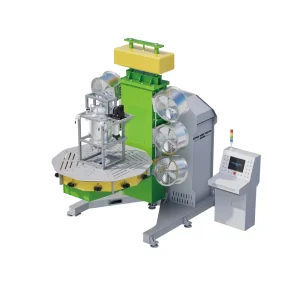
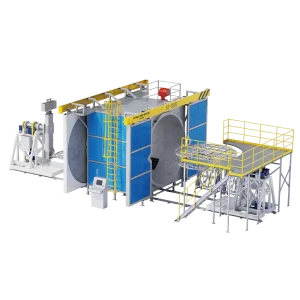
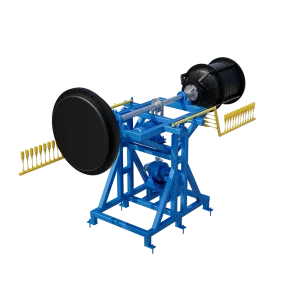
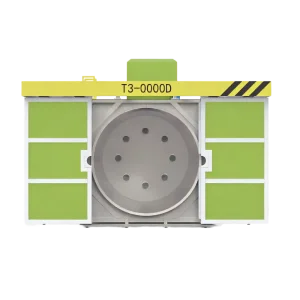
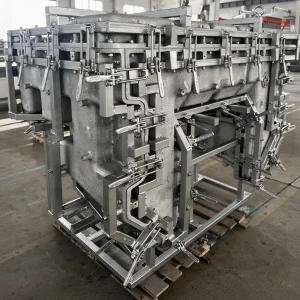
Explore our flagship, CE-compliant rotational molding tooling, laboratory systems, and automated machine platforms engineered for precision cycle control.
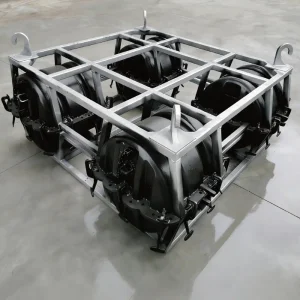
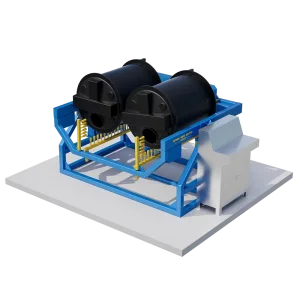
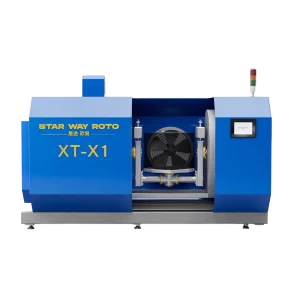
The global rotational molding (rotomolding) sector has evolved from agricultural utility tanks into high-precision polymer engineering across automotive, clean energy, and aerospace logistics.
Rotational molding is recording accelerated compound annual growth rates (CAGR > 6.2%), driven by the light-weighting of electric commercial vehicles, cross-linked polyethylene chemical containment, and marine vessel buoyancy systems. The demand has shifted from simple single-layer structures to multi-layer barrier vessels requiring micro-porosity-free mold tooling.
Historically reliant on fabricated carbon sheet steel with loose tolerances, contemporary rotomolding mandates high-conductivity cast A356 aluminum and 5-axis CNC-machined 6061-T6 aluminum alloys. This shift ensures dimensional stability, tighter part shrinkage predictability, and seamless mating surfaces that eliminate parting-line flash defects.
Global tier-1 OEMs require full traceability. Tooling and machinery must integrate CE compliance, safety interlocks, low-voltage directives, and pressurized venting parameters. Manufacturers can no longer operate with uncertified machinery; international projects depend entirely on third-party validated equipment.
CE marking is not merely a trading label; it is a legally binding testament that the rotational machinery, electrical controls, and pressurized tooling assemblies withstand rigorous operational loads without mechanical failure.
Mandates kinematic fail-safes across rotating machine arms (carousel, rock & roll, and shuttle tracks). Enforces dual-channel safety switches, torque limiters on primary drive reduction gears, and automatic thermal shutoff perimeters.
Governs electrical hazards in oven heating systems (electric, natural gas, or LPG burner controls). Complies with EN 60204-1 safety standards, ensuring insulation resistance, earth bonding integrity, and protection against electrical arcs.
Ensures PLC systems (Siemens, Omron, Delta) and variable-frequency motor drives (VFDs) remain immune to electromagnetic interference while operating high-current heating banks, avoiding corrupted cycle data or runaway thermal scenarios.
Tooling operating under internal pressurization or vacuum evacuation cycles is verified against structural thermal fatigue. Vent port sizing calculations (using PTFE or steel breathable inserts) prevent over-pressurization during heating phases.
Under CE audit guidelines for high-temperature closed-chamber processing (temperatures reaching 280°C to 340°C), rotomolding moulds must incorporate properly calculated vent ratios. A standardized rule-of-thumb ratio is 13 mm of vent diameter per cubic meter of internal mold cavity volume. Failing to maintain this venting ratio leads to localized backpressures, causing microscopic pinholes, severe wall thinning, and risk of mechanical blow-out along clamped flange interfaces.
Selecting the correct tooling substrate directly impacts thermal cycle times, parting-line tolerances, surface finish replication, and tool longevity over hundreds of production heats.
| Evaluation Parameter | Cast Aluminum (A356 Grade) | CNC Billet Aluminum (6061-T6) | Fabricated Steel (Q235B / SS304) |
|---|---|---|---|
| Thermal Conductivity (W/m·K) | 150 – 170 W/m·K (Rapid Heat Up) | 160 – 190 W/m·K (Peak Uniformity) | 45 – 55 W/m·K (Slow Heat Dissipation) |
| Dimensional Tolerance | ±0.3 mm to ±0.5 mm | ±0.05 mm (Ultra-Precision) | ±1.0 mm to ±2.5 mm |
| Ideal Component Applications | Complex aesthetics, kayaks, toys, coolers | Medical cases, EV battery trays, aerospace | Large chemical IBCs, septic tanks (50kL) |
| Porosity & Surface Integrity | Micro-porosities require vacuum impregnation | Zero Porosity / Mirror Polish Ra 0.2 | Weld seams visible; require manual grinding |
| Tooling Lifetime (Heats) | 10,000 – 25,000 thermal cycles | 50,000+ thermal cycles | 8,000 – 15,000 thermal cycles |
| Lead Time for T0 Samples | 35 – 45 Days | 25 – 35 Days | 20 – 30 Days |
Cast aluminum tools are produced using precision wooden or resin foundry patterns. Molten A356 alloy is poured under vacuum-assisted or gravity feed methods. Ideal for organic contours, compound radii, and multi-piece articulated side-draw cores. Highly cost-effective for medium-to-large consumer parts where compound curves would make 5-axis CNC roughing cost-prohibitive.
Directly carved out of forged aerospace-grade 6061-T6 aluminum blocks using multi-axis high-speed milling centers. There are zero internal casting voids or sand inclusions. Flange seal faces maintain razor-sharp tolerances that eliminate flash without requiring post-mold trimming. Exceptional heat dissipation reduces overall cycle times by up to 22%.
Constructed from heavy-gauge structural plate, rolled and tig-welded to form massive volume vessels. While thermal conductivity is lower than aluminum, steel tooling offers unmatched structural stiffness for multi-ton products (such as 10,000-liter to 50,000-liter vertical agricultural storage vessels). Easily repaired and modified on-site using standard welding protocols.
Combining deep tooling clusters with vertically integrated machine manufacturing allows global buyers to shorten tooling development timelines from months to weeks.
Ningbo StarWay Roto operates an integrated 20-acre production campus. Unlike standalone tooling shops that lack testing machines, StarWay fabricates both the rotomolding machinery (Carousel, Shuttle, Rock and Roll) and the moulds concurrently. Factory Acceptance Testing (FAT) includes actual resin trial shots under real thermal conditions before overseas dispatch.
Western tooling shops face high overheads and long lead times for raw billet procurement. By leveraging Ningbo's industrial cluster—one of the world's dense precision metallurgy and casting hubs—StarWay delivers equivalent or superior tooling steel and aluminum moulds at a 35% to 50% CapEx reduction, shortening the customer's ROI payback horizon to under 12 months.
Founded in 2009 with roots tracing back 23+ years, StarWay engineers engineered and delivered the world's largest commercial rotomolding machine: the S2-8500. Supported by 40+ specialized R&D engineers (80% holding advanced engineering degrees), StarWay maintains 23 patents covering energy-saving burner chambers, high-load arm bearings, and zero-gap clamping systems.
From critical fluid containment to heavy structural marine hulls, rotomolding creates hollow, stress-free, seamless components unmatched by injection or blow molding.
Bulk storage tanks, IBC containers, septic tanks, and dosing vessels. Requires stress-crack-resistant LLDPE/XLPE resins and seamless tooling that withstands aggressive internal hydraulic pressures.
Single and tandem recreational kayaks, sailing dinghies, yacht hulls, floating docks, and harbor navigation buoys. High-buoyancy hollow profiles with molded-in threaded brass inserts.
Heavy-duty insulated cooler boxes, dry ice carriers, vaccine transport containers, and food processing bins. Double-wall roto construction injected with high-density polyurethane (PU) foam.
Diesel DEF/AdBlue tanks, hydraulic reservoirs, HVAC ductwork, tractor roofs, and EV battery cooling shrouds. Complex routing geometries that integrate directly into automotive chassis packaging.
Commercial playground crawl tubes, helical slides, traffic crash cushions, road barriers, and animal husbandry feed troughs. Focuses on high impact absorption and smooth tactile skin.
Rotational molding is shaking off its legacy craft reputation. Advanced telemetry, robotic demolding, and computational fluid modeling are setting new benchmarks for cycle repeatability.
Modern CE-certified StarWay machines interface with wireless telemetry transmitters (such as K-PAX or DATAPAQ sensors) mounted directly inside the mold cavity. By tracking Peak Internal Air Temperature (PIAT), the machine dynamically commands the arm to exit the oven the instant powder pool fusion occurs, cutting cycle times and eliminating under-cure or resin degradation.
To comply with carbon-neutral directives in Europe and North America, StarWay is leading the transition away from fossil-fuel open burners. Electric heating elements embedded directly into the mold backing plate transfer heat directly by conduction, slashing factory carbon emissions, reducing floor footprint, and lowering energy consumption by up to 30%.
Tooling thermal distribution must adapt to recycled feedstocks. StarWay's thermal modeling simulates the varying melt flow indexes (MFI) of 30% to 100% PCR polyethylenes. Specialized mold texturing and optimized draft angles allow seamless demolding of regrind materials without surface gouging or warpage.
Industrial buyers must evaluate prospective rotational molding suppliers against rigorous engineering benchmarks to avoid mold cracking, cycle extension, or CE regulatory rejection.
Ensure the supplier verifies tool cavity geometries against native 3D CAD files via coordinate measuring machines (CMM) or laser scanning, generating color-mapped deviation reports.
Inspect spring-loaded clamp assemblies and parting-line guide pins. Flanges must maintain tongue-and-groove or silicone seal profiles to prevent micro-flashing under thermal expansion.
For dual-wall or multi-layer containers, verify that drop-box systems and pneumatic poppet valves integrate directly into the machine's primary spider arm rotary slip rings.
Confirm the factory provides a complete Technical Construction File (TCF), including electrical schematics, burner combustion safety audits, and Declaration of Conformity documents.
Authoritative answers to critical engineering, metallurgy, and certification questions in rotational mould fabrication and production machinery operation.
Under the EU Machinery Directive (2006/42/EC), rotomolding moulds mounted onto automated armatures are classified as interchangeable equipment or essential machinery components. If the mould includes hydraulic core-pulls, pneumatic release systems, or electrical heat sensors, it must comply with relevant safety and low-voltage standards. In addition, rotating machinery platforms (Carousel and Shuttle ovens) require full third-party CE certification covering burner gas safety (EN 746-2), emergency stops (EN ISO 13850), and electrical architectures (EN 60204-1). Uncertified equipment risks customs impoundment and factory operating shutdowns across the European Economic Area.
Volumetric shrinkage in rotational molding is substantial compared to injection molding due to ambient-pressure crystallization. Standard linear low-density polyethylene (LLDPE) typically shrinks between 2.5% and 3.5% (0.025 to 0.035 mm/mm). High-density polyethylene (HDPE) ranges from 3.0% to 4.0%, while cross-linked polyethylene (XLPE) averages 2.0% to 2.8%. Engineering polyamides (PA6/PA12) can range from 1.2% to 2.0% depending on moisture conditioning. At StarWay, our CAD engineers integrate variable non-linear shrinkage models depending on local wall thickness, cooling rate differentials, and geometry-induced corner constraints.
Specify CNC billet 6061-T6 aluminum when the product demands: 1) Hermetic sealing surfaces with razor-thin parting lines (e.g., watertight cases, military transport housings); 2) High aesthetic polish (mirror finish Ra < 0.4 µm) without microscopic pinholes caused by casting sand voids; 3) Thin uniform walls requiring aggressive cycle time reduction, as billet provides roughly 15% better thermal conductivity than cast alloys; and 4) Complex CNC-machined tongue-and-groove seal geometries. Conversely, cast aluminum is preferred for complex organic shapes, furniture, kayaks, and large structural components where raw CNC billet removal would be cost-prohibitive.
Warpage results from non-uniform cooling rates between the outer skin (facing the mould) and the inner surface (exposed to cavity air). StarWay addresses this through a three-stage strategy: First, we calculate wall thickness variations using FEA mold flow analysis to place heat-sink ribs or insulating blankets where necessary. Second, we integrate multi-stage cooling bays that balance forced ambient air and fine water mist atomizers to prevent thermal shock. Third, our patented internal air-cooling probes direct compressed chilled air into the hollow interior of the cooling part, synchronizing inner and outer skin crystallization and reducing internal stress warpage by over 70%.
For CNC billet aluminum tooling, lead time is typically 25 to 35 calendar days. For cast aluminum tooling, the pattern-making, foundry casting, CNC flange machining, and hand-finishing process averages 35 to 45 calendar days. Large fabricated sheet steel moulds (such as 10,000L tanks) can be completed in 20 to 30 days. Because Ningbo StarWay operates an in-house machine testing bay, T0 sample parts can be molded, dimensionally checked via 3D laser scan, and watertight-tested before international crating, saving weeks of overseas troubleshooting.
The baseline engineering formula establishes a vent cross-sectional area of approximately 13 mm diameter per cubic meter of mold cavity volume (or roughly 0.1 sq. inch per cubic foot). For materials with rapid gas release or parts with intricate internal pockets, venting must be scaled up or split into multiple ports. StarWay utilizes heat-resistant PTFE (Teflon) breather tubes packed with mineral wool or sintered porous bronze plugs. This allows volatile gases and expanding air to vent freely without letting molten polyethylene back-flow into the vent line or leaving flash marks on the part surface.
Carousel machines (typically 3-arm or 4-arm independent or fixed) operate in continuous rotational cycles (heating, cooling, demold/servicing stations running simultaneously). They are optimal for high-volume, standardized production runs where cycle times across all arms can be synchronized. Shuttle machines feature an oven in the center with two independent carts shuttling in and out. Shuttle systems provide maximum flexibility: one cart can run a heavy 45-minute heating cycle for a 5,000L tank while the other cart runs a quick 15-minute cycle for thin-walled bins, without idling stations or wasting energy.
To meet medical, cleanroom, and food-contact criteria (where sacrificial chemical release agents like siloxanes or fluoropolymers are prohibited), StarWay applies permanent semi-crystalline fluoropolymer coatings (such as FEP or PTFE matrix coatings) directly to the CNC-machined cavity. These coatings provide non-wetting surface energy, allowing clean part ejection for thousands of thermal cycles. For standard industrial molding, sandblasting textures (from VDI 24 to VDI 36) or micro-shot peening hide resin flow lines and provide an attractive matte finish that resists cosmetic marring.
Complete your manufacturing facility with our CE-certified carousel machines, electric-heating units, custom high-load shuttles, and testing stations.