StarWayRoto
Request a Catalog
Industry Whitepaper & Executive Sourcing Guide

Rotomolding Mould Manufacturers & Quotes serving Germany

Engineering Excellence, Industrie 4.0 Integration & Cost-Optimized Custom Mold Fabrication for German Industrial OEMs

Send Inquiry Now Read Whitepaper
Section 1 · Economic & Technical Analysis

German Industrial Rotomolding Ecosystem: Demand Dynamics & Tooling Rigor

Germany remains the undisputed manufacturing powerhouse of Europe, driven by stringent engineering standards, green energy transitions, and advanced industrial automation under the Industrie 4.0 roadmap. Industrial hubs across Baden-Württemberg, Bavaria, North Rhine-Westphalia, and Lower Saxony generate relentless demand for seamless, stress-free, and hollow plastic components. From heavy automotive fluid reservoirs to chemical containment intermediate bulk containers (IBCs) and agricultural spray tanks, rotational molding (rotomolding) has evolved from a niche plastic process into a primary manufacturing strategy.

However, purchasing rotational moulds within Germany presents distinct procurement challenges. Domestic European toolmakers face skyrocketing energy costs, extended labor shortages, and lead times often stretching between 16 to 26 weeks. For German Original Equipment Manufacturers (OEMs) and Tier-1 automotive suppliers, these structural bottlenecks risk delaying critical product launch schedules.

VDA 6.3 & ISO 9001 Compliance
Tooling engineered to pass rigorous German Quality Management audits, featuring complete material traceability certifications (EN 10204 3.1) for raw aluminum and steel.
Shrinkage & Distortion Control
Advanced CAD thermal compensation models accounting for polyethylene (LLDPE/HDPE/XLPE) shrink rates (1.5% to 3.0%) to ensure exact dimensional tolerances (DIN 16901).
50% TCO Lead-Time Advantage
Delivering high-precision cast aluminum CNC moulds in 30 to 45 calendar days, slashing Total Cost of Ownership (TCO) by 40-50% compared to Western European toolshops.

Technical Standards Benchmark: European vs. Advanced Export Tooling

To meet German operational expectations, rotomolding moulds cannot simply be hollow metal shells. They require sophisticated thermal distribution engineering, air evacuation venting channels, precise parting-line clamping mechanisms, and uniform wall thickness management.

Technical Parameter German / EU Domestic Standard StarWay China Factory 4.0 Standard Industrial Value Benefit
Mould Cavity Material Cast Aluminum A356 / CNC Block Alum High-Density A356 / A357 Alloy + CNC Finishing Identical thermal conductivity, zero porosity risk
Parting Line Tolerance < 0.15 mm precision threshold CNC Milled < 0.10 mm with tongue-and-groove Eliminates manual trimming; seamless plastic flash control
Tooling Lead Time 16 – 24 Weeks 4 – 6 Weeks (Air Express / DDP Delivery) Rapid time-to-market advantage for German OEMs
Surface Finishing VDI 3400 / Sandblasted / Micro-texture VDI 3400 Texture / Mirror Polish / Custom Teflon Flawless demolding without stress-cracking parts
Thermal FEA Simulation Optional / High Surcharge Integrated standard design procedure Prevents hot/cold spots during heating and cooling cycles
Section 2 · Advanced Manufacturing Synergies

China Factory 4.0: Supply Chain Resilience & Precision CNC Tooling

How StarWay Roto integrates 5-axis CNC machining, digital twin mold simulations, and direct German logistics to deliver unmatched tooling reliability.

23+
Years R&D Mastery
<0.08mm
Machining Precision
40+
Export Nations
100%
On-Time DDP Delivery

1. Full Digital Twin CAD/CAM Integration

Using SolidWorks, Siemens NX, and Moldex3D, our engineering department collaborates directly with German engineering teams. We import STEP/IGES CAD data, run comprehensive finite element heat transfer analysis (FEA), and simulate shrinkage profiles. Potential cooling warpage is corrected in the digital domain before a single chip of aluminum is cut.

2. Direct Cast Aluminum & Fabricated Steel Synergy

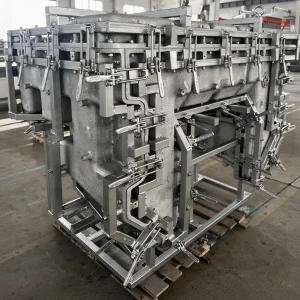
Whether your component demands high-volume aesthetic perfection (Cast Aluminum Moulds carved via 5-Axis CNC centers) or massive industrial volume containment (Fabricated Sheet Steel Moulds for 10,000L tanks), our 20-acre production hub in Ningbo handles end-to-end tooling production under one roof.

Consult With Our Senior Tooling Engineers
Section 3 · Industrial Case Scenarios

Localized German Application Scenarios & Case Studies

Rotational molding tooling designed for the German market must adapt to strict environmental laws, mechanical stress criteria, and specialized industry applications:

A. Heavy Machinery & Commercial Vehicles
Target Products: Hydraulic oil tanks, AdBlue/DEF reservoirs, tractor roofs, and engine ducting for brands across Stuttgart and Munich.
Tooling Criteria: Mold inserts with high-precision brass thread embedded inserts, hydraulic core-pull systems, and oil-resistant, leak-proof internal seam designs.
B. Environmental & Water Management Systems
Target Products: Stormwater underground detention tanks, grease separators, bio-reactors matching WHG (Wasserhaushaltsgesetz) regulations.
Tooling Criteria: Large-scale fabricated steel molds with modular ribs to withstand soil earth pressure without wall collapse.
C. Hazardous Materials & Chemical Logistics
Target Products: Double-walled chemical bunds, UN-certified IBC inner liners, heavy-duty plastic pallets.
Tooling Criteria: Uniform wall thickness thermal control (preventing thin corners), acid-resistant Teflon mold coating, and drop-test validated geometry.
D. Medical, Cleanroom & Insulated Cold Chain
Target Products: Vaccine transport coolers, medical device housing enclosures, food-grade insulated containers.
Tooling Criteria: High-polish cast aluminum CNC cavities ensuring zero bacterial trap grooves, conforming to strict EU Food Contact Regulations.

RFQ & Pricing Breakdown: How German Buyers Can Request Accurate Quotes

When requesting a rotomolding mould quotation serving Germany, supplying comprehensive engineering data significantly accelerates quote turnarounds (typically provided within 24 hours).

  • 3D CAD Model: Preferred formats include STEP (.stp), IGES (.igs), or Parasolid (.x_t).
  • Resin Grade & Shrinkage Rate: Specify material type (e.g., LLDPE, HDPE, XLPE, Polypropylene) or provide plastic density/MFR details.
  • Surface Finish Requirement: Detail if the outer surface requires VDI 3400 texture, mirror polish, or customized grain embossing.
  • Production Machine Interface: Arm size, maximum swing diameter, mounting hole patterns, spider arm geometry, or heating oven limits.
  • Incoterms & Logistics: Freight preference (FOB Ningbo, CIF Hamburg/Bremerhaven, or DDP direct to your factory door in Germany).
Section 4 · Technical Q&A

Rotomolding Mould Sourcing FAQ for German Industrial Buyers

Expert answers to technical, commercial, and logistical queries regarding custom mold manufacturing and export to Germany.

Q: What are the primary differences between cast aluminum moulds and fabricated steel moulds for rotomolding?
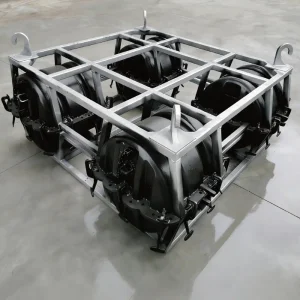
Cast aluminum moulds are carved from high-density aluminum alloy (A356) using 5-axis CNC machinery. They offer superior heat transfer, seamless integration of complex curved geometry, fine surface texturing (VDI 3400), and longer production lifespan—ideal for intricate parts like automotive tanks and medical equipment. Fabricated steel moulds are hand-welded from high-grade sheet steel, providing lower initial tooling costs and faster production for large, simple geometric forms like 5,000L+ water tanks and agricultural silos.
Q: How do you guarantee dimensional accuracy and prevent shrinkage errors for German OEM parts?
We utilize advanced CAD simulation tools (Moldex3D) combined with 23+ years of practical empirical data. We calculate precise non-linear shrinkage coefficients based on the specific resin grade (e.g., LLDPE vs. HDPE) and wall thickness profile. Before mold casting or CNC cutting, dimensional scale factors are embedded into the 3D core and cavity design, ensuring final molded parts comply with German DIN 16901 tolerances.
Q: What logistics and customs options do you offer for delivery into Germany (DACH region)?
We provide full flexibility: FOB Ningbo/Shanghai, CIF Hamburg or Bremerhaven ports, and comprehensive DDP (Delivered Duty Paid) service directly to your facility in Germany. Under DDP terms, StarWay manages all export customs clearance, ocean/air freight, import customs duties, and inland truck transport, eliminating administrative burdens for your procurement team.
Q: Can your moulds be fitted directly onto European-made rotomolding machines (e.g., Carousel or Shuttle machines)?
Yes. We design customized mounting frames, spider arms, clamp points, and pneumatic/hydraulic ejector pin interfaces tailored to your specific machine arm configuration. Whether you operate European, American, or Asian rotational molding equipment, our engineering team ensures plug-and-play mechanical compatibility.
Q: How does StarWay conduct Quality Assurance and First Article Inspection (FAI) before mold shipment?
Every mould undergoes full CMM dimensional inspection, pressure venting tests, and parting line light-leak testing. Upon request, we perform full T1 plastic sample sampling in-house on our own carousel rotomolding machines. We send complete CMM inspection reports, video documentation of the sample molding cycle, and physical T1 sample parts via DHL/FedEx to Germany for your final lab approval prior to mold dispatch.
Q: What is the expected production lifespan of your cast aluminum rotomolding moulds?
Our CNC-machined cast aluminum moulds (A356 alloy) are engineered to easily withstand 100,000+ rotational molding thermal cycles without structural distortion or pinhole degradation. Proper mold maintenance, cleaning, and release agent reapplication further extend operational service life.

Ready to Accelerate Your Rotomolding Tooling Project?

Get instant engineering feedback, DDP logistics estimates, and competitive quotations tailored to German industrial specifications within 24 hours.

Send Inquiry Now