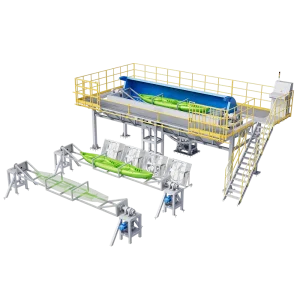
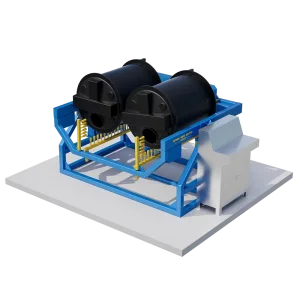
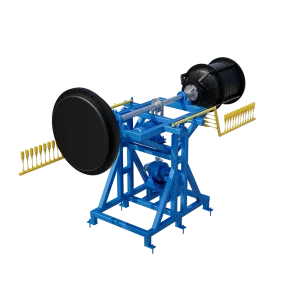
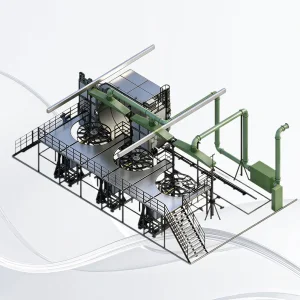
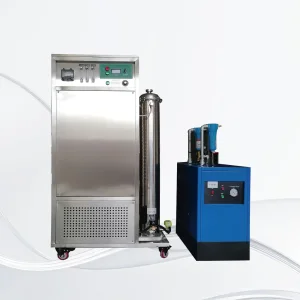
Explore our flagship OEM rotational molding equipment engineered for maximum thermal efficiency, structural integrity, and high-throughput industrial production.
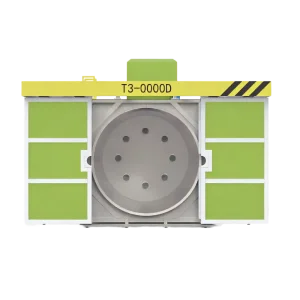
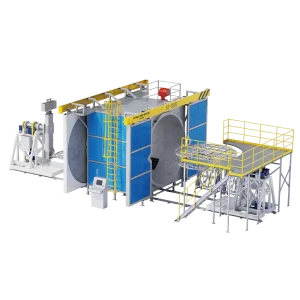
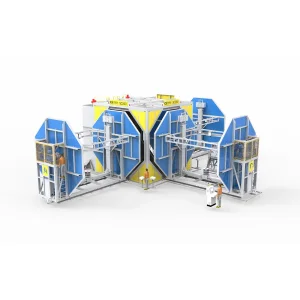
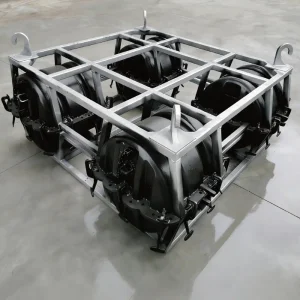
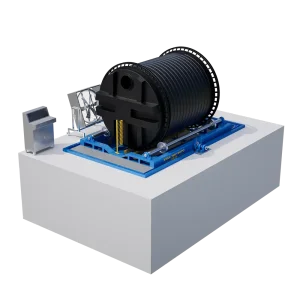
The transformation of heavy polymer processing: Why global OEMs are shifting to rotational molding for stress-free, seamless, multi-layer hollow component manufacturing.
Rotational molding (rotomolding) has evolved from a niche plastic fabrication method into a core pillar of modern industrial manufacturing. Unlike injection molding or blow molding—which rely on high pressure to force molten polymer into tool cavities—rotomolding is a low-pressure, high-temperature biaxial rotational process. This unique thermodynamic mechanism yields hollow plastic components completely free of residual internal stresses, exhibiting uniform wall thickness distribution, exceptional impact resistance, and seamless structural integrity.
Today, multinational original equipment manufacturers (OEMs) across chemical processing, automotive, marine, logistics, and municipal infrastructure require specialized rotomolding solutions capable of replacing traditional metal weldments and heavy fiberglass composites. As chemical compatibility mandates become stricter and environmental regulations enforce circular economy standards, modern rotomolding platforms must deliver precise material micro-dispersion, automated thermal cycle control, and reduced carbon footprints.
Understanding the thermal coalescence kinetics, melt flow indices, and precise speed ratios required for superior OEM part performance.
Real-time wireless temperature monitoring inside the mold cavity tracks PIAT between 190°C and 215°C. This ensures complete resin cross-linking and bubble removal without causing thermal degradation or pinhole porosity.
Independent variable-frequency drives (VFD) govern major (arm) and minor (plate) axis speeds with precision ratios (typically 4:1 to 1:1), guaranteeing uniform powder coverage across complex geometry corners.
Engineered to process LLDPE, HDPE, Cross-linked Polyethylene (XLPE), Polypropylene (PP), and Nylon 6/12 powders (35 to 50 mesh size) with controlled Melt Flow Index (MFI 2.0 – 7.0 g/10min).
| Manufacturing Process | Tooling Capital Investment | Internal Stress Profile | Max Part Volume / Scale | Wall Thickness Uniformity | Design Change Flexibility |
|---|---|---|---|---|---|
| OEM Rotomolding | Low to Moderate | Stress-Free (Zero Pressure) | Extremely Large (Up to 50,000L+) | High (Controlled via Rotation) | High (Fast Tool Modification) |
| Injection Molding | Very High | High Residual Shear Stress | Limited (Small to Medium) | Fixed by Tool Cavity | Extremely Low & Costly |
| Large Blow Molding | High | Moderate Mold Stress | Medium (Tanks up to 5,000L) | Variable (Parison Sag Risk) | Low |
| FRP Hand Lay-Up | Low | Low Stress / Delamination Risk | Large | Manual / Variable | Moderate (Labor Intensive) |
Tailored rotomolding solutions customized for rigorous operational environments across chemical, automotive, marine, cold-chain, and sanitation sectors.
Heavy-duty double-wall chemical containment tanks, IBC tote liners, and acid neutralization basins. Engineered with cross-linked polyethylene (XLPE) for maximum resistance to sodium hypochlorite, sulfuric acid, and hazardous fluids under continuous environmental stress cracking (ESCR).
Seamless diesel fuel tanks, DEF (Diesel Exhaust Fluid) tanks, air intake snorkels, hydraulic oil reservoirs, and tractor ROPS canopy roofs. Built with molded-in brass/steel threaded inserts, leak-proof port integration, and high impact strength at -40°C.
Encapsulated dock flotation billets, navigational buoys, commercial kayaks, and double-hulled workboats. Compounded with UV-20+ rated hindered amine light stabilizers (HALS) to withstand long-term marine saltwater exposure and solar degradation.
Dual-wall insulated transport containers, medical vaccine coolers, and dry-ice storage shippers. Integrated high-density polyurethane (PU) foam pressure injection (<0.022 W/m·K thermal conductivity) ensuring extended temperature retention over 120+ hours.
Ergonomic industrial waste carts, hazardous medical disposal containers, public recycling banks, and mobile sanitation units. Features antimicrobial silver-ion additive masterbatches and flame-retardant formulation meeting UL94 V-0 safety criteria.
Comprehensive design-to-production services utilizing CNC-machined 6061-T6 aluminum and cast A356 aluminum molds. Complete with mirror-polished surfaces, complex undercut action slides, and air-venting systems optimized for zero-defect output.
Optimizing Total Cost of Ownership (TCO) through rigorous engineering design rules, quality audit protocols, and material selection guidelines.
When sourcing custom rotomolded parts, procurement managers and engineering teams must adhere to fundamental Design for Manufacturability (DFM) principles to prevent excessive cycle times, warpage, and structural hot spots:
To guarantee long-term supply chain reliability, global buyers must audit OEM rotomolding vendors across three core manufacturing dimensions:
Verify that the factory utilizes automated wireless Datapaq / K-Thermometer systems to record continuous temperature curves across oven, cooling, and demolding phases.
Confirm non-destructive ultrasonic wall thickness gauge mapping across at least 16 designated grid points per part to ensure tolerance compliance within ±10%.
Demand ARM (Association of Rotational Molders) dart drop impact testing at sub-zero temperatures (-40°C) and hydrostatic pressure testing for liquid vessels.
Leading the transition toward zero-carbon electric heating, AI process optimization, and circular bio-based polyolefins.
Replacing open gas burners with high-efficiency electric convection and infrared heating modules. Eliminates localized carbon emissions, reduces energy consumption by up to 28%, and provides pinpoint heating zone control.
Machine-learning closed-loop control algorithms adjust major/minor rotation speeds dynamically based on viscosity telemetry. Enables fully autonomous production cycles with automatic mold opening, demolding robotics, and weight verification.
State-of-the-art multi-layer co-rotation moulding enables the use of 50%+ Post-Consumer Recycled (PCR) polyolefin cores sandwiched between virgin food-grade outer skin layers, satisfying stringent ESG sustainability goals.
Seamless international logistics, certification compliance, and lifecycle technical support across North America, Europe, Asia, and Latin America.
StarWay Roto operates under strict international quality management standards to ensure seamlessly integrated procurement experiences for multinational OEM buyers. Our manufacturing facilities are certified to ISO 9001:2015 and ISO 14001:2015. All rotomolding machinery complies fully with European Safety Directives (CE Marking, 2006/42/EC Machinery Directive), incorporating dual-circuit safety interlocks, explosion-proof combustion blowers, and emergency stop networks.
For chemical and food-contact storage applications, our polyolefin formulations satisfy FDA 21 CFR 177.1520, NSF/ANSI Standard 61 for potable water safety, and EU Regulation No 10/2011. Furthermore, our raw materials conform to REACH (EC 1907/2006) and RoHS 3 environmental chemical guidelines.
Expert answers to key technical, engineering, and procurement queries regarding OEM rotomolding application manufacturing.
Explore our extended industrial machinery lineup including rock and roll systems, specialized moulds, and auxiliary processing units.