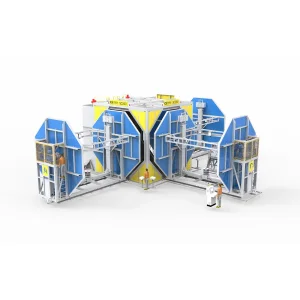
Precision-engineered carousel systems, rock & roll units, and high-efficiency thermal processing apparatus built to international industrial tolerances.
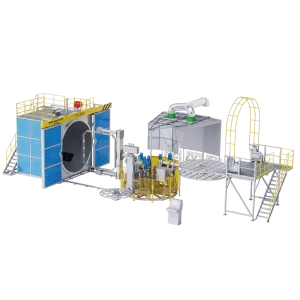
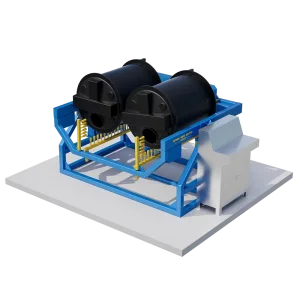
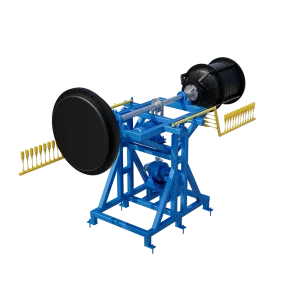
From atmospheric thermal sintering to smart-actuated bi-axial manufacturing systems: how modern OEM factories are redrawing large-scale hollow plastics capabilities.
Rotational molding is fundamentally an atmospheric pressure, zero-shear stress manufacturing methodology. Unlike high-pressure injection or extrusion blow molding, rotomolded matrices rely purely on thermal conduction across the mold exterior to fuse micro-pelletized or micronized thermoplastic powders. Modern OEM builders integrate optimized air velocity profiles and dynamic chamber circulation to eliminate premature surface skinning, bubble entrapment, and molecular degradation.
Historically reliant on direct open gas flames or heavy natural gas convective burners, tier-1 rotational molding factories now engineer ultra-insulated modular ovens and clean-room electric infrared/induction systems. By utilizing advanced PID closed-loop burner modulations, modern machinery curbs overall fuel expenditure by up to 35% while yielding pinpoint control over Peak Internal Air Temperature (PIAT) curve trajectories.
Because molten polymers adhere through gravity and bi-axial rotation without hydrodynamic hydraulic forcing, rotomolded vessels possess zero molded-in residual stresses. OEM machine builders optimize speed ratio synchronizations (typically ranging from 4:1 to 1:4 primary-to-secondary rotational speeds) to ensure isotropic wall thickness distribution across complex concavities, undercuts, and heavy load-bearing structural ribs.
Assessing Total Cost of Ownership (TCO), dynamic drive kinematics, and structural metallurgy when auditing rotational plastic molding machinery manufacturers.
| Machine Typology | Kinematic Drive Profile | Optimum Throughput Scale | Thermal Efficiency Rating | Primary Industrial Use-Case |
|---|---|---|---|---|
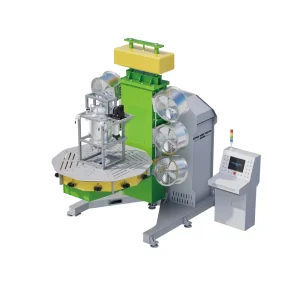
| Independent-Arm Carousel | Fixed central turret, 3 to 6 independent cantilever/fixed arms | High-Volume Continuous Assembly (24/7 run) | Superior (Heat Recirculated) | Automotive fuel tanks, chemical IBC totes, consumer kayaks |
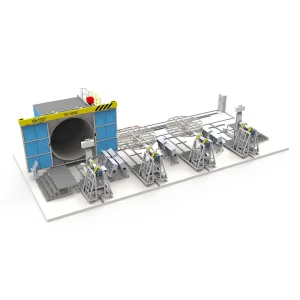
| Linear Shuttle System | Dual carriage cars traversing linear steel rails into central oven | Flexible Batch & Mixed-Mold Sizes | High (Modulating Chamber) | Industrial tanks (500L - 10,000L), playground components |
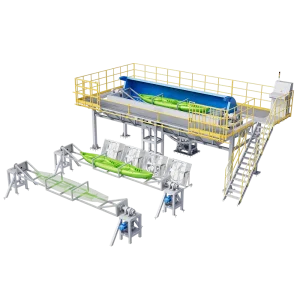
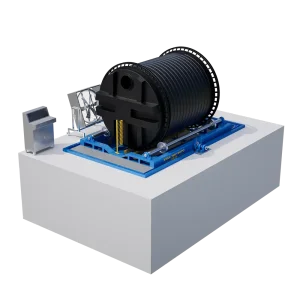
| Rock & Roll / Swing Unit | 360° full roll axis with controlled rocking angle (±45°) | Extra-Large Elongated Cylindrical Structures | Direct Thermal Convection | Vertical/horizontal water storage (up to 50,000L), drainage conduits |
| Electric Infrared / Clean Oven | Precision multi-zone ceramic/quartz heating resistance | Ultra-Clean High-Tech / Medical Enclosures | Zero Direct Carbon Emissions | Sterile pharmaceutical vessels, defense-grade radomes |
High-payload rotating arms require forged 40Cr or 42CrMo alloy drive shafts, paired with high-torque cycloidal or planetary speed reducers capable of handling multi-ton eccentric mold weights at continuous operating temperatures exceeding 280°C.
High-capacity blowers engineered with backward-curved impellers circulate conditioned hot air across complex mold envelopes at speeds up to 18 m/s, preventing cold air pockets and guaranteeing wall thickness variance below ±3%.
Modern OEM systems rely on enterprise Siemens S7-1500 or Allen-Bradley GuardLogix PLCs. Digital human-machine interfaces (HMI) log real-time arm rotation speed, heating chamber temperature curves, and multi-stage cooling damper cycles.
High-density rock wool insulation (150-200mm thickness) within double-walled galvanized steel oven housings guarantees casing exterior temperatures remain below 45°C, maximizing worker ergonomics and complying with OSHA standards.
From ultra-large multi-layer chemical storage tanks to high-density insulated logistics, see how rotomolding OEM equipment fulfills rigorous industrial design mandates.
Rock and roll and large swing shuttle machinery fabricate seamless vertical and horizontal fluid containment systems scaling up to 50,000 liters. By leveraging multi-layer co-molding capabilities, these machines form chemical barrier inner liners (PVDF/Nylon) bonded to impact-resistant UV-stabilized LLDPE outer bodies for hostile storage applications.
Heavy machinery builders require seamlessly integrated Diesel Exhaust Fluid (DEF) reservoirs, hydraulic fluid chambers, tractor cabins, and engine ducting. Carousel rotomolding machines with multi-arm configurations allow simultaneous, high-precision processing of complex geometry parts containing molded-in brass bushings, internal baffles, and structural inserts.
Double-walled hollow insulated cooler boxes and vaccine cold-boxes demand zero surface pinholes and robust wall uniformity. Precision OEM machines provide controlled multi-stage cooling air and mist profiles, eliminating mold warpage and guaranteeing pristine surface finish required for secondary high-pressure polyurethane foaming injection.
Seamless marine buoys, marina dock floats, and dual-hull touring kayaks necessitate continuous stress-free wall matrices capable of withstanding saltwater hydrostatic fatigue. Large-swing OEM shuttle machinery enables massive CNC-milled aluminum molds to execute precise secondary axis rotations for hollow, buoyant structures.
From 1100-liter wheelie trash bins to septic digestion tanks and storm-water filtration vaults, rotomolded polymers withstand direct sub-surface ground pressures without risk of corrosion. Heavy-duty arm machines provide high weight capacity for structural, thick-walled engineering parts.
Spiral tube slides, crawl tunnels, and structural playsets depend on high cosmetic sheen and zero sharp parting lines. OEM tooling with advanced cast aluminum molds mounted to balanced spider arms enables fast cycle turnarounds with vivid, color-fast compounded resins.
International factory setups require adherence to stringent safety directives, thermal combustion codes, and robust on-site engineering support.
European installations mandate comprehensive compliance with EN ISO 12100 safety risk assessments, EN 60204-1 electrical equipment standards, and EN 746-2 industrial thermoprocessing safety norms covering gas-fired and liquid combustion trains, dual-block flame safety solenoids, and emergency pressure vents.
For the North American market, control panels are built to UL 508A industrial panel standards with NEMA-rated enclosures. Natural gas and propane burners comply strictly with NFPA 86 Class B industrial oven protocols, incorporating automated purge cycles, airflow differential pressure interlocks, and redundant high-limit thermostats.
Global OEM leaders provide end-to-end Field Service Engineering (FSE), dispatching senior mechanical and automation engineers for foundation leveling, electrical integration, burner commissioning, and trial mold testing. Comprehensive operator training curriculums ensure factory staff master mold balancing, recipe programming, and preventative maintenance.
Exploring the frontier of digital twin modeling, dynamic wireless thermodynamic telemetrics, and high-performance crosslinked polymers.
Traditional timers are being replaced by high-frequency wireless radio transmitters mounted within rotating mold spiders. Continuous tracking of Peak Internal Air Temperature (PIAT) allows the central machine PLC to detect exact resin melt, bubble coalescence, and crystallization transitions, triggering oven departure and cooling chamber entry autonomously to trim cycle times by 18%.
Future factory cells integrate 6-axis articulated industrial robots mounted on overhead rails. These robotic systems automate mold latch unclamping, high-pressure pneumatic ejection, automated inner-part flaming/deburring, and precision gravimetric powder charging, dramatically cutting direct labor overhead while eliminating human exposure to hot mold faces.
While LLDPE, MDPE, and HDPE dominate 85% of global output, leading-edge rotomolding equipment is refined to process engineering polyamides (Nylon 6, 11, 12), Polypropylene (PP), cross-linked polyethylene (XLPE), and high-percentage Post-Consumer Recycled (PCR) resin blends with tailored inert nitrogen atmospheric purging to prevent matrix oxidation.
Authoritative answers on cycle calculations, structural payloads, burner efficiencies, and machine selection parameters.
Explore our full line of specialized swing machines, shuttle systems, certified electric ovens, and precision fabrication molds.