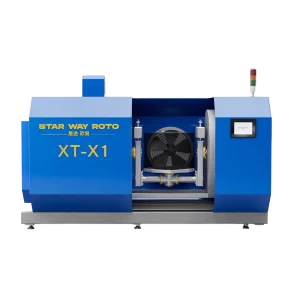
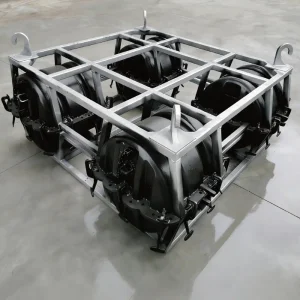
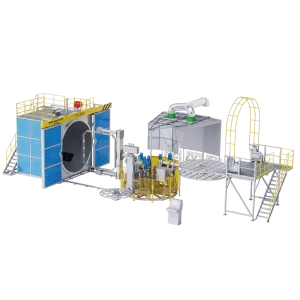
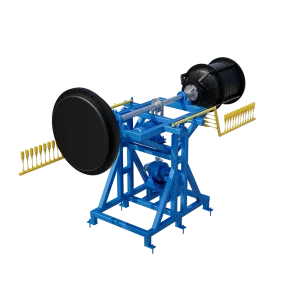
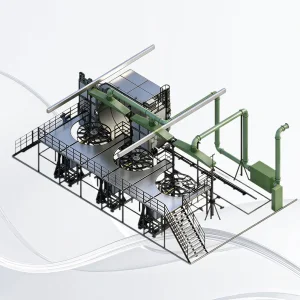
Explore our premium grade heavy-duty machinery, high-load shuttle rotomolders, and custom boat molds powering marine craft exporters worldwide.
Analysing structural integrity, polymer economics, and quote dynamics for commercial and recreational watercraft production.
The global marine manufacturing industry is undergoing a structural paradigm shift. Traditional fiberglass (GRP) hand-layup methods and aluminum hull fabrications are increasingly being superseded by rotomolded polyethylene (PE) boats. Driven by the search for ultra-durable, maintenance-free, recyclable, and impact-resistant vessels, commercial procurement buyers and OEM marine brands now consistently seek top-tier rotomolded boats quotes and exporter options from world-class manufacturing centers.
Rotational molding—a process involving seamless hollow molding using liquid or resin powder heated inside bi-axial rotating molds—provides unprecedented structural advantages for marine hulls. Unlike traditional composite boats that suffer from gelcoat cracking, osmotic blistering, and delamination under severe hydrodynamic impact, rotomolded plastic boats feature a stress-free monolithic structure with uniform wall thickness distribution, exceptional buoyancy dynamics, and complete chemical immunity to saltwater corrosion.
Data derived from accelerated hydrodynamic stress testing, drop impact metrics, and Total Cost of Ownership (TCO) lifecycle analysis over a 15-year operational span.
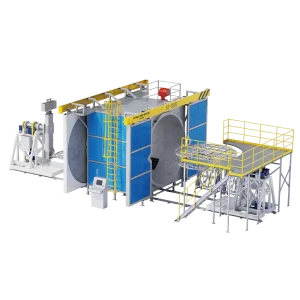
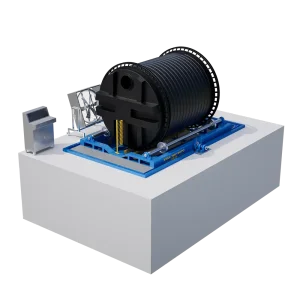
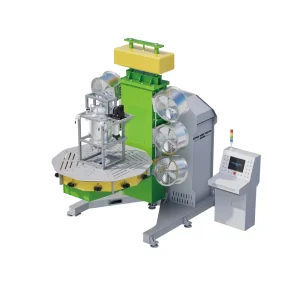
Understanding the economics of procuring rotomolded boats requires evaluating both equipment expenditures (CAPEX) and per-unit production costs (OPEX). High-capacity marine rotational molding requires specialized multi-arm carousel machines, heavy-load shuttle machines, and precision-machined CNC aluminum or steel molds engineered to withstand multi-zone heat dynamics. As a result, partnering with an experienced direct exporter who controls the entire value chain—from mold design to final watercraft testing—is the single most vital factor for international procurement success.
Extensive supply chain integration, advanced tooling precision, and unmatched cost-to-performance benchmarks.
China's industrial clusters (particularly in Ningbo and Zhejiang province) combine raw resin compounding factories, 5-axis CNC mold manufacturing facilities, and automated rotomolding machinery assembly plants within a tight geographical radius. This drastically cuts engineering iteration cycles.
Developing custom 6-meter to 10-meter boat molds in Europe or North America often involves prohibitive capital expenditure. Chinese manufacturers leverage specialized cast-aluminum tooling and high-tensile steel fabrications at a fraction of Western costs without compromising dimensional tolerances.
Modern Chinese exporters incorporate closed-loop PLC thermal regulation, eco-friendly electric heating rotational molding systems, dynamic internal air pressure monitors, and real-time resin melt viscosity sensors to guarantee zero-defect hull outputs.
Why LLDPE, HDPE, and foam-filled sandwich constructions deliver unsinkable performance.
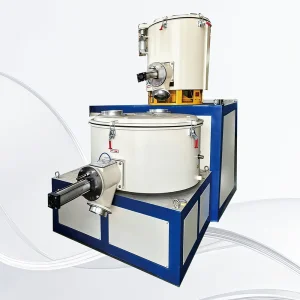
The foundational success of a rotomolded boat relies heavily on material selection. Industrial marine grade LLDPE (Linear Low-Density Polyethylene) and HDPE (High-Density Polyethylene) polymers are modified with specialized additive masterbatches containing UV-20 stabilizers, anti-oxidants, and color pigments. This guarantees that boats deployed in equatorial tropical waters or arctic sub-zero conditions resist structural embrittlement, stress cracking, and color fading caused by solar ultraviolet radiation.
Leading rotomolded boat exporters utilize multi-layer rotational molding techniques. By co-rotating high-density virgin skin layers with expanded polyurethane (PU) or polyethylene foam cores, the resulting marine hull exhibits structural stiffness comparable to double-hulled aluminum craft. The trapped closed-cell foam prevents water ingress even if the outer skin experiences severe puncture during high-speed grounding or rocky shore landings—making the vessel virtually unsinkable.
Achieving uniform hull thickness in large complex shapes (such as deep-V fishing hulls, catamarans, or pontoon boats) demands thermal simulation software during mold design. Chinese mold engineering teams analyze bi-axial rotation speeds, arm ratios, and heat dissipation rates within the heating chamber to eliminate thin spots at keel transitions and transom mounting brackets, ensuring ultimate structural reliability under heavy motor loading.
From initial CAD modeling to sea trials and containerized international logistics.
B2B buyers collaborate with naval engineers to define hull hydrodynamics, center of gravity, load-bearing capacities, transom outboard rating, and internal deck drainage systems. 3D STEP/IGES files are generated and stress-tested using Finite Element Analysis (FEA).
High-grade aluminum block alloys (e.g., A356 or 6061) are CNC machined or sand-cast to form high-precision molds. Polished mold cavities are fitted with pneumatic ejector pins, parting-line clamps, and internal venting units to ensure seamless surface finishes.
Using high-load shuttle rotomolders or multi-station carousel machines, raw resin compounds undergo precise oven cycle times and rapid controlled air/water mist cooling. Automated closed-cell foam injection follows for unsinkable deck reinforcement.
Hulls undergo ultrasonic wall thickness measurement, drop impact testing, hydrostatic buoyancy tests, and hardware stress checks. Qualified units are stack-nested or custom-crated for optimal 40ft HQ container loading to minimize ocean freight rates.
Versatile deployment profiles across commercial, government, and leisure marine sectors globally.
Highly durable flat-bottom rescue tenders deployed by municipal fire departments during coastal flooding and river rescue missions. Extremely impact-resistant against submerged debris.
Heavy-duty feeder workboats, floating pontoons, and cage maintenance craft designed to withstand harsh saltwater bio-fouling and continuous daily industrial loading.
Single/double kayaks, pedal boats, and electric motor dinghies built for resort rental operations requiring virtually zero routine maintenance and maximum damage resistance.
Custom rotomolded drone boat hulls integrated with sonar, lidar, and oceanographic sensors for autonomous hydrographic surveying and environmental monitoring.
Key technological innovations reshaping quotes, material efficiency, and factory selections through 2030.
When requesting quotes from a Chinese rotomolded boat manufacturer or exporter, ensure your RFQ includes the following key specifications:
Comprehensive technical and commercial answers for international marine buyers and importers.
Browse our turnkey machinery, high-load shuttle rotomolders, lab testing units, and specialized molds.