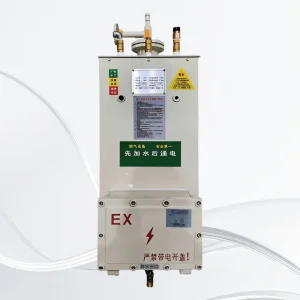
Explore industrial-grade rotational molding machines, automated carousels, shuttle lines, and precision mold tooling backed by ISO & CE certifications.
Unlocking the structural superiorities of stress-free thermoplastic manufacturing through low-pressure biaxial heat transfer dynamics.
Custom Rotational Moulding (Rotomolding) represents a specialized, high-temperature, low-pressure thermoplastic process utilizing biaxial rotation to manufacture seamless, stress-free, hollow plastic products. Unlike high-pressure injection molding or extrusion blow molding—which introduce residual shear stresses due to forced polymer melt flow—rotomolding relies entirely on thermal sintering, gravity, and precise rotational velocity dynamics. Micro-ground polymer powders (typically 35-50 mesh / 300-500 microns) coalesce progressively against the heated internal cavity of a customized aluminum or steel mold tool.
The technical integrity of custom rotomolded hollow components hinges on real-time continuous control of the Internal Air Temperature (IAT) curve within the mold cavity. Modern contract manufacturing facilities deploy telemetry-driven wireless pyrometers and IR sensor arrays to track four distinct kinetic thermodynamic phases:
Engineering Gain Insight: Because rotational molding does not force melted plastic through continuous high-pressure runners or gates, the molded components feature zero weld lines, uniform corner wall thickness accumulation, and exceptional environmental stress crack resistance (ESCR). Wall thickness at sharp external corners can actually be engineered up to 15-25% thicker—a direct physical inversion of injection molding thinning characteristics.
How Fortune 500 procurement teams and OEM buyers navigate material substitution, tooling investments, and global supplier qualification.
The global rotational molding market is experiencing an unprecedented structural expansion, projected to achieve a CAGR of 6.2% through 2030. This surge is driven by aggressive material substitution strategies: heavy industrial manufacturing sectors are systematically replacing legacy sheet metal, welded steel, and fiberglass reinforced plastics (FRP) with engineered rotomolded polyethylene (LLDPE, HDPE, XLPE) and polyamide (PA12/Nylon) assemblies.
Rotomolding tooling costs 60% to 80% less than comparable injection molding dies, making it the mathematically superior choice for low-to-medium annual volumes (50 to 20,000 units/year).
Cross-linked Polyethylene (XLPE) and High-Density Polyethylene (HDPE) offer extraordinary resistance to aggressive acids, diesel fuels, and harsh agricultural chemicals without risk of internal corrosion or seam failure.
Complex multi-component sheet metal weldments can be consolidated into a single rotomolded hollow structure, eliminating secondary fasteners, gaskets, manual welding labor, and potential leak pathways.
To provide global procurement officers and chief technology officers (CTOs) with clear cost-benefit clarity, the following engineering matrix compares key manufacturing processes for large hollow products:
| Evaluation Parameter | Rotational Moulding | Injection Moulding | Extrusion Blow Moulding | Fiberglass (FRP) Hand Layup |
|---|---|---|---|---|
| Initial Tooling Cost (CAPEX) | Low ($5k - $45k) | Extremely High ($80k - $400k+) | Moderate-High ($35k - $150k) | Very Low ($2k - $12k) |
| Stress Distribution | Stress-Free Monolith | High Residual Stresses | Moderate Axis Stresses | Variable Internal Stresses |
| Wall Thickness Uniformity | Excellent (Thicker Corners) | Uniform (Stretched at corners) | Non-uniform (Parison stretch) | Manual Operator Dependent |
| Economic Production Volume | 50 to 25,000 units/yr | 50,000+ units/yr | 10,000+ units/yr | 1 to 1,000 units/yr |
| Multi-Layer & Foam Core | Seamless Multi-Layer Integration | Extremely Difficult | Co-extrusion limited | Manual Sandwich Core |
| Threaded Inserts & Graphics | Molded-in Solid Metal Inserts | Post-molded or Overmolded | Difficult Molded-in Threads | Glued/Secondary Assembly |
Selecting the precise operational machine layout and CNC mold tooling medium tailored to volume, dimensions, and structural specifications.
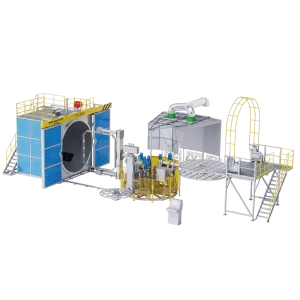
Modern rotational molding factories utilize four major machine kinematic architectures. Selecting the right machinery directly dictates thermal efficiency, cycle time optimization, and factory unit economics:
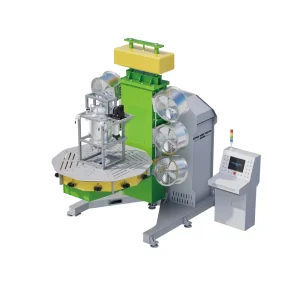
Feature 3 or 4 independent arms revolving between Heating, Pre-cooling, Cooling, and Unloading stations. Allows continuous high-volume production with distinct cycle timing per arm.
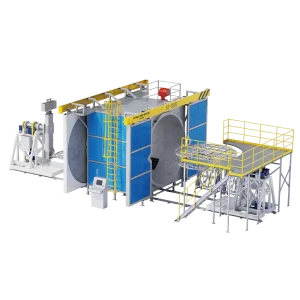
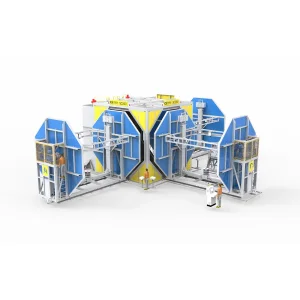
Configured with a central heating oven and two independent shuttling carts moving horizontally. Ideal for massive products, disparate cycle times, and flexible batch production.
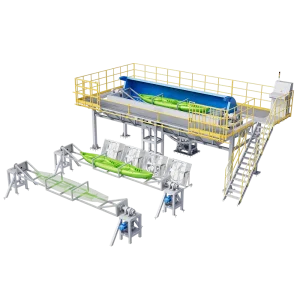
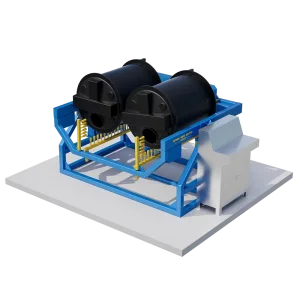
Designed specifically for narrow, long hollow objects (fuel tanks, heavy industrial pipes, marine vessels, kayaks). Executes full 360° rotation on the long axis with a 45° rocking motion on the perpendicular axis.
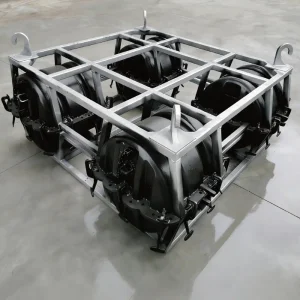
The operational success of custom rotomolding relies heavily on precision mold manufacturing. Engineering teams evaluate mold structural choices based on part surface finish requirements, geometric complexity, and production run life expectancy:
Unpacking Ningbo and Zhejiang’s rotomolding manufacturing clusters, smart electric heating innovations, and rapid export logistics.
China’s premier rotomolding industrial cluster—centered in Ningbo, Zhejiang—has evolved into a globally dominant hub for smart rotational moulding technology. By combining complete vertically integrated raw material compounding, precision CNC mold fabrication, machine assembly, and digital PLC sensor integration, Chinese factories deliver unrivaled supply chain agility and cost optimization for global B2B clients.
Pioneering electric-heating rotomolding machinery replaces open gas flames with zero-emission, clean conductive infrared heating, lowering energy consumption by up to 35% while dramatically improving heating uniformity.
Leading Ningbo factories house internal cryogenic pulverizing, color masterbatch blending, and UV-stabilizer compounding lines (UV8 to UV24 ratings), ensuring zero virgin resin contamination.
Modern export-oriented facilities operate under ISO 9001:2015 quality management systems, providing CE certified machine safety interlocks, automated PLC burner controls (Siemens / Schneider), and full material traceability.
Supply Chain Advantage: Ningbo Port’s proximity allows seamless ocean freight dispatch of massive rotomolding machinery, oversize moulds, and finished plastic products directly to North America, Europe, Australia, and the Middle East, reducing international transit lead times by up to 10-14 days.
From initial CAD feasibility to final ultrasonic wall thickness verification and CMM inspection.
Executing a successful custom rotomolding project demands a disciplined 5-stage engineering workflow to ensure zero geometric distortion and flawless structural performance:
Delivering tailored rotomolded components across global water treatment, marine, logistics, and heavy machinery sectors.
Seamless vertical water tanks, chemical dosing vessels, double-walled hazardous material bunds, and agricultural spray tanks up to 30,000-liter capacity engineered from corrosion-resistant HDPE and XLPE resins.
Heavy-duty floating pontoons, dock fenders, navigational buoys, commercial marine floats, and custom rotomolded boat hulls filled with closed-cell polyurethane foam for non-sinkable buoyancy.
Insulated vaccine containers, rotomolded ice boxes/coolers with R-value polyurethane insulation, heavy-duty plastic pallets, linen carts, and spill-containment work pallets for chemical drums.
Vibration-proof diesel fuel reservoirs, hydraulic oil tanks with molded-in brass threads, tractor operator cabs, engine shrouds, and air intake ducting for excavator manufacturers.
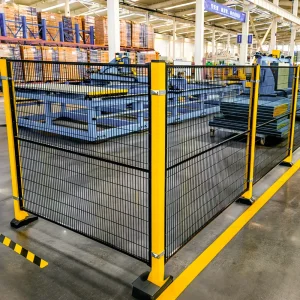
Modular surrounding safety fences, outdoor commercial playground slides, traffic barriers, smart waste management bins, and ergonomic outdoor architectural furniture.
Custom housings for medical diagnostic equipment, waste scrubbers, air filtration plenums, and hazardous chemical spill containment bins requiring flame-retardant compounding.
Understanding key price drivers to eliminate hidden manufacturing costs and maximize total return on investment (ROI).
When evaluating quotes from custom rotational moulding factories, overseas buyers should scrutinize four core cost components that define total cost of ownership (TCO):
| Cost Component | Percentage of Unit Price | Optimization Strategy |
|---|---|---|
| Raw Polymer Resin | 40% - 55% | Optimize nominal wall thickness via FEA structural ribbing rather than simply adding mass. Specify standard LLDPE grades where possible. |
| Heating & Machine Cycle Time | 20% - 30% | Utilize CNC cast aluminum moulds with thermal pins/conductive vents to shorten oven bake times by 15-20%. |
| Tooling Amortization (CAPEX) | 10% - 20% | Amortize high-precision CNC aluminum tooling across minimum order quantities (MOQ) or multi-cavity mold frames. |
| Post-Molding & Assembly | 5% - 15% | Integrate molded-in thread inserts, spin-weld fittings, and mold-in graphics during the heating cycle to minimize manual labor. |
Pro Procurement Tip for Quotations: Always request an itemized RFQ response detailing: 1) Mold Material Grade (e.g., A356 aluminum vs Q235 steel); 2) Guaranteed Tooling Lifespan (e.g., 50,000 cycles); 3) Specific Polymer Powder Mesh & UV Rating; 4) Secondary CNC Trimming inclusions; and 5) Packaging & Containerization Efficiency.
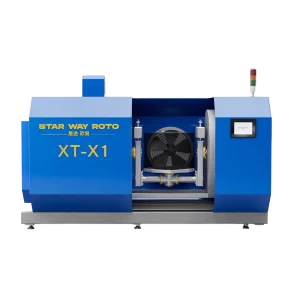
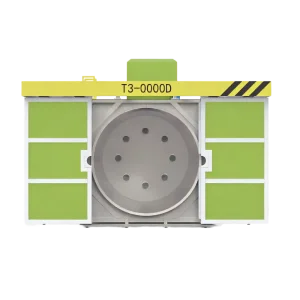
Explore lab testing equipment, specialized Rock & Roll systems, square shuttles, and heavy steel tooling.
Expert technical answers resolving core inquiries regarding rotomolding process parameters, mold engineering, and factory sourcing.