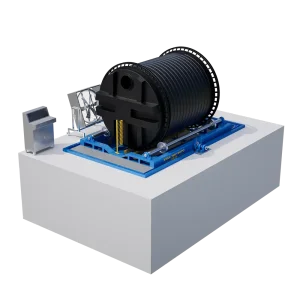
Direct factory configurations manufactured under ISO9001 and CE compliance for high-yield hollow plastic parts production.
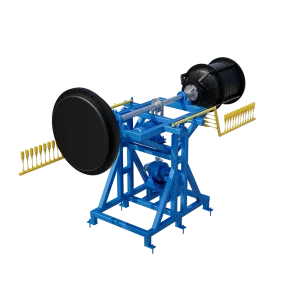
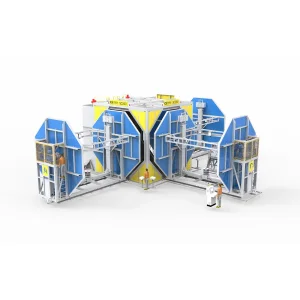
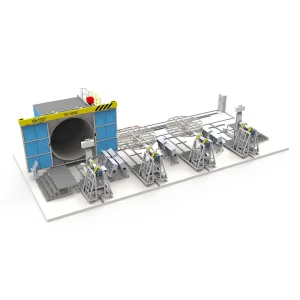
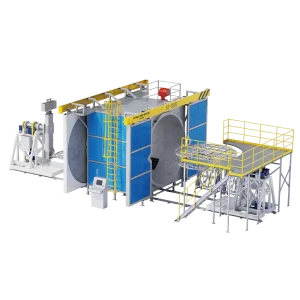
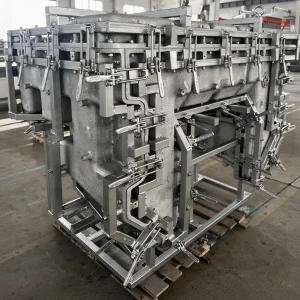
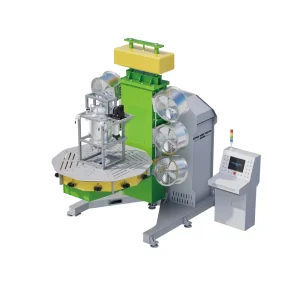
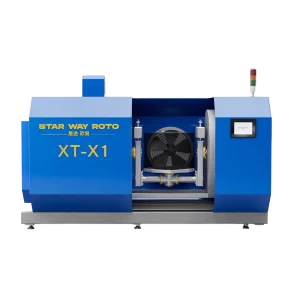
Rotational molding (Rotomolding) is a stress-free thermoplastic processing method characterized by biaxial rotation, atmospheric heating, and synchronized cooling. Tooling design dictates 85% of final part mechanical performance, dimensional stability, and cycle efficiency.
Rotomolding relies strictly on conductive and convective heat flux without hydraulic injection pressure. Aluminum alloys (A356/6061) exhibit thermal conductivity of ~160 W/(m·K), reducing cycle times by 25-35% compared to fabricated carbon steel (~45 W/(m·K)).
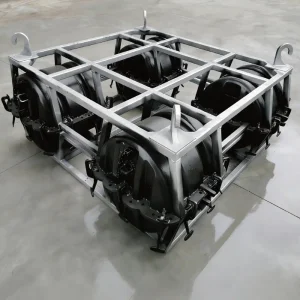
Direct 5-axis CNC machining of forged aerospace-grade aluminum blocks ensures microscopic tolerance control, eliminates internal porosity, and guarantees perfect parting line alignment, vital for cosmetic consumer-facing products.
Heavy-duty structural frames, clamping spider systems, and pneumatic unlatching assemblies are engineered to withstand continuous 250°C oven thermal cycling and secondary cooling shock without warping.
Evaluating Cast Aluminum, Direct CNC Billet Machined Aluminum, and Fabricated Sheet Steel moulds for total manufacturing efficiency, tooling ROI, and volume suitability.
| Engineering Parameter | Cast Aluminum Moulds (A356) | CNC Billet Machined Moulds (6061) | Fabricated Sheet Steel Moulds |
|---|---|---|---|
| Primary Fabrication Method | Wood/Resin Pattern → Foundry Casting → CNC Finishing | Direct 5-Axis Subtractive CNC Billet Milling | CNC Laser Cutting → Press Brake → TIG Welding |
| Dimensional Tolerance | ±0.25mm to ±0.50mm | ±0.05mm to ±0.12mm (Aerospace grade) | ±1.00mm to ±2.50mm |
| Thermal Conductivity | 150 - 170 W/(m·K) (Fast thermal transfer) | 160 - 180 W/(m·K) (Ultra-fast & homogeneous) | 40 - 50 W/(m·K) (Slower cycle time) |
| Geometric Complexity | Extremely High (Undercuts, deep ribs, compound curves) | High to Extreme (Micro-features, sharp edges) | Low to Moderate (Cylindrical, box shapes) |
| Surface Finish Range | Cast texture, bead blast, chemical etching | Class-A Mirror polish, high-definition textures | Mill finish, painted, bead blasted |
| Tooling Weight vs Steel | ~60% lighter than equivalent steel | ~65% lighter than equivalent steel | Baseline Heavyweight |
| Relative Tooling Cost (CapEx) | Medium (High pattern cost, low unit replication) | Medium-High (High material cost, fastest lead time) | Lowest initial CapEx for large simple tanks |
| Ideal Production Scale | Medium-to-High Volume Complex Products | High-Precision, Automotive & Tech Enclosures | Ultra-Large Water Tanks, Simple Containers |
Headquartered in Ningbo, Zhejiang—the epicenter of China's world-class mold manufacturing cluster—Ningbo StarWay Roto Co., Ltd. delivers unparalleled supply chain speed, vertical engineering control, and cost competitiveness.
Operating from our 20-acre dedicated manufacturing facility, encompassing dedicated foundry patterns, CNC machining centers, steel fabrication, and machine assembly lines.
Direct local access to virgin aluminum ingots, specialized laser cutting, and heat treatment allows DFM approval to T1 sample delivery in as little as 25-35 days.
Lower tooling and machine procurement CapEx by 35% to 55% relative to European or North American machinery builders, with zero compromise on component quality.
Situated 40 km from Ningbo-Zhoushan Port—the world's largest container throughput hub—ensuring streamlined maritime logistics, heavy-lift containerization, and fast export customs.
Every custom rotomolding mould adheres to a strict 5-stage engineering lifecycle governed by internal CMM dimensional control and thermal stress simulation.
Comprehensive draft angle review (2°-5°), volumetric shrinkage compensation (1.5%-3.5% PE/PP), and parting line optimization.
Precision 5-axis high-speed CNC milling of casting wooden/resin patterns or monolithic 6061-T6 aluminum tool cavities.
High-density aluminum casting with degassing agents to eliminate voids, followed by T6 artificial aging for structural stability.
Micro-blasting, chemical etching (VDI 3400), PTFE non-stick coating application, and custom temperature-resistant venting ports.
Full rotomolding machine trial run on StarWay carousel or shuttle machines to verify cycle time, wall thickness, and part release.
Mitigate international operational risks with turnkey compliance standards built into all StarWay Roto equipment, controls, and tooling frameworks.
StarWay Roto machines and electrical control cabinets strictly comply with EU Machinery Directive 2006/42/EC and Low Voltage Directive 2014/35/EU, utilizing Siemens PLC, Schneider electrical components, and dual-redundant safety interlocking systems.
Natural gas, LPG, and diesel burner systems feature European Riello / Weishaupt combustion controls with multi-stage gas leak detection, automated purge cycles, and explosion-relief venting adhering to NFPA and ATEX thermal chamber guidelines.
Equipped with industrial 4G/5G remote IoT VPN gateways, our software engineers provide 24/7 telemetry diagnostics, PLC firmware updates, and dispatch factory field engineers for Site Acceptance Testing (SAT) across North America, Europe, and Asia-Pacific.
Explore the diverse sectors where StarWay Roto custom moulds and machines empower multi-cavity, multi-layer, and high-impact structural manufacturing.
Cast aluminum and steel moulds engineered for UN-rated chemical IBC tote containers, underground septic vaults, and vertical water storage up to 50,000 liters.
Lightweight DEF (AdBlue) tanks, commercial EV battery cooling shrouds, off-highway tractor cabin roofs, fenders, and air intake ducts with high dimensional repeatability.
Seamless monolithic kayak moulds, multi-passenger recreational boats, offshore mooring buoys, and floating marina docks featuring foam-filled sandwich walls.
Heavy-duty insulated roto-molded cooler boxes, dry-ice vaccine containers, and thermal logistics pallets molded with strict parting line seal tolerances.
Animal feeding troughs, commercial sweeper housings, portable sanitation cabins, and industrial waste handling bins designed for maximum UV and impact resistance.
The rotomolding sector is advancing rapidly from traditional craft-based operations into Industry 4.0 automated, energy-efficient manufacturing.
Transitioning from open gas convection to direct electric cartridge/induction heating elements integrated directly into the mould body. Reduces energy consumption by up to 50%, eliminates flue gas emissions, and enables cleanroom-grade medical molding.
Wireless in-mold temperature logging (PIAT - Peak Internal Air Temperature monitoring) enables automated closed-loop PLC machine indexing. The machine automatically advances stations the exact second material cure is reached, eliminating under-cure or thermal degradation.
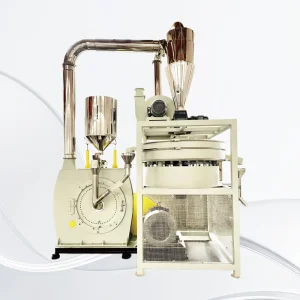
Expanding beyond standard LLDPE into cross-linked polyethylene (XLPE), Polyamide (Nylon 6 / 12), Polypropylene (PP), and 100% Post-Consumer Recycled (PCR) circular polymers with micro-grinding particle size optimization (35-50 mesh).
Comprehensive engineering and procurement answers for international tooling managers, plant directors, and OEM buyers.
For standard polyethylene parts with smooth finishes, a minimum draft angle of 1.5° to 2° per side is recommended. For textured surfaces (such as leatherette, sandblast, or VDI textures), add 1° to 1.5° of draft for every 0.025mm of texture depth. Deep vertical ribs or female cavities may require up to 3°-5° to prevent part sticking during cooling shrinkage.
Volumetric shrinkage in rotational molding depends heavily on resin density, wall thickness, and cooling rate. Typical Linear Low-Density Polyethylene (LLDPE) exhibits 2.5% to 3.2% shrinkage; High-Density Polyethylene (HDPE) exhibits 3.0% to 3.8%; while Polypropylene (PP) can reach 1.5% to 2.2%. Our engineering team applies non-linear shrinkage compensation directly into 3D CAD/CAM toolpaths before CNC cutting.
A properly maintained cast aluminum (A356) mould with robust steel clamping frames easily exceeds 50,000 to 80,000 molding cycles. Direct CNC machined 6061 billet aluminum moulds can endure 100,000+ cycles without parting line degradation. Regular preventative maintenance involves checking PTFE vents, inspecting spring toggle clamp tensions, and cleaning parting line flash tracks.
Because rotomolding is an atmospheric process, air inside the mould expands during heating and contracts during cooling. Inadequate venting leads to backpressure blowouts, pinholes, thin corners, and structural vacuum collapse of the cooling part. We incorporate temperature-resistant PTFE breathable tubes and sintered bronze vent inserts sized at 12mm-25mm per cubic meter of part volume.
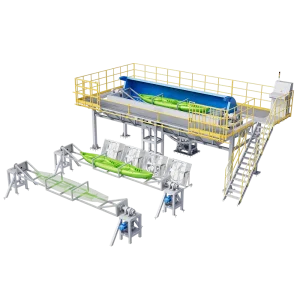
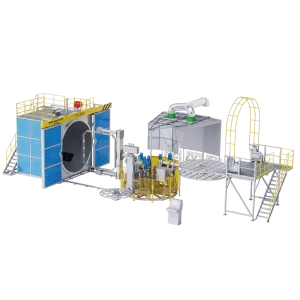
Carousel machines (Fixed or Independent Arm) are optimal for high-volume, continuous 24/7 manufacturing of uniform items where heating, cooling, and servicing cycles are closely synchronized. Shuttle machines offer maximum production flexibility for variable product sizes, different mould changeovers, low headroom requirements, and lower capital investment.
Standard cast aluminum tooling typically takes 25 to 35 business days from 3D CAD approval to T1 trial part shipment. Standard shuttle or carousel rotomolding machines require 45 to 60 days for complete manufacturing, electrical assembly, and in-house dry cycle factory acceptance testing (FAT) prior to ocean export.
Explore our high-capacity shuttle systems, large-scale rock and roll ovens, precision steel moulds, and auxiliary plastic pulverizers.