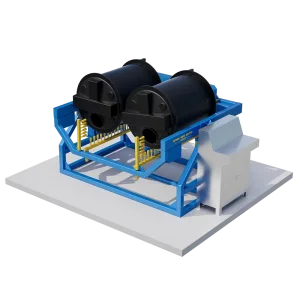
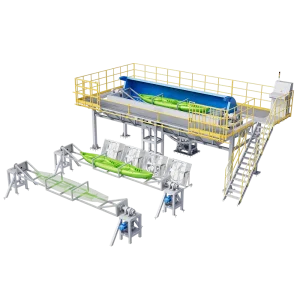
Engineered for extreme structural durability, high thermal transfer efficiency, and automated closed-loop production cycles. Browse our premier heavy-load and high-efficiency systems.
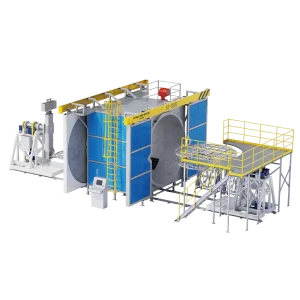
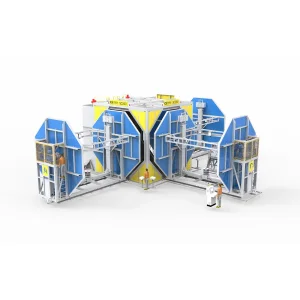
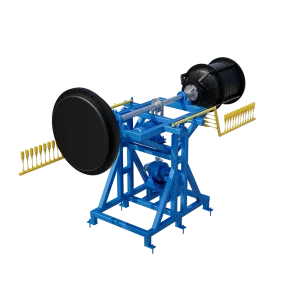
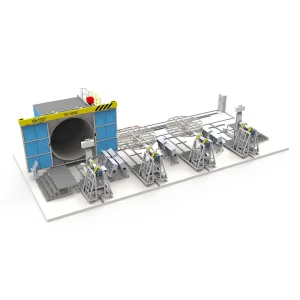
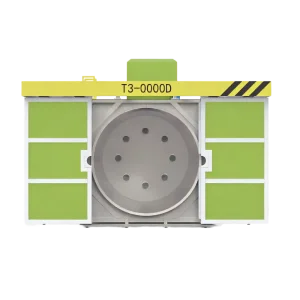
Multi-stage intelligent burners and balanced recirculating airflow guarantee +/- 2.5°C thermal variance across massive multi-cavity moulds, eliminating residual stress and thin spots.
Independent VFD servo drives on major and minor axes deliver infinitely variable rotation speed ratios (1:1 to 1:20) for optimal polymer wall distribution on asymmetric geometries.
Siemens & Mitsubishi PLC control suites integrate recipe storage, real-time wireless internal air temperature (PIAT) telemetry, predictive maintenance, and energy logs.
Rotational molding (Rotomolding) has evolved from an empirical craft into a highly regulated, thermo-mechanically controlled polymer manufacturing discipline. As global demand surges for ultra-large seamless hollow structures—including IBC chemical containers, heavy agricultural liquid reservoirs, complex automotive fuel systems, offshore marine floats, and insulated cold-chain logistics crates—the machinery powering this transformation requires exceptional mechanical rigidity, intelligent thermal dynamics, and predictable closed-loop process automation.
Modern rotational molding facilities face strict regulatory pressures regarding energy consumption (BTU/kg of processed polymer), cycle time optimization, and wall-thickness uniformity. Historically, European and North American machinery dominated high-precision sectors, but high capital expenditure (CapEx) and prolonged lead times prompted international manufacturers to look toward Tier-1 Chinese machinery OEMs. Today, premier Chinese suppliers provide vertical integration, covering machine fabrication, 5-axis CNC aluminum tooling, auxiliary material handling, and automated post-mold PU foaming cells.
Global procurement teams prioritize three critical pillars when auditing Chinese rotomolding machinery factories:
Selecting the correct machinery configuration depends on product envelope, wall thickness profile, resin kinetics, and batch production volumes. Below is a comparative engineering overview:
| Machine Architecture | Kinematic Axis Motion | Ideal Product Envelope | Throughput / Flexibility | Key Engineering Benefit |
|---|---|---|---|---|
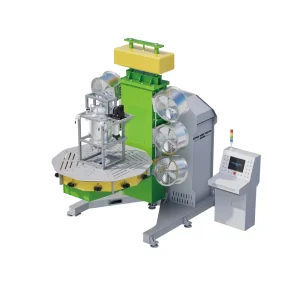
| Carousel (3 to 5 Arms) | Bi-Axial (360° Primary / 360° Secondary) | High-volume uniform items (coolers, bins, tanks < 3,000L) | High Throughput / Medium Flexibility | Simultaneous cooking, cooling, and demolding across synchronized dedicated stations. |
| Independent Shuttle | Bi-Axial with Custom Speed Ratios | Extra-large structures, irregular parts (tanks up to 50,000L, kayaks) | Medium Throughput / Maximum Flexibility | Independent arm cycle timing; one arm can cook while the other cools or undergoes mold changes. |
| Rock & Roll / Open Flame | Uniaxial 360° Rotation + ±45° Longitudinal Rocking | Long cylindrical vessels, pipe floats, large septic tanks, boat hulls | Specialized / Low-to-Medium Batches | Minimal footprint, low capital cost, extremely low energy usage for elongated geometries. |
| Direct Electric / IR Oven | Bi-Axial Synchronized Servo Drives | Cleanroom medical hollowware, technical engineering plastics (PA12, XLPE) | Precision Batch / Cleanroom | Zero combustion emissions, uniform electric radiant heating, compliant with strict carbon mandates. |
In rotational molding, over 65% of operating costs (OpEx) relate to resin raw materials and thermal energy. Standard forced-air convection ovens waste substantial heat through exhaust stacks and unsealed joints. StarWay Roto addresses this through advanced computational fluid dynamics (CFD) airflow simulations, creating optimized high-flow recirculating vortexes that transfer heat rapidly to mould walls via forced convection.
Variable frequency high-temperature draft blowers modulate air volume based on cycle status, reducing electricity use during loading and unloading intervals. Burner modulating valves automatically ramp down firing rates as chamber temperature reaches equilibrium, eliminating temperature overshoots that cause polymer discoloration or stress cracking.
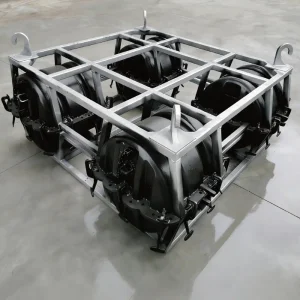
Machinery performance is fundamentally bound to mould engineering. A high-efficiency machine paired with sub-optimal tooling leads to prolonged cycle times and premature part distortion. Ningbo StarWay Roto maintains dedicated in-house CNC machining and aluminum foundry infrastructure:
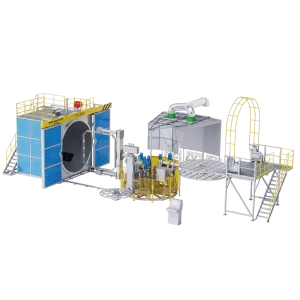
From raw polymer compounding to finished, robotic-trimmed rotational moldings—we engineer complete end-to-end production lines supported by global field engineers.
All exported systems comply with EU Machinery Directive 2006/42/EC, Low Voltage Directive 2014/35/EU, EMC Directive 2014/30/EU, and UL 508A electrical switchgear safety standards.
Our Field Service Engineering (FSE) teams handle foundation anchoring, electrical wiring, gas burner calibration, mould trial optimization, and operator training worldwide.
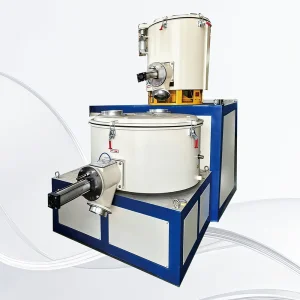
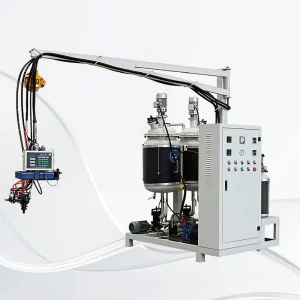
We design and supply complete peripheral equipment: high-speed polymer turbo blenders, cryo-pulverizers, high-pressure PU foaming machines, and mold-loading cranes.
Answers to common engineering, procurement, electrical compatibility, and logistical questions regarding Chinese rotomolding machinery supply.
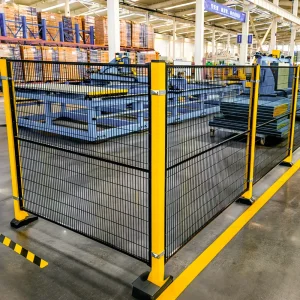
Discover our comprehensive range of high-capacity swing systems, carousel configurations, CNC molds, and safety enclosures designed for industrial scalability.