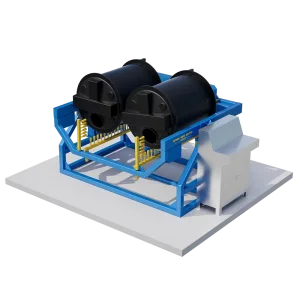
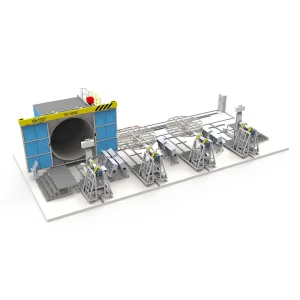
Explore our industrial-grade rotational molding machines engineered for maximum thermal efficiency, precision biaxial control, and reduced cycle times.
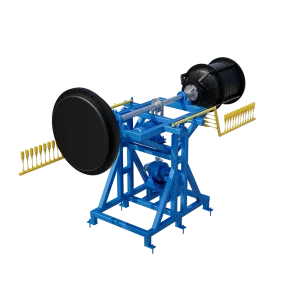
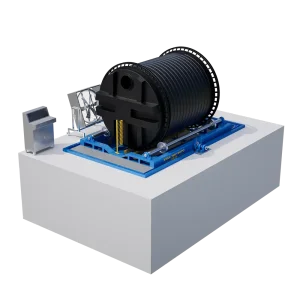
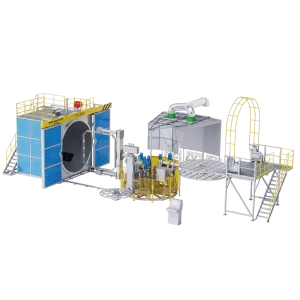
Understanding the physics, thermomechanical dynamics, and strategic market shift toward stress-free hollow plastic manufacturing.
Rotational molding, commonly termed rotomolding or rotocasting, represents a specialized zero-pressure thermoplastic processing technique tailored for manufacturing seamless, stress-free, hollow, double-walled, or multi-layered structural plastic components. Unlike traditional high-pressure polymer processing techniques—such as injection molding or blow molding—the rotational molding process relies exclusively on continuous biaxial rotation and gravity-driven thermal consolidation inside a heated mold chamber.
Globally, the rotational molding industry has transitioned from producing simple agricultural water tanks and containers into a high-precision engineering sector capable of producing heavy-duty fuel tanks, marine yachts, complex medical housings, military transport chests, and insulated cold-chain logistics containers. The global market value of rotomolded products continues to experience steady compound annual growth (CAGR > 6.2%), driven by rising demand for lightweight, corrosion-resistant, and high-impact structural alternatives to conventional metal fabrications.
| Manufacturing Process | Tooling Cost | Internal Residual Stress | Wall Thickness Uniformity | Maximum Part Volume | Design Flexibility |
|---|---|---|---|---|---|
| Rotational Molding | Low to Medium (Economical) | Zero / Negligible | High (Controlled by speed ratio) | > 30,000 Liters (Very Large) | Seamless hollows, undercuts & inserts |
| Injection Molding | Very High (Extensive CNC steel) | High (Cooling under pressure) | Strict limits (Rib-dependent) | Restricted by clamping force | High detail, solid walls only |
| Blow Molding | Medium to High | Moderate (Extrusion draw stress) | Variable (Pinch-off weakness) | Medium (Tanks, bottles) | Limited to symmetrical containers |
| Thermoforming | Low to Medium | Moderate | Thin corners / uneven draw | Medium (Open-faced items) | No fully enclosed hollow parts |
How top-tier Chinese rotomolding manufacturers combine advanced CNC cast aluminum tooling, intelligent burner automation, and cost efficiency.
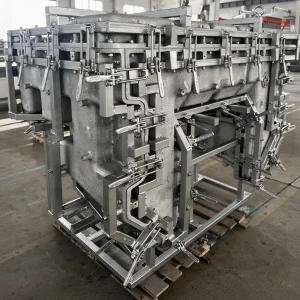
Leading Chinese facilities operate vertically integrated campuses where machine design engineers collaborate directly with CNC cast aluminum mold patternmakers. This eliminates geometric tolerances and ensures thermal synchronization between burner airflow and mold thermal mass.
Modern Chinese rotomolding machines incorporate PLC smart control systems, wireless internal air temperature (IAT) telemetry sensors, gas-saving direct-ignition combustion chambers, and independent arm rotation frequency drives for exact wall thickness targeting.
With localized supply chains for forged aluminum, high-grade structural steel, precision gear reducers, and ceramic fiber insulation, Chinese OEMs deliver high-durability production lines at 35% to 50% lower capital expenditure than European counterparts.
A rigorous examination of thermal sintering, bubble dissipation, biaxial velocity ratios, and controlled cooling thermodynamics.
The manufacturing process begins by accurately dispensing micronized thermoplastic powder (typically 35 Mesh / 500-micron grain size) into a hollow mold cavity. The quantity of material added determines the exact nominal wall thickness of the finished container. Advanced factories use computerized gravimetric dosing systems to maintain a wall thickness tolerance within ±0.3mm across complex geometries.
Once sealed, the mold assembly is transferred into a forced-convection hot air oven (operating between 260°C and 340°C depending on polymer type). The mold is simultaneously rotated on two perpendicular axes (major axis and minor axis) at low RPM (typically 4:1 or 8:1 speed ratio, rotating between 2 to 15 RPM). As the metal mold wall heats up, the internal powder reaches its melting temperature (Tm), adhering layer-by-layer to the mold interior. Surface tension drives the coalescence (sintering) of polymer particles, driving out trapped air pockets to form a homogenous liquid melt layer.
After complete sintering and bubble removal, the rotating mold transitions into a cooling chamber equipped with high-velocity air blowers and fine water mist atomizers. Cooling is the most critical phase for dimensional stability and warpage control. If cooled too rapidly, severe differential thermal shrinkage causes part distortion; if cooled too slowly, cycle time suffers and polymer crystal growth increases brittleness. Automated dual-stage cooling curves ensure optimal semi-crystalline density and minimal volumetric shrinkage (typically 2.5% to 3.0% for LLDPE).
When the internal air temperature drops below the polymer's heat deflection temperature (HDT), rotation stops, the mold is opened, and the solid hollow part is stripped from the mold cavity. Mechanical pneumatic ejectors or manual assistance are utilized depending on part depth and draw angles.
How rotomolded polymer solutions replace heavy steel and fragile fiberglass in heavy industries globally.
From 500L residential water tanks to 50,000L heavy-duty vertical chemical storage tanks engineered for sulfuric acid, sodium hypochlorite, and agricultural fertilizers. Steel-lined plastic rotomolding guarantees total chemical inertia.
Rotomolded double-hulled motorboat hulls, offshore floating docks, marine fenders, oceanographic buoy markers, and jet-ski platforms filled with expandible PU foam for unsinkable buoyancy.
Complex hydraulic oil reservoirs, seamless diesel fuel tanks for excavators and tractors, air intake ducts, tractor cab roofs, fender flaring, and impact-resistant battery housings.
Heavy-duty rotomolded cooler boxes, dry ice shipping chests, vaccine storage cases, and insulated fish tubs featuring thick PU foam injection walls for multi-day passive thermal retention.
Essential criteria for evaluation, quality assurance protocols, and machine selection guidelines.
When international procurement directors evaluate China-based rotational molding machine manufacturers, several critical technical standards must be audited to guarantee long-term operational uptime and low total cost of ownership (TCO):
The transition toward electric heating rotomolding, zero-emission burners, and circular post-consumer resins.
Eliminating open flames and gas combustion by embedding electric heating elements directly inside or around the mold surface, drastically reducing greenhouse gas emissions and thermal losses.
Real-time machine learning algorithms that dynamically adjust arm rotation speeds based on wireless internal temperature readings, eliminating trial-and-error scrap cycles during new mold commissioning.
Engineering specialized heat stabilizer packages that enable rotomolding with up to 100% Post-Consumer Recycled (PCR) polyethylenes and bio-based polylactic acid (PLA) compounds without degrading mechanical toughness.
Direct expert answers to key engineering queries regarding rotational molding machines, tooling options, and production efficiency.
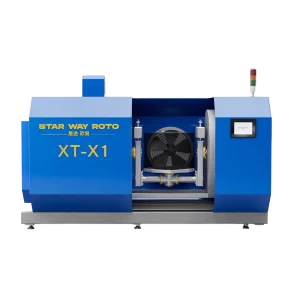
Explore our specialized range of shuttle machines, open flame systems, cast aluminum tooling, and laboratory testing rotomolders.