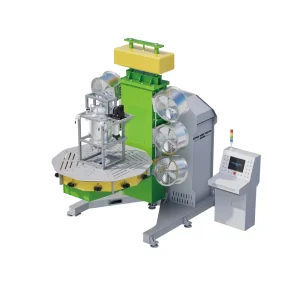
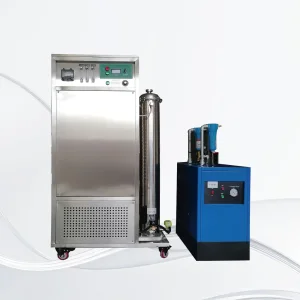
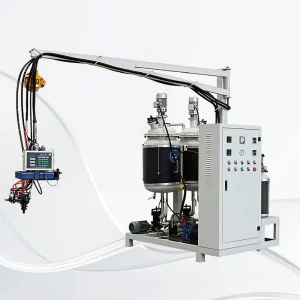
Engineered for large-format hollow molding, high thermal uniformity, and minimized operational expenditure across global manufacturing plants.
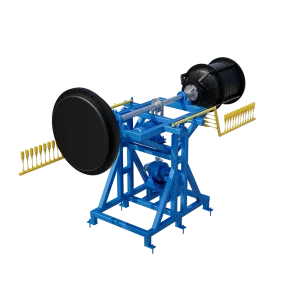
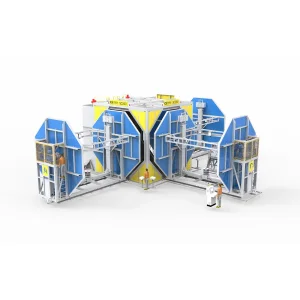
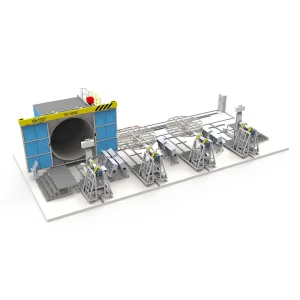
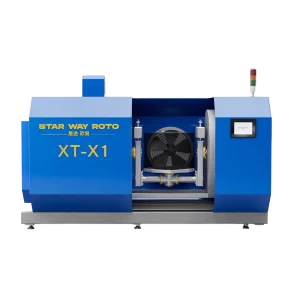
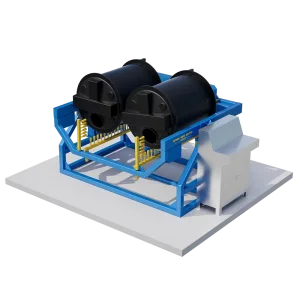
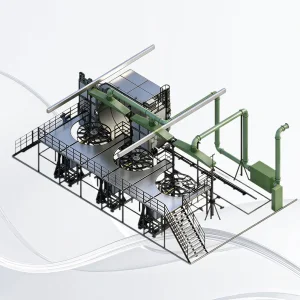
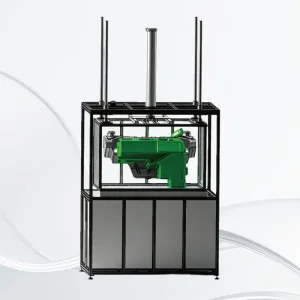
Understanding the fundamental physics governing 360-degree continuous axial roll coupled with variable transverse rocking oscillation.
While conventional carousel and shuttle systems operate through 360-degree simultaneous dual-axis planetary rotation (major and minor axes), Rock and Roll (R&R) machines utilize a dedicated single-axis 360° continuous roll combined with a transverse tilting (rocking) angle typically modulated between ±30° and ±45°. This specific kinematic motion delivers optimized resin powder deposition for elongated hollow profiles, preventing resin pooling at center cavities and ensuring homogeneous wall thickness across extreme length-to-diameter aspect ratios.
The thermomechanical transition of micro-pelletized or 35-mesh rotational molding resins (LLDPE, HDPE, XLPE, PP) demands controlled heat flux across mold surfaces. As the rock-arm tilts along the longitudinal plane, gravitational cascades force the fluid polymer pool across structural ribs, bosses, and narrow ends. Precise speed regulation of the secondary rolling drive eliminates centrifugal voiding, allowing pin-hole-free fusion, bubble dissolution, and zero-shear stress curing under minimal internal mold pressure.
Enclosing massive long-form molds (such as 5-meter expedition kayaks, 10,000-liter horizontal transport vessels, or agricultural culvert pipes) inside a traditional spherical bi-axial oven results in enormous volumetric air waste. Rock and Roll systems minimize oven chamber clearance by matching the cylindrical or horizontal profile of the tooling, slashing gas or electric energy consumption by 32% to 48% compared to standard carousel oven volumes.
From atmospheric open-flame systems to closed-loop digital twin thermal cells, evaluate how modern rotomolding is transitioning into automated Industry 4.0 factories.
While open flame rock and roll machinery remains highly prized across emerging industrial centers for its ultra-low capital entry cost and rapid cycle setup on large tanks, mature markets are actively upgrading to enclosed forced-convection rock and roll oven systems. Enclosed heating delivers tight PID temperature bands (±2.5°C), protects delicate mold surfaces from direct flame erosion, and enables seamless compliance with strict workplace emissions, NFPA gas codes, and European CE directives.
Modern StarWay Roto systems integrate Peak Internal Air Temperature (PIAT) telemetry and wireless non-contact infrared thermal sensors. Rather than relying solely on predetermined cycle timers, the control algorithm dynamically modulates burner output and rock/roll angular frequency based on real-time polymer viscosity feedback, eliminating under-curing, brittle impact failures, and surface pinholes caused by ambient shop-floor temperature shifts.
Legacy hydraulic rocker cylinders are being systematically replaced by high-precision AC servo drives coupled with heavy-duty planetary gear reducers. This mechanical architecture provides digital rock-angle setting (e.g., dwelling longer at steep 45° angles to feed material into reinforced kayak bow sections) and eliminates hydraulic fluid leakage hazards, reducing overall preventive maintenance intervals by more than 60%.
Evaluate technical parameters, production throughput, and Capex-to-Opex ratios across major rotational molding machine topologies.
| Evaluation Parameter | Open Flame Rock & Roll Machine | Enclosed Oven Rock & Roll Machine | Bi-Axial Linear Shuttle System | Bi-Axial Fixed Arm Carousel |
|---|---|---|---|---|
| Primary Application Geometry | Long cylindrical tanks, simple culverts, septic barrels | Complex kayaks, recreational hulls, drainage tubes | Cubic containers, IBC totes, multi-cavity parts | High-volume symmetric tanks, playground toys |
| Initial Capital Expenditure (CAPEX) | Ultra-Low (Optimal Entry) | Moderate (High ROI) | Moderate to High | High to Very High |
| Thermal Efficiency (BTU/kg) | Moderate (Atmospheric radiation) | Very High (Convective loop) | High (Sealed chamber) | Moderate to High |
| Aspect Ratio Suitability (L:D > 4:1) | Exceptional | Exceptional | Limited by spherical swing | Extremely restricted by arm radius |
| Floor Space Utilization (m²) | Minimal Footprint | Compact linear footprint | Linear double-end layout | Expansive radial layout required |
| Mould Changeover Flexibility | Under 15 minutes | Under 25 minutes | 30–45 minutes | Complex multi-arm synchronization |
| Temperature Regulation Precision | Manual / Optical Pyrometer (±8°C) | Closed-loop Multi-zone PID (±2°C) | Multi-zone PID (±3°C) | Multi-zone PID (±3°C) |
How Ningbo StarWay Roto leverages precision manufacturing, vertical supply integration, and stringent quality assurance to support global industrial procurement.
Operating out of a modern 20-acre manufacturing plant in Ningbo, StarWay Roto houses complete heavy-fabrication infrastructure, including heavy gantry CNC milling, automatic submerged arc welding lines, and dynamic balancing test rigs for ultra-large rock arms. Our vertically integrated pipeline eliminates sub-tier contractor delays, ensuring reliable delivery schedules even during global supply disruptions.
With more than 80% of our engineering staff holding accredited engineering degrees and over 10 years of rotomolding specialization, our team holds 23 proprietary patents. From finite element stress analysis (FEA) on cantilevered U-arms to custom thermal modeling of burner chambers, our engineering department designs custom-tailored solutions for complex product geometries.
Having engineered and commissioned the world's largest rotomolding machine (Model S2-8500), StarWay Roto possesses proven engineering expertise in structural load balancing, oversized burner synchronization, and high-safety interlock integration required for extreme-scale rotational molding machinery.
Examining specific market drivers, statutory requirements, and equipment configurations across core international manufacturing regions.
High demand for automated, enclosed rock and roll cells capable of continuous production for multi-layer outdoor recreational kayaks, marine pontoons, and cross-linked polyethylene (XLPE) chemical transport tanks. Compliance with NFPA 86 industrial furnace standards, UL-listed electrical panels, and Allen-Bradley/Siemens PLC architectures are critical procurement prerequisites.
Strict European Union CE Machinery Directives (2006/42/EC), Low Voltage Directive, and EN 746-2 industrial thermoprocessing safety codes drive preference toward high-efficiency enclosed convection ovens, electric heating variants, low-NOx burners, and comprehensive sound-attenuation chambers to meet aggressive factory sustainability targets.
Rapid urban infrastructure expansion and agricultural modernization fuel robust demand for durable, cost-effective Open Flame and Hybrid Rock and Roll machines. Buyers prioritize rugged mechanical designs, dual-fuel capability (LPG / Diesel / Natural Gas), low maintenance overhead, and rapid local commissioning for agricultural liquid tanks and sanitation systems.
Engineered tooling synergies delivering structural integrity across critical commercial and consumer product categories.
Single, tandem, and fishing kayaks, stand-up paddleboards, and marine floating docks. Rock and roll motion ensures dense, bubble-free plastic distribution along narrow bow and stern keels without excessive hull wall buildup.
Horizontal chemical spray tanks, fertilizer transport vessels, and livestock feeding troughs up to 10,000 liters. The rock-and-roll layout accommodates massive cylindrical tools without requiring 8-meter high factory roof clearances.
Underground ribbed septic tanks, rainwater culvert retention chambers, and grease trap manifolds. Extreme wall thickness uniformity prevents buckling under subterranean hydrostatic and soil compressive loads.
Water-ballasted traffic crash attenuators, expansion barriers, and airport runway markers. Robust rotation controls enable fast molding cycles with heavy-duty virgin and recycled PCR resin blends.
Direct answers to critical technical questions from plant managers, procurement directors, and rotomolding process engineers.
Bi-axial rotomolding machines rotate molds through 360 degrees along two perpendicular axes simultaneously, creating a spherical distribution pattern ideal for cubic, spherical, or symmetrical geometries. In contrast, Rock and Roll machines rotate the mold continuously 360 degrees around its main longitudinal axis while tilting (rocking) the entire chassis end-to-end between ±30° and ±45°. This directed motion makes Rock & Roll systems vastly superior for elongated, high-aspect-ratio parts like kayaks, canoes, horizontal tanks, and drainage pipes, avoiding the heavy center wall accumulation common in bi-axial machines.
An Open Flame Rock and Roll machine is ideal when capital budget minimization, rapid deployment, and manufacturing large, uniform-wall products (such as agricultural water tanks or simple culverts) are the primary objectives. It eliminates the cost and structural overhead of an insulated oven chamber. However, if you are manufacturing complex, aesthetic products (such as multi-color kayaks, high-end recreational craft, or parts using engineering resins like PP and PA-12), an Enclosed Convection Oven machine is essential for tight thermal control (±2°C), energy recovery, and surface finish protection.
Our advanced Rock and Roll control system allows programmable variable rocking dwell profiles. The operator can configure the machine PLC to pause or oscillate at maximum tilt angles (e.g., holding at +42° for 8 seconds and -42° for 8 seconds while rolling continuously) to ensure sufficient molten polymer pools into deep nose and tail cavities before indexing back through center. Combined with localized auxiliary hot-air blowers or directional infrared heaters, wall thickness variation is held within ±5% across the entire hull length.
A standard commercial Rock and Roll cell requires: (1) Electrical Supply: 3-phase 380V/440V, 50/60Hz, typically 15kW to 45kW depending on blower and drive motor configurations; (2) Gas Supply (for gas-fired variants): Natural gas at 50–100 mbar or LPG at 1.5–2.5 bar, with burner outputs ranging from 150,000 to 600,000 kcal/h; (3) Compressed Air: 6 to 8 bar clean, dry industrial air for pneumatic clamps and mold locks; (4) Floor Foundation: Level reinforced concrete pad (minimum 200mm thickness) engineered to absorb dynamic oscillating moments.
Yes. Our enclosed convection oven Rock and Roll machines feature multi-stage burner modulation, programmable closed-loop cooling chambers, and optional inert nitrogen purging systems. These capabilities satisfy the strict narrow processing windows required for XLPE chemical cross-linking and prevent oxidative degradation during the high-temperature melting phases of Polypropylene (PP) and Polyamides (PA-6/PA-12).
We offer comprehensive global customer support consisting of: (1) On-site installation and factory acceptance testing (FAT) by senior bilingual commissioning engineers; (2) Standardized non-proprietary mechanical and electrical components (e.g., Siemens PLC, Schneider contactors, Riello burners, NSK bearings) readily sourcable in your local market; (3) Cloud-connected IoT remote diagnostics providing 24/7 telemetry and ladder-logic troubleshooting; and (4) Fast-track express spare parts dispatch from our Ningbo logistics hub.
From lab testing and specialized shuttle lines to polyurethane foaming and post-mold inspection systems, discover our end-to-end manufacturing catalogue.