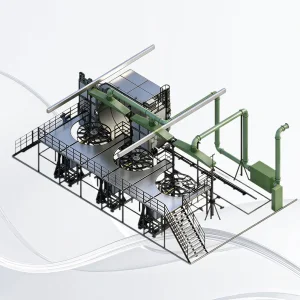
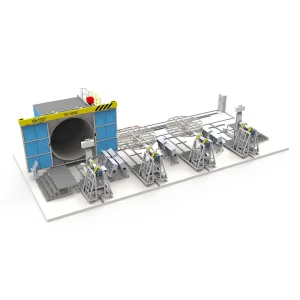
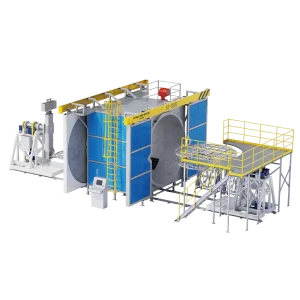
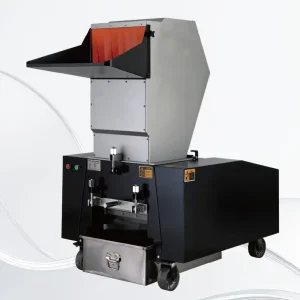
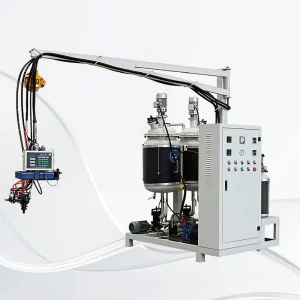
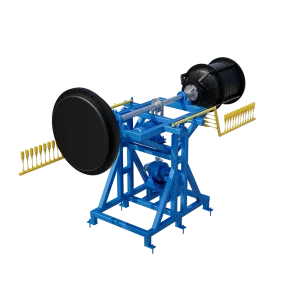
Explore our heavy-duty shuttle machines, rock-and-roll systems, and precision mould tools designed for continuous B2B manufacturing.
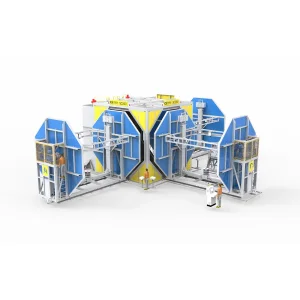
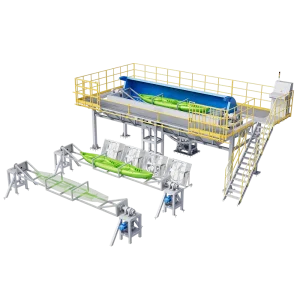
A rigorous engineering comparison of structural integrity, stress-free wall distribution, tooling economics, and scalability in industrial hollow-body manufacturing.
Unlike injection moulding or blow moulding, rotational moulding operates under ambient pressure within heated atmospheric ovens. Polyethylene (LLDPE/HDPE) or Polyamide (PA12) micro-powders sinter gradually against molten mould walls, completely eliminating molded-in molecular stress and structural shear planes. This yields exceptional impact resistance and environmental stress-crack resistance (ESCR).
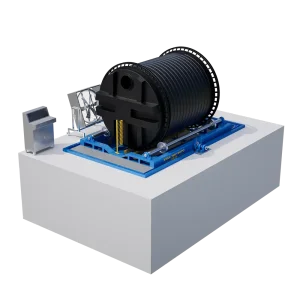
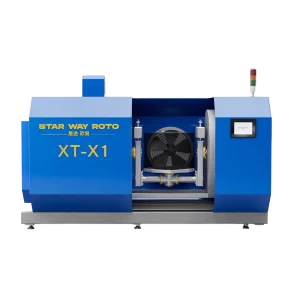
Modern carousel and shuttle rotational molding equipment utilize bi-axial rotation (major and minor axes) powered by high-torque AC servo drives. This guarantees precise, uniform resin distribution across deep recesses, complex undercuts, and large hollow structures, ensuring corner wall thickness remains equal to or thicker than straight side walls.
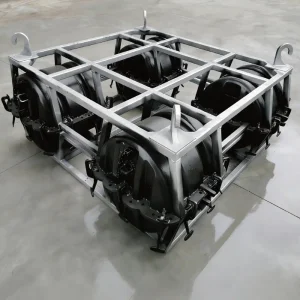
Cast aluminum (A356) and CNC-milled steel tooling for rotomolding require significantly lower capital expenditure than high-pressure injection molds. Tooling amortizes rapidly even for low-to-medium batch volumes (50 to 5,000 units/year), allowing rapid prototype iteration and seamless scale-up without prohibitive tooling overhead.
| Engineering Attribute | Rotational Moulding (StarWay Standard) | Injection Moulding | Extrusion Blow Moulding |
|---|---|---|---|
| Tooling Pressure Rating | Atmospheric (1.0 bar) | High Pressure (500–1500 bar) | Medium Pressure (25–100 bar) |
| Part Wall Uniformity | Excellent (Corner Reinforced) | Variable (Draft Angle Dependent) | Pinch-off Thinning at Corners |
| Max Part Volume Capacity | Up to 50,000 Liters+ | Limited (< 200 Liters) | Moderate (< 5,000 Liters) |
| Mould Tooling Amortization Cost | Low (10% - 25% vs Injection) | Extremely High ($50k - $500k+) | Moderate to High ($30k - $150k) |
| Molecular Stress Concentration | Zero Residual Stress | High Internal Stress Planes | Moderate Residual Stress |
| In-Mould Insert Integration | Seamless Brass/Steel Threads | Complex Insert Automation | Difficult / Secondary Ops Needed |
Leveraging deep industrial clusters in Zhejiang Province, state-of-the-art 20-acre production facilities, and end-to-end vertical integration.
Headquartered in Ningbo—one of Asia's primary maritime and industrial manufacturing centers—Ningbo StarWay Roto integrates structural mechanical design, multi-axis CNC mold machining, burner assembly, PLC automation control wiring, and full thermal testing under one 20-acre modern facility.
Over 80% of our 40-member engineering department hold bachelor's degrees or higher with over a decade of dedicated rotomolding specialization. Holding 23 proprietary patents, our engineering team continuously advances burner thermal dynamics, energy efficiency ratios, and multi-arm station synchronization.
StarWay Roto engineered and manufactured the world's largest rotational molding machine—the flagship S2-8500 model. Featuring high-load mechanical arms capable of carrying massive multi-cavity tooling or mega-volume marine tanks, our machinery breaks capacity bottlenecks for heavy industry buyers worldwide.
How Industry 4.0 automation, smart thermal telemetry, and sustainable polymer formulations are reshaping global rotational molding capabilities.
Traditional rotomolding relied on timer-based oven cycles, leading to over-curing or under-curing resin risks. StarWay's modern intelligent PLC control panels integrate wireless internal air temperature (TPAT) sensors and real-time infrared thermal cameras to continuously monitor polymer melting phases and optimize cycle times automatically.
Energy accounts for up to 30% of rotomolding operational costs. Next-gen StarWay heating chambers utilize ceramic fiber insulation blankets combined with Italian Riello or Weishaupt burner systems. Closed-loop recirculating airflow reduces natural gas/LPG consumption by up to 22% compared to standard open-flame systems.
Advancements in polymer science enable multi-layer rotomolding. Inner anti-bacterial layers, middle foaming insulation layers (PU/PE foam), and outer UV-stabilized skin layers can be molded simultaneously using drop-box automated sequence charging, opening new possibilities for insulated containers and chemical vessels.
A structured, risk-mitigated procurement methodology tailored for international original equipment manufacturers (OEMs) and contract plastic moulders.
Initial evaluation of 3D CAD models (STEP/IGES). Complete Finite Element Analysis (FEA) to verify wall thickness, shrinkage compensation (1.5%–3.0%), draft angles (min 1° to 3°), and mechanical stress points.
High-precision CNC milling of aluminum block or pattern casting (A356 aluminum alloy) with micro-textured skin surface finishes. Parallel assembly of machine chassis, hydraulic arms, and Siemens PLC control panels.
Factory Acceptance Testing (FAT) conducted at our Ningbo plant. Sample parts undergo dimensional CMM inspection, wall thickness ultrasonic testing, impact drop tests, and hydrostatic leak verification.
Heavy machinery export packaging in wooden cases/crates. StarWay senior engineers deploy overseas to assist with foundation setup, burner gas pipe installation, PLC programming, and staff training.
Discover how StarWay rotomolding equipment drives performance across maritime, agricultural, municipal, and commercial storage sectors.
Large-scale Rock and Roll (Swing) machines enable the single-piece seamless molding of marine yachts, boat hulls, floating docks, and navigational buoys. Seamless polyethylene construction ensures 100% watertight reliability without welded joints susceptible to saltwater fatigue.
From 500-liter residential roof tanks to 50,000-liter industrial chemical storage tanks, StarWay shuttle and carousel rotomolding machines produce heavy-duty LLDPE/XLPE tanks resistant to aggressive acids, alkalis, and ambient outdoor UV weathering.
Automated feeding and weighing livestock systems molded via custom rotational tooling withstand harsh farm environments. Smooth interior surfaces prevent feed buildup and bacterial growth while providing high resistance to livestock impact and kick forces.
Expert answers addressing resin selection, machinery configuration, mold life cycles, and operational efficiency.
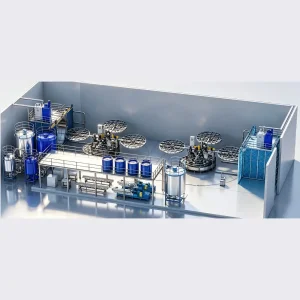
Explore auxiliary equipment, automatic feeding, PU foaming, micro-pellet pulverizers, and custom high-load capacity machinery.