
Explore our flagship rotational casting machinery, custom aluminum/steel tooling molds, material testing laboratories, and auxiliary recycling systems engineered for high-throughput OEM operations.
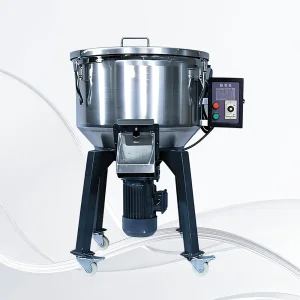
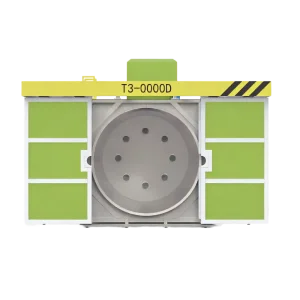
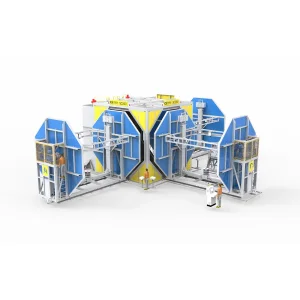
Rotational casting—commonly known as rotational molding or rotomolding—is a specialized thermomechanical manufacturing process designed to create seamless, stress-free, hollow plastic products. Unlike high-pressure methods such as injection molding or blow molding, the rotational casting process operates at atmospheric pressure, relying on heat flux transfer, gravity, and continuous biaxial rotation to achieve uniform polymer deposition along complex mold cavities.
The micro-physics of rotational casting involves four distinct phase transitions: powder fluidization, surface sintering, melt consolidation, and bubble removal (coalescence). Initially, micronized polymer powders (typically 35 mesh / 500 microns) are loaded into a cold mold cavity. As the mold travels into the heating oven, thermal energy conducts through the metal shell wall, elevating the inner surface temperature beyond the polymer’s melting point (Tm).
Powder particles stick to the heated mold surface in successive thin layers. Fluidization is driven by low-speed biaxial rotation, where the major and minor axis rotation ratio (typically 4:1, 3:1, or 1:4) ensures an even distribution of liquid polymer across complex radii, internal ribs, and deep recesses without centrifugal expulsion.
A critical metric of superior rotational casting manufacturing quality is the complete dissolution of trapped air bubbles within the polymer melt matrix. During the sintering phase, air pockets are initially trapped between melting powder granules. As heat continues to permeate the polymer layer, viscosity decreases, prompting interfacial surface tension forces to shrink and dissolve these air pockets into the molten matrix.
Leading rotational casting process manufacturers utilize real-time internal air temperature (TPAT) monitoring sensors to track the precise instant of total melt densification. Cooling must then be executed under controlled thermal gradients to prevent polymer crystalline shrinkage, warpage, or stress cracking.
Selecting top-tier rotational casting process manufacturers requires a rigorous audit beyond upfront capital expenditure. B2B procurement leaders must assess total cost of ownership (TCO), thermal heating efficiency, mechanical reliability, tooling tolerance capabilities, and OEM/ODM engineering customization depth.
Energy consumption accounts for up to 45% of total rotational molding operating costs. premier manufacturers construct high-efficiency insulated ovens featuring air-recirculation burners or zero-emission direct electric heating modules that cut thermal waste by 25–35%.
The mechanical integrity of rotomolded parts is heavily reliant on mold geometry. Advanced suppliers utilize 5-axis CNC machining for cast aluminum molds or precision sheet metal fabrication for large structural molds, guaranteeing joint seal alignments under 0.1mm.
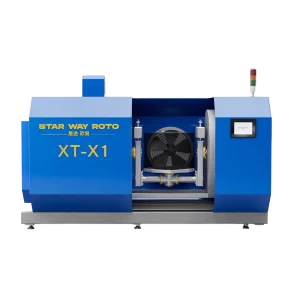
Modern rotational casting machines integrate Industry 4.0 PLC controls (Siemens S7-1500 / Schneider Electric) with touchscreen HMIs, permitting multi-recipe storage, independent arm speed control, and dynamic thermal ramping curves.
Different industrial applications demand specific machinery layouts. Below is a structural comparison of primary rotational molding machine types engineered by industry-leading manufacturers.
Carousel machines feature a central pivot axis carrying 3 to 4 processing arms that index sequentially through heating, cooling, and loading/unloading stations. Independent Arm Carousel machines represent the gold standard for high-volume manufacturing, allowing each arm to run distinct mold sizes, cycle times, and temperature profiles without throttling plant output.
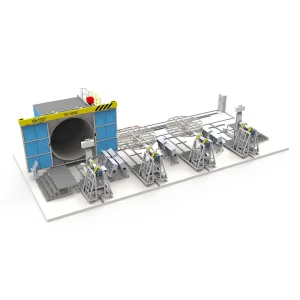
Shuttle systems utilize a central oven chamber with two independent carts moving horizontally on rail tracks from opposite sides. While one shuttle cart resides inside the heating oven, the second cart operates in the cooling or stripping station. Compact Lined Shuttle Machines drastically decrease floor footprint while maintaining continuous oven utilization.
Rock & Roll equipment is specialized for long, narrow hollow products such as agricultural pipes, kayaks, fuel tanks, and elongated vessels. The machine rotates the mold 360 degrees around its longitudinal axis while rocking it vertically along its transverse axis (+/- 45 degrees).
Representing the next frontier in eco-friendly rotational casting, direct electric heating machines replace open flame gas burners with infrared or direct electrical resistance elements embedded inside or closely surrounding the mold shell. This eliminates CO2 emissions and slashes workplace ambient heat dissipation.
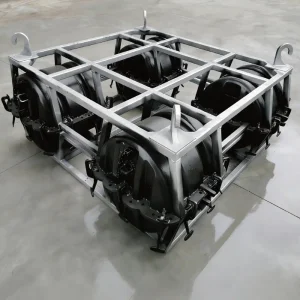
The quality of a rotational cast part is fundamentally capped by the thermal conductivity, surface integrity, and parting-line accuracy of its mold tooling. Expert manufacturers provide both CNC Cast Aluminum and Sheet Steel tooling tailored to structural requirements.
Aluminum molds are crafted by pouring molten alloy into precision sand/ceramic patterns or via direct 5-axis CNC block milling. Aluminum possesses exceptional thermal conductivity (~160 W/m·K), facilitating rapid heating and uniform cooling cycles that minimize cycle times by up to 20% compared to steel.
Steel molds are constructed from high-tensile carbon or stainless steel sheets cut via fiber laser and welded along precision jigs. Steel exhibits lower thermal conductivity (~50 W/m·K) but provides immense structural rigidity, making it economical for large, simple geometry products like chemical storage tanks.
Browse additional specialized machinery including open-flame systems, lab testing equipment, plastic pulverizers, and modular shuttle plants.
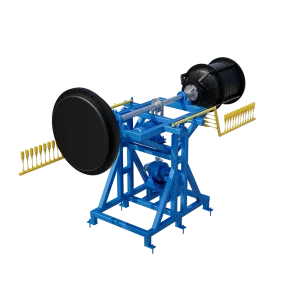
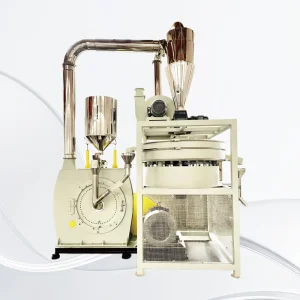
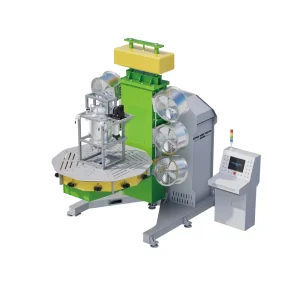
Rotational casting enables seamless integration of metal inserts, double-wall foam insulation, and complex hollow geometries. Industry-leading manufacturers provide end-to-end solutions customized for diverse global sectors.
Fabrication of seamless, heavy-duty vertical and horizontal chemical tanks ranging from 500L to 50,000L. Utilizing Linear Low-Density Polyethylene (LLDPE) or Cross-linked Polyethylene (XLPE), these tanks withstand highly corrosive acids, alkalis, and industrial effluents without environmental stress cracking.
Rotomolded double-skin kayaks, floating pontoons, and marine navigation buoys leverage high-impact UV-stabilized Polyethylene (UV8+ rating). Hollow cavities are routinely polyurethane (PU) foam-filled for permanent unsinkability and structural rigidity against ocean wave action.
Replacement of metal fuel tanks, air intake ducts, tractor roofs, and agricultural sprayer hoppers with lightweight rotomolded components. Parts exhibit superior vibration damping, zero rust potential, and easy integration of brass or stainless steel threaded inserts during mold rotation.
Leading rotational casting process manufacturers adhere to stringent global quality frameworks, ensuring that machinery and products conform to regional safety, electrical, and environmental statutes.
To eliminate operational downtime, premier manufacturers deploy localized field support engineers alongside remote 5G IoT diagnostic gateways. PLC systems support multi-language operator interfaces (English, Spanish, German, Arabic, Russian) and allow real-time telemetry monitoring for predictive maintenance.
The rotational casting sector is undergoing a massive transformation powered by smart automation, polymer physics advancements, and decarbonization mandates.
Transition from external oven timer controls to direct wireless internal air temperature telemetry. Embedded mold sensors continuously communicate with AI-driven burner valves, dynamically altering heat flux based on exact polymer melt kinetics to prevent thermal degradation.
Widespread adoption of direct electric mold heating networks and microwave-assisted sintering, reducing cycle times by 40% while achieving complete zero carbon emissions during factory processing.
Development of specialized micro-pulverized bio-polyethylene (PLA/PHA blends) and high-density circular post-consumer recycled (PCR) resin matrices capable of maintaining 95%+ of virgin mechanical tensile strength.
Get answers to critical engineering, manufacturing, and procurement questions regarding the rotational casting process and machine supplier capabilities.
Rotational casting operates at atmospheric pressure without internal mechanical force or high pressure extruders. Polymer powder melts against heated mold walls strictly via heat transfer and biaxial rotation. This produces stress-free hollow parts with uniform wall thickness—especially at outer corners—and requires significantly lower tooling investment costs compared to high-pressure injection molds.
The rotational ratio between the major and minor axes dictates how polymer powder coats the inner surface of the mold. A typical ratio of 4:1 means the major axis completes 4 rotations while the minor axis completes 1 rotation. Correct ratio tuning prevents resin accumulation in flat regions and ensures even wall distribution across complex geometries.
Electric heating systems deliver up to 35% higher energy efficiency, precise thermal zone management (+/- 1°C accuracy), zero factory carbon emissions, and cleaner operating environments. Gas ovens remain popular for ultra-large industrial tanks (>10,000L) due to lower local gas utility tariffs, but electric systems lead in medical, high-tech, and green-certified manufacturing plants.
Standard plastic pellets cannot melt fast or evenly enough under atmospheric heat without trapping large air voids. Pulverizing resin into 35-mesh (approx. 500 microns) fine powder optimizes thermal conduction surface area, allowing powder granules to coat the mold evenly and release trapped bubbles rapidly during the sintering phase.
Yes. Advanced multi-arm carousel and shuttle machines utilize automated drop-boxes. A secondary layer (e.g., foaming agents or barrier resins) is automatically dropped into the mold at a specific peak internal air temperature (PIAT) without stopping the machine arm, creating durable multi-layer skin-foam-skin composite structures.
CNC-machined A356 cast aluminum molds generally deliver 15,000 to 20,000 thermal cycles when properly maintained with release agents and non-abrasive cleaning. High-grade fabricated steel molds can exceed 30,000 cycles, making them exceptionally durable for high-volume structural containers.