
Direct export configurations engineered for Hungarian manufacturing plants and CEE industrial supply chains.
Technical analysis of thermal dynamics, alloy selection, and structural optimization for Central European procurement directors.
Hungary has positioned itself as one of Central and Eastern Europe’s premier manufacturing and logistics powerhouses. Driven by massive capital investments in automotive assembly, electric vehicle (EV) battery manufacturing hubs in Debrecen and Győr, agricultural equipment modernizations, and specialized environmental containment, Hungarian industrial enterprises require custom polymer processing tooling engineered to exacting European standards. Rotational molding (rotomolding)—a process revered for creating seamless, stress-free, hollow plastic products—hinges entirely on the thermodynamic integrity and dimensional accuracy of the tooling. Original Design Manufacturing (ODM) rotomolding mould solutions provide the critical operational link, transforming complex computer-aided designs (CAD) into high-performance, long-lifecycle steel and cast aluminum moulds.
As a specialized global manufacturer, our factory delivers complete ODM rotational molding mould solutions tailored specifically for Hungarian OEMs, plastic molders, and industrial product developers. By leveraging advance 5-axis CNC machining centers, automated pattern-making software, finite element stress modeling (FEA), and state-of-the-art foundry facilities, we bridge the gap between initial conceptual sketching and full-scale factory deployment. Whether your production facilities are situated in the industrial zones of Budapest, Székesfehérvár, Miskolc, or Kecskemét, our engineering framework ensures precise fitment with global carousel, shuttle, and rock-and-roll rotomolding machinery systems.
Mapping structural procurement requirements to specialized ODM mould engineering.
Procurement teams and industrial engineers operating within Hungary operate under stringent European economic directives. To achieve low total cost of ownership (TCO) and maximize Return on Capital Employed (ROCE), procurement intent focuses heavily on mold longevity, fast thermal dissipation, minimum parting-line deflash requirements, and compliance with EU environmental regulations (such as REACH and the EU Green Deal initiatives). Below is an analytical breakdown of how our ODM rotomolding moulds directly satisfy local industrial demand segments across Hungary:
Hungary's massive automotive corridor requires custom adBlue tanks, complex air ducts, underbody shields, and EV battery cooling fluid expansion vessels requiring zero-leakage, pressure-tested hollow geometries.
Serving Hungary's fertile Great Plain (Alföld), OEMs need heavy-duty chemical sprayer tanks, liquid fertilizer containers, and tractor canopy hoods with high UV resistance and structural ribbing.
Hungary’s position as a pan-European transit hub creates immense demand for heavy-duty plastic pallets, insulated fish/meat tubs, spill containment pallets, and EUR-pallet-compatible bulk boxes.
Meeting these diverse industrial applications requires moving beyond standardized off-the-shelf catalog tooling. True ODM manufacturing requires deep co-engineering—where our structural designers evaluate wall thickness distributions, thermal shrinkage factors of linear low-density polyethylene (LLDPE), cross-linked polyethylene (XLPE), or polypropylene (PP), and design optimized mold clamping systems that integrate seamlessly into existing machine platens.
Selecting the optimal structural matrix for your Hungarian manufacturing plant's volume and finish requirements.
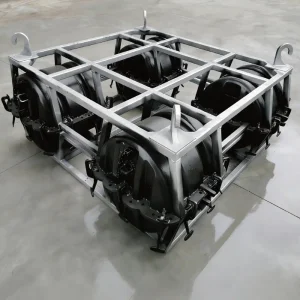
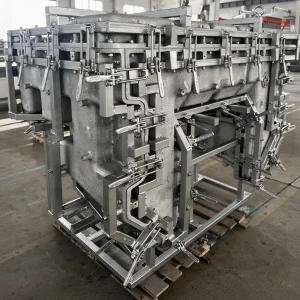
A fundamental decision for technical buyers in Hungary is selecting between CNC-machined/cast aluminum moulds and fabricated sheet steel moulds. Each tooling path carries distinct thermal conductivity profiles, structural strength, mold life expectancy, and capital outlay metrics. As an ODM specialist, our factory fabricates both categories in-house to deliver unbiased engineering advice.
| Engineering Attribute | CNC Cast Aluminum Tooling (A356) | Fabricated Sheet Steel Tooling (P20/S235) |
|---|---|---|
| Thermal Conductivity | High (~160 W/m·K) – 30% faster cycle cooling | Moderate (~50 W/m·K) – Standard heating profiles |
| Surface Complexity & Aesthetics | Superior – Ideal for complex 3D grain, logos, textures | Moderate – Best for large, simple geometric forms |
| Dimensional Tolerance | Extremely High (±0.05 mm via CNC machining) | High (±0.5 mm via laser cutting/welding) |
| Mold Weight & Handling | Lighter – Reduces rotational stress on machine arms | Heavier – Demands high-capacity shuttle arms |
| Primary Application in Hungary | Automotive components, fuel tanks, outdoor kayaks, medical units | Large chemical storage tanks (5,000L–20,000L), septic systems |
| Typical Tooling Life | 20,000+ heat cycles with proper care | 10,000–15,000 cycles |
Our ODM factory workflow employs computer-aided thermal flow analysis to model internal mold air temperatures (IAT) during the heating phase in the oven. Standard rotomolding often suffers from uneven wall thickness at tight radii or internal corners. To counteract this in our moulds exported to Hungary, we incorporate variable wall thickness mold backings, specialized air-venting tubes (Teflon-lined or silicone pinhole vents), and spring-loaded mechanical core pulls for complex undercuts.
End-to-end integration designed to de-risk overseas procurement and accelerate time-to-market.
Utilizing 3D-printed master patterns and modular aluminum frame inserts to validate product ergonomics before committing to full-production multi-cavity tooling.
Every ODM mold undergoes complete thermal trial runs in our factory. First Article Inspection (FAI) reports along with full CMM dimensional measurement sheets are dispatched prior to shipping.
From chemical-resistant DuPont Teflon spray coatings for easy demolding to bead-blasted or micro-etched aesthetic surface patterns matching Automotive VDA standards.
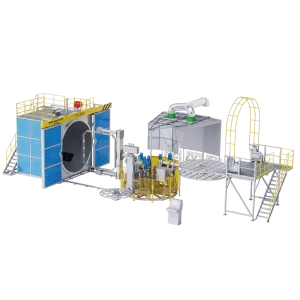
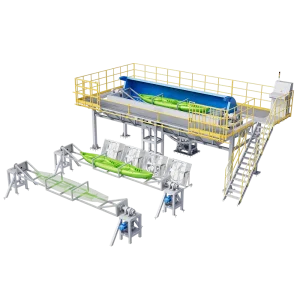
By offering an integrated service loop—combining mould engineering, auxiliary spider-arm fixtures, mold frame mounting systems, and matching rotational molding machinery—Hungarian clients eliminate interface mismatches between machine clamp arms and mould mounting plates. This holistic approach yields an immediate reduction in commissioning times at local facilities in Hungary.
Innovations shaping the future of energy-efficient, smart rotational molding across Europe.
The global rotational molding industry is undergoing a paradigm shift driven by digital integration, automation, and energy-decarbonization imperatives. For factories in Hungary striving to meet EU zero-emission targets, traditional energy-intensive heating cycles must be optimized. Our R&D division is actively driving four transformative technological pillars:
Eliminating massive gas-fired ovens by embedding micro-tubular heating elements directly within the cast aluminum mold body. This reduces energy consumption by up to 45% and eliminates greenhouse gas emissions on the factory floor.
Integrating wireless, high-temperature internal pressure and temperature sensors inside the mould cavity. Live telemetry is transmitted directly to machine PLC controllers to automatically trigger cooling cycles the exact second polymer fusion completes.
Engineering internal mold surface micro-geometries to handle the specialized viscosity profiles of bio-based polyethylene, post-consumer recycled (PCR) resins, and flame-retardant polyamide (PA12) formulations.
Replacing manual bolt-down perimeter clamping with pneumatic or quick-action hydraulic latching mechanisms, cutting mold loading/unloading times by 60% during high-volume manufacturing runs.
De-risking international logistics and ensuring seamless regulatory approval in Hungary.
Purchasing tooling from an overseas ODM factory requires complete clarity surrounding compliance, logistics, warranty, and technical service. We provide a comprehensive support framework designed specifically for Central European buyers:
All structural metalwork, electrical accessories, and auxiliary components conform strictly to CE Directives (2006/42/EC). Mold materials meet strict chemical safety standards under EU REACH regulations.
We provide full Delivered Duty Paid (DDP) ocean and intermodal freight directly to industrial parks in Budapest, Debrecen, Győr, or Szeged, managing all customs clearances and VAT documentation.
Every mold is delivered with complete 3D digital twin files (STEP/IGES format), spare parting-line gaskets, replacement vent pipes, and a comprehensive 2-year warranty against structural foundry defects.
Expert answers to common engineering and procurement queries regarding ODM rotomolding mould export to Hungary.
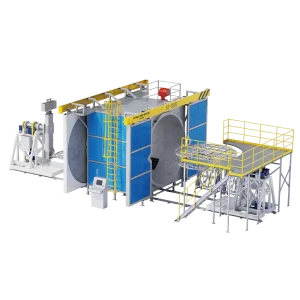
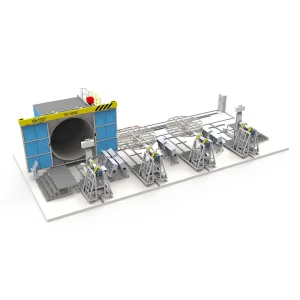
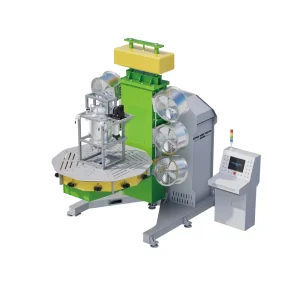
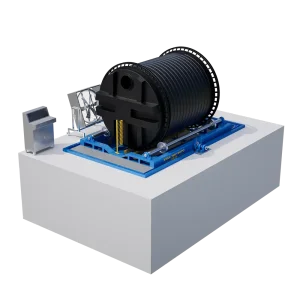
Explore our full range of high-efficiency shuttle machines, linear plants, and specialized rotomolding systems exported to Hungary.
Connect directly with our senior ODM tooling engineers for CAD evaluations, material consultations, and comprehensive factory quotations within 24 hours.
Send Inquiry Now