
Explore our flagship series of carousel systems, rock-and-roll units, electric ovens, and auxiliary equipment engineered for zero-defect polymer hollow molding.
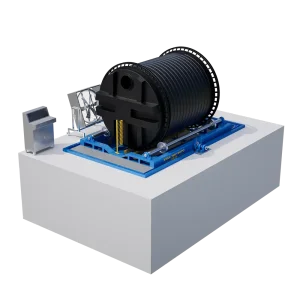
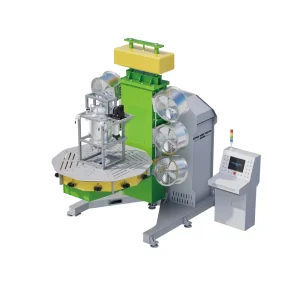
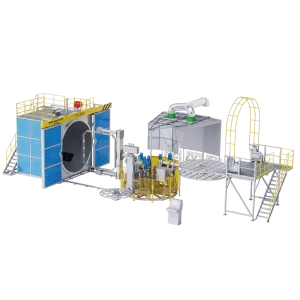
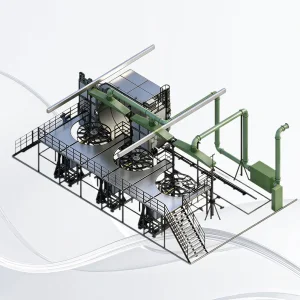
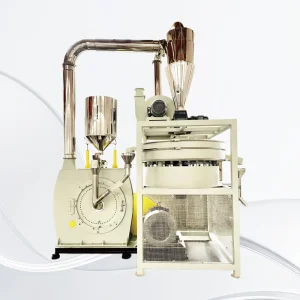
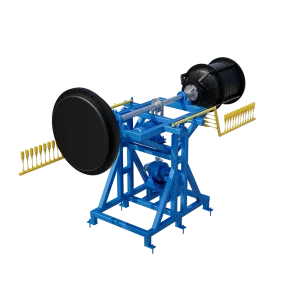
Unlike high-pressure injection or blow molding processes, rotational molding relies upon stress-free, low-shear polymer coalescence driven purely by gravity, biaxial rotation, and precision thermal conduction.
The efficiency of rotational moulding moulds is dictated by the thermal diffusivity ($α = k / (ρ \cdot c_p)$) of the mould shell. Our cast and billet aluminum moulds maintain wall thicknesses balanced between 8mm to 15mm, guaranteeing uniform thermal absorption across complex geometries while eliminating localized hot or cold zones.
Flash generation at mold parting lines creates substantial post-processing labor and aesthetic defects. Our engineering teams apply precision tongue-and-groove or CNC-machined step parting lines integrated with heavy-duty pneumatic or manual clamp systems.
Improper mold cavity ventilation leads to blowholes, surface pinholes, and internal vacuum warpage during the isobaric cooling phase. We engineer dynamic PTFE breathing vents, directional sintered metal breathers, and custom multi-port vent chimneys.
Strategic supply chain analysis: How premier rotational molders across North America, Europe, APAC, and Latin America are modernizing their tooling assets to meet evolving regulatory and technical demands.
While traditional sand-cast aluminum moulds served general utility tanks well, technical applications—such as automotive DEF/Urea tanks, medical housings, and high-performance insulated cooler boxes—now demand 5-axis CNC billet blocks (Alloy 6061/7075). CNC tooling guarantees zero internal porosity, absolute wall thickness symmetry, and tight geometric dimensioning and tolerancing (GD&T).
Environmental standards (CARB / EPA / EU Tier 5) require fuel containment vessels and chemical tanks to eliminate hydrocarbon permeation. ODM mould designs now incorporate specialized thermal balancing for multi-layer resin sequences (e.g., HDPE skin + EVOH barrier + Cross-linked XLPE core), ensuring uniform melt layer distribution without delamination.
Surging natural gas and electric energy costs in global industrial hubs have catalyzed demand for rapid-heating tooling structures. By integrating thermal conduction fins, optimized frame spider weight, and aerodynamic shell designs, StarWayRoto tooling reduces machine gas consumption per metric ton of processed polymer by up to 22%.
Selecting the appropriate tooling metallurgy is vital for matching project budget, production volume, surface finish criteria, and dimensional tolerances.
| Engineering Parameter | Cast Aluminum (A356 Alloy) | 5-Axis CNC Billet (6061-T6) | Fabricated Sheet Steel / SS |
|---|---|---|---|
| Thermal Conductivity ($W/m\cdot K$) | 160 – 180 (High) | 170 – 200 (Highest & Uniform) | 45 – 55 (Low to Moderate) |
| Cavity Porosity Risk | Low to Medium (Managed via casting flux) | Zero Porosity (Solid Billet) | Zero Porosity (Plate Metal) |
| Dimensional Tolerance | ±0.50 mm to ±0.80 mm | ±0.15 mm to ±0.25 mm | ±1.00 mm to ±2.50 mm |
| Surface Finish Capability | VDI 24–36, Bead Blast, Cast Texture | SPI A2 Mirror Polish, Precision Micro-Etch | Mill Finish, Industrial Smooth, 2B |
| Design Complexity / Undercuts | Excellent for organic, complex shapes | Superior for micro-features & tight ribs | Best for simple geometry & large tanks |
| Expected Service Life | 50,000+ Production Cycles | 100,000+ Production Cycles | 30,000 – 60,000 Cycles |
| Optimal Applications | Playground equipment, Kayaks, Coolers | Automotive DEF tanks, Medical cases | Agricultural & Industrial water tanks |
From initial 3D part concept to first-shot polymer validation, our standardized 4-phase gateway guarantees rigorous quality verification at every milestone.
Comprehensive Design for Manufacturability analysis. Volumetric shrinkage calculation (1.5% to 3.5% based on MFI and density of PE/PP/PA), draft angle optimization (≥1.5° for smooth texture, ≥3.5° for heavy textures), and non-isothermal polymer solidification analysis.
Precision patterns milled from high-density epoxy tooling board or direct 5-axis HSC machining of forged 6061-T6 aluminum blocks. Precision venting channels, heat sinks, and balanced spider mounting arms engineered to interface perfectly with carousel or shuttle machine arms.
Hand benching, chemical etching (VDI 3400 texture range), and semi-permanent PTFE/silicone fluoropolymer mold release coating application. Precision alignment of parting line clamps, pneumatic de-molding assist pins, and threaded brass insert encapsulation fixtures.
Trial rotational molding test run using client-specified polymer powders. Real-time temperature measurement via Rotolog/K-Thermocouple dataloggers to map PIAT (Peak Internal Air Temp), followed by full 3D optical laser scanning and CMM dimensional reporting.
Industrial reliability engineered for compliance with international safety, environmental, and mechanical standards across 40+ global destinations.
Every StarWayRoto machine and mould assembly adheres to rigorous global safety frameworks:
Bridging overseas procurement with localized responsiveness through comprehensive lifecycle support:
From material R&D testing units to extra-large yacht rotational molding machinery—engineered for high dimensional stability and round-the-clock industrial duty.
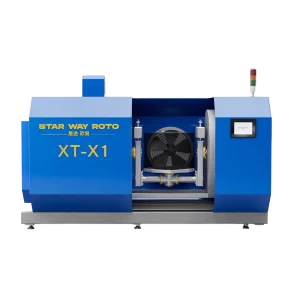
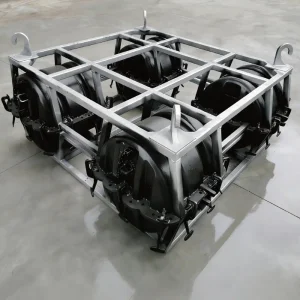
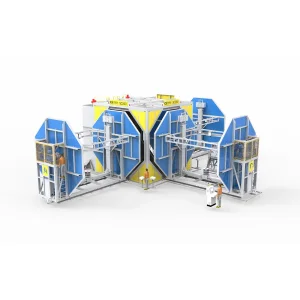
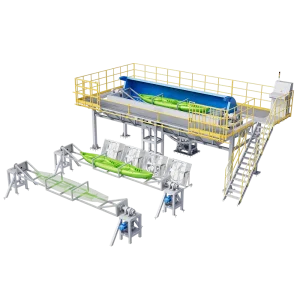
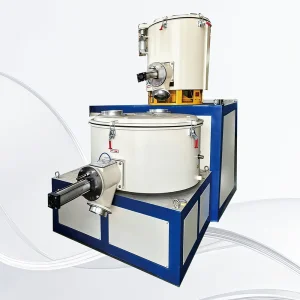
How StarWayRoto R&D is pioneering the integration of intelligent telemetry, resistive internal heating, and AI-driven thermal balance across rotational tooling.
Integrating wireless passive thermocouples and micro-pressure cavity sensors directly within the aluminum mould walls to continuously stream real-time melt state data to the machine PLC, automatically triggering the cooling cycle upon precise polymer fusion.
Developing oven-less rotational tooling utilizing embedded mineral-insulated resistive heating elements and direct internal fluid cooling jacket channels. This architecture yields up to 65% energy reduction compared to traditional gas convection ovens.
Next-generation ODM moulds featuring onboard compressed air actuation that automatically unlocks parting line perimeter clamps and ejects large deep-draw hollow parts within 15 seconds of arm positioning, maximizing operator safety and cycle cadence.
Detailed technical answers addressing critical parameters in rotational mould tooling design, material shrink compensation, and cycle optimization.