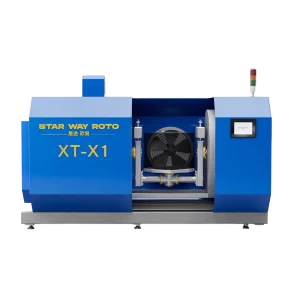

Precision-engineered rotational molding machines, laboratory test units, and custom fabricated steel tooling engineered for global volume manufacturing and micro-tolerance polymer wall uniformity.
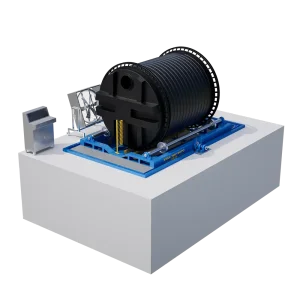
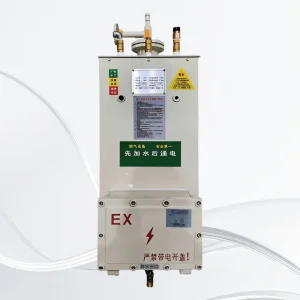
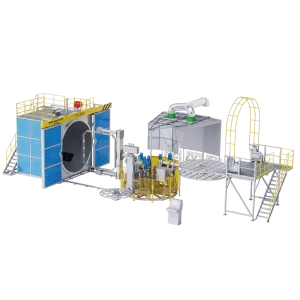
How international Tier-1 OEMs, municipal infrastructure contractors, and industrial product innovators evaluate total cost of ownership (TCO), thermal efficiency, and cycle repeatability in rotational roll molding manufacturing.
In the modern industrial manufacturing ecosystem, selecting a qualified custom roll molding factory requires far more than comparing baseline machinery quotes. Procurement leaders across North America, Europe, Australia, and the Asia-Pacific are navigating stringent carbon-neutrality mandates, rising polymer raw material prices, and tight dimensional tolerances for heavy hollow components. Rotational molding (and specifically rock & roll or roll molding kinematics) stands out as the single most capital-efficient manufacturing method for large-scale, stress-free hollow plastics—ranging from 500-liter chemical dosing tanks to 12-meter nautical hulls.
Strategic sourcing teams now evaluate suppliers against three primary engineering vectors: Kinematic Heating Chamber Efficiency, Dynamic Biaxial Speed Ratio Control, and Die-Cast / Fabricated Tooling Longevity. Unlike conventional blow molding or heavy injection tooling that requires millions in upfront capital tooling and massive hydraulic clamping tonnage, roll molding utilizes atmospheric pressure and continuous bi-directional or rocking rotation inside an oven chamber. This minimizes residual internal stresses, eliminates weld lines, and achieves uniform thickness across extreme radii.
CapEx amortized across high-volume production vs. low-volume customized runs. Direct electrical heating and high-efficiency gas burners slash thermal energy expenditure by up to 28% per metric ton of processed PE/PP.
Real-time closed-loop temperature control via internal air temperature (PIAT) telemetry ensures the plastic powder reaches complete sintering without thermal degradation or bubble entrapment.
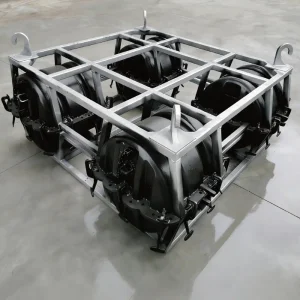
From CNC billet-machined aircraft-grade 6061 aluminum to heavy Q235B/Q345 fabricated steel tooling, mold construction directly governs cycle cooling times, parting line flash, and product aesthetics.
Roll molding (Rock and Roll) machines specialize in high-aspect-ratio geometries (cylindrical, longitudinal, flat-profile parts like kayaks, septic tanks, fuel cells, and air ducts). Partnering with a vertically integrated OEM factory that fabricates both the kinematic machinery and the CNC tooling shortens commissioning lead times from 24 weeks down to 8–10 weeks.
How our custom roll molding machine architectures and automated production cells solve complex structural polymer manufacturing challenges across six major global industries.
Bulk liquid containment demands 100% stress-crack resistance and seamless wall structural integrity. We design multi-layer LLDPE/HDPE/XLPE tanks up to 50,000 liters.
Hydrodynamic hulls, pontoon floats, long-keel yachts, and high-performance kayaks manufactured via oversized rock & roll ovens with custom multi-zone air cooling.
Custom fuel tanks, DEF tanks, agricultural tractor roofs, hydraulic fluid reservoirs, and complex engine air intake ducts replacing fabricated sheet metals.
Rotomolded insulated cooler containers, dry-ice transport chests, pharmaceutical shippers, and heavy-duty logistics pallets with impact-absorbing ribbed geometries.
Corrosion-proof livestock water troughs, automated calf hutches, pesticide sprayer vessels, and feed hoppers engineered to endure sub-zero frost and high livestock impact.
Road traffic barriers, water-filled crash attenuators, municipal waste separation containers, and commercial park playground slides engineered for public durability.
Selecting the optimal kinematic motion and thermal chamber configuration for your specific hollow part profile, cycle throughput, and factory floor space.
| Machine System | Kinematic Motion | Primary Part Applications | Thermal Chamber Type | Typical Cycle Efficiency | Capital Investment (CapEx) |
|---|---|---|---|---|---|
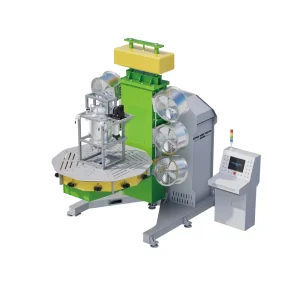
| Carousel Rotomolding Line | Full 360° Biaxial Rotation (Major/Minor Axis) | High-volume symmetrical parts, toys, tanks <3,000L | Enclosed Forced-Air Convection (Gas/Oil/Electric) | Ultra High (3–5 Arms) | Moderate to High |
| Shuttle Machine System | Biaxial Independent Dual-Arm Shuttle | Medium to large tanks, custom complex molds | Central Shared Oven with Dual Cooling Stations | High (Station Decoupled) | Moderate |
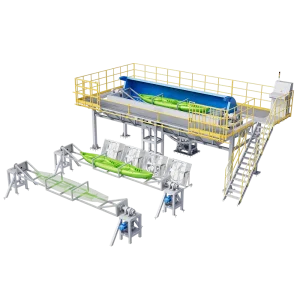
| Rock & Roll (Swing) Machine | 360° Axial Roll + ±45° Rocking Pitch | Longitudinal geometries, boats, kayaks, pipe floats, large vessels | Open Flame Direct or Enclosed Thermal Oven | Optimized for High Aspect Ratio | Low to Moderate (High ROI) |
| Direct Electric Heating Unit | Multi-Zone Surface Conduction / Induction | Medical components, micro-tolerance engineering plastics (PA, POM) | Ovenless Electric Internal Mold Elements | Precision Cleanroom Capable | High (Specialized) |
Understanding the Mechanics of Roll Molding (Rock & Roll): In conventional biaxial rotomolding, a mold rotates continuously along two perpendicular axes. However, for long cylindrical or elongated geometries (such as kayaks, watercraft hulls, long chemical tubes, and culvert pipes), biaxial rotation leads to centrifugal powder pooling at outer ends or uneven wall distribution.
Rock & Roll machines solve this fundamentally by rolling the mold 360 degrees around its major horizontal axis while rocking or tilting it up to 45 degrees along the longitudinal axis. This allows the molten polymer pool (LLDPE, HDPE, or crosslinked PE) to glide smoothly across the entire internal length of the mold cavity, yielding ultra-uniform wall thickness across extreme length-to-diameter ratios while consuming drastically less heating energy.
How industry 4.0 telemetry, direct electric resistive molds, closed-loop machine vision, and circular biopolymer integration are transforming rotational molding.
Wireless non-contact thermocouple telemetry embedded directly in the mold cavity. Machine automatically advances from cook to cool cycles the exact millisecond bubble coalescence completes.
Eliminating massive gas-fired convection ovens entirely. Electric heating elements integrated directly into CNC aluminum molds slash ambient factory heat emissions and reduce thermal footprint by 60%.
Advanced multi-layer drop boxes automatically feed virgin inner contact layers and 100% PCR (Post-Consumer Recycled) structural cores without sacrificing tensile impact resistance.
6-axis articulated robotic arms automate resin powder shot dosing, pneumatic mold latch opening, part extraction, and automated non-destructive ultrasonic wall thickness mapping.
Navigating international trade corridors, regional nearshoring dynamics, and turnkey equipment export strategies across 40+ countries.
Surging demand for infrastructure rainwater harvesting, EPA-compliant fuel containers, and rotational-molded commercial playground sets driving equipment modernization.
Strict CE/Machinery Directives and carbon-pricing driving high adoption of electric heating ovens, closed-loop burner combustion, and automated secondary processing cells.
Rapid expansion of municipal water grids, aquaculture sea cages, and agricultural storage solutions fueling massive procurement of large-envelope Rock & Roll machines.
Heavy-duty industrial chemical storage, solar water heater outer shells, and high-impact mining septic tanks requiring rugged, low-maintenance open-flame & shuttle lines.
Rigorous engineering governance ensuring every piece of rotomolding equipment meets strict international safety, electrical, and mechanical certifications before containerized dispatch.
Full compliance with European Machinery Directive 2006/42/EC, CE certified electrical panels, UL 508A industrial control panel standards, and OSHA dual-channel safety light curtains with mechanical safety interlocks.
Every machine undergoes a full 72-hour continuous dry-run and live mold thermal trial test at our Ningbo production base. Clients receive complete video telemetry, thermographic heat mapping, and vibration analysis reports.
Integrated VPN router modules on all Siemens and Schneider PLC panels allow our senior controls engineers to provide instant remote diagnostics, parameter tuning, and firmware updates across any time zone worldwide.
In-depth technical answers addressing polymer thermodynamics, mold metallurgy, cycle time reduction, and turnkey facility planning.
Biaxial Carousel machines rotate the mold 360 degrees on two perpendicular axes simultaneously, which is ideal for spherical, cubic, or balanced 3D geometries. Rock & Roll machines rotate 360 degrees along the central roll axis while rocking back and forth (typically ±15° to ±45°) along the horizontal plane. This longitudinal rocking motion is specifically engineered for elongated, narrow parts (kayaks, vessels, long pipes, large pontoon floats) where biaxial rotation would cause powder segregation and uneven wall thickness at the far ends.
Electric heating ovens provide ultra-clean production, zero exhaust emissions, and exceptional localized PID temperature zone accuracy (±1°C), making them essential for cleanroom environments and regions with strict gas emission taxes (e.g., Western Europe, California). While electricity costs per BTU can be higher in certain territories, our electric heating ovens utilize vacuum ceramic insulation panels and targeted infrared conduction to reduce standby thermal loss, achieving near 92% thermal efficiency compared to 55–65% for open combustion burners.
Fabricated Steel (Sheet Metal): Best for simple, large-volume hollow shapes (cylindrical tanks, septic systems, road barriers) with lower tooling cost and high thermal shock resistance.
Cast Aluminum (A356): Best for complex 3D shapes with detailed textures, logos, and intricate ribs (playground sets, cooler boxes).
CNC Billet 6061 Aluminum: Best for tightest mechanical tolerances (automotive ducts, medical housings, aerospace fuel containers) requiring zero porosity and flawless parting line match.
Pinholes and internal bubbles typically occur when the polymer powder does not reach its true melt-sintering Peak Internal Air Temperature (PIAT, typically 190°C–205°C for LLDPE) or due to inadequate mold venting. We integrate specialized PTFE breathable vent tubes (Supavent systems) and customize our 3-stage heating recipes to maintain proper heat soaking. Warpage is mitigated by implementing multi-stage controlled air-water-mist cooling curves to prevent rapid differential crystallization across thick and thin wall sections.
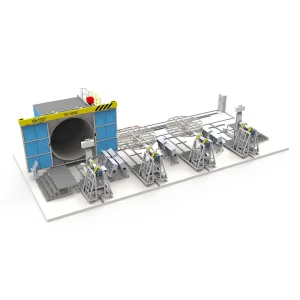
Complete production lines, high-capacity carousel stations, electric oven systems, and precision marine rock-and-roll swing machinery manufactured to ISO 9001 and CE directives.
Connect directly with our senior application engineering team in Ningbo. Submit your 3D CAD (.STP / .IGS), target resin formulation (PE, PP, PA, XLPE), and annual volume targets for a comprehensive DFM (Design for Manufacturability) analysis and formal factory quote within 24 business hours.