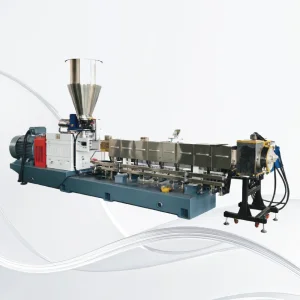
Deploying industrial-grade shuttle machines, electric heating ovens, and high-conductivity cast aluminum moulds tailored for Polypropylene (PP) and Polyethylene (PE) rotational molding.
Rotational molding (rotomolding) has historically been dominated by Polyethylene (PE) due to its broad thermal processing window, forgiving sintering behavior, and minimal thermal degradation during prolonged oven cycles. However, modern industrial procurement increasingly demands materials with elevated chemical resistance, higher Heat Deflection Temperatures (HDT), superior flexural modulus, and enhanced environmental stress crack resistance (ESCR).
Polypropylene (PP)—both in Homopolymer (PP-H) and Impact Copolymer (PP-C) variants—fills this critical structural gap. As a premier Custom Polypropylene Rotational Molding Company & Factory, Ningbo StarWay Roto Co., Ltd. (established in 2009) leverages over 23 years of specialized engineering expertise, 23+ core patents, and an advanced 20-acre manufacturing plant to solve the long-standing challenges of rotational molding PP, including thermal oxidation control, volumetric crystallization shrinkage, and narrow melt flow index windows.
Global OEM procurement departments across North America, Europe, the Middle East, and Asia-Pacific are increasingly transitioning from heavy metallic fabrications (such as stainless steel and welded aluminum) and fiberglass (FRP) toward custom rotomolded polypropylene components. Procurement decision-makers prioritize Total Cost of Ownership (TCO), scrap rate reduction, corrosion elimination, and weight reduction.
| Polymer Type | Flexural Modulus (MPa) | Heat Deflection Temp (HDT @ 0.45 MPa) | Tensile Yield Strength (MPa) | Volumetric Shrinkage (%) | Rotomolding Melt Flow Index (MFI g/10min) |
|---|---|---|---|---|---|
| PP Homopolymer (PP-H) | 1,350 - 1,600 | 105°C - 120°C | 33 - 39 | 1.8% - 2.5% | 5.0 - 9.0 |
| PP Impact Copolymer (PP-C) | 1,100 - 1,350 | 90°C - 105°C | 27 - 33 | 1.5% - 2.1% | 4.5 - 8.0 |
| LLDPE (Standard Roto Grade) | 650 - 800 | 60°C - 70°C | 18 - 22 | 2.5% - 3.5% | 3.5 - 7.0 |
| HDPE (High Density) | 900 - 1,150 | 70°C - 85°C | 24 - 28 | 3.0% - 4.0% | 2.0 - 4.0 |
| Cross-Linked PE (XLPE) | 700 - 900 | 80°C - 95°C | 20 - 25 | 2.8% - 3.8% | Special Reactive |
| Polyamide 12 (PA12 / Nylon) | 1,200 - 1,400 | 140°C - 160°C | 45 - 55 | 1.2% - 1.8% | 8.0 - 14.0 |
As illustrated in the engineering matrix above, custom rotomolded polypropylene provides an optimal balance between structural rigidity and thermal resistance, filling the performance void between commodity Polyethylene and expensive engineering resins like Polyamide 12.
Rotational molding of Polypropylene differs fundamentally from injection molding or blow molding. In rotomolding, zero-shear powder sintering occurs slowly inside a biaxially rotating mould without mechanical compaction. Engineering PP for rotational molding requires stringent controls across four distinct thermodynamic stages:
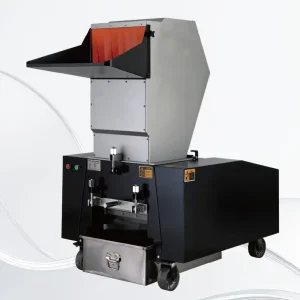
Polypropylene resins must be cryogenically or room-temperature pulverized into fine powder measuring 35 to 50 mesh (300–500 microns). Irregular powder particle geometry leads to air entrapment, pinholes, and prolonged sintering times. StarWayRoto employs high-speed multi-blade disk mills to achieve narrow particle size distribution with high bulk density (>0.38 g/cm³).
PP contains tertiary carbon atoms along its polymer backbone, making it significantly more susceptible to thermo-oxidative degradation than PE when exposed to high oven temperatures (260°C–310°C). To eliminate surface yellowing, brittleness, and inner-wall oxidation, our rotomolding machines integrate automatic Nitrogen (N2) purge systems into the mould cavity, keeping internal oxygen levels below 2%.
Sintering of PP powder begins at its melting peak (~165°C for PP-H). Real-time telemetry sensors monitor the Internal Air Temperature (IAT) inside the tool. The peak internal air temperature (PIAT) must be precisely controlled between 190°C and 215°C. Overheating causes chain scission, while underheating leaves unfused powder boundaries, drastically reducing impact strength.
Polypropylene exhibits a high volumetric shrinkage rate (1.5% to 2.5%) during semi-crystalline cooling. Rapid cooling causes differential thermal contraction and severe part warpage. StarWayRoto utilizes dual-stage cooling protocols—combining controlled air turbulence with atomized water misting—to control alpha-phase spherulite growth and ensure dimensional stability within ±0.5% tolerances.
Achieving flawless Polypropylene rotomolded components demands synergy between specialized processing machinery and high-precision tooling. Standard legacy rotomolding equipment lacks the thermal agility required for rigid PP processing.
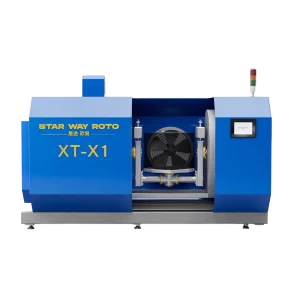
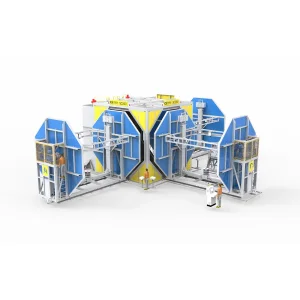
Unlike traditional direct gas-fired open burners that create localized thermal hotspots, StarWayRoto's patented Electric Heating Ovens deliver uniform radiative and convective airflow. Hot spots are eliminated, maintaining oven temperature uniformity within ±2.5°C across massive mould volumes.
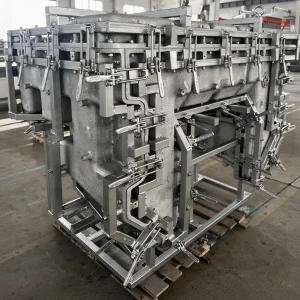
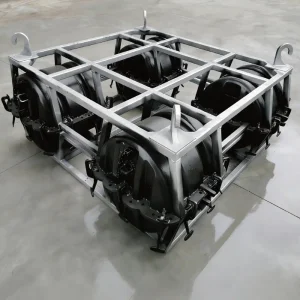
Tooling for PP rotomolding requires superior thermal conductivity. We manufacture A356 grade Cast Aluminum tooling utilizing 5-axis CNC pattern machining and pressure-cast foundry techniques. Internal cooling fins and copper-alloy inserts accelerate heat transfer during critical crystallization cycles.
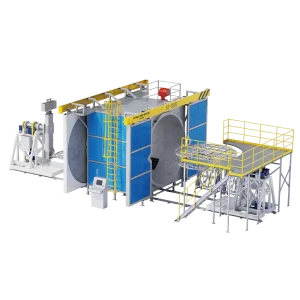
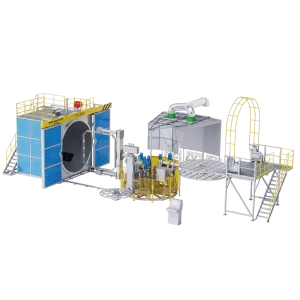
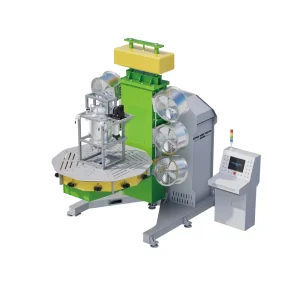
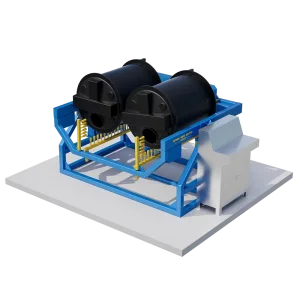
Our Independent Arm Shuttle and Carousel machines (ranging from 2.0-meter to 6.5-meter spherical swing diameters) allow customized heating, cooling, and indexing times for each arm. This allows complex PP tools and standard PE tools to run simultaneously on the same production line.
Our custom polypropylene rotational molding solutions serve mission-critical applications across worldwide commercial and industrial sectors:
Polypropylene's immunity to environmental stress cracking makes it ideal for chemical scrubbers, electroplating tanks, acid etching baths, and chemical dosing vessels. Unlike HDPE, PP maintains structural integrity when exposed to organic solvents and elevated chemical working temperatures (up to 95°C).
Under-hood vehicle components require extreme heat endurance. StarWayRoto engineers custom PP air intake ducts, expansion tanks, DEF (Diesel Exhaust Fluid) reservoirs, and commercial vehicle HVAC ductwork. Replacing metal fabrications with single-piece rotomolded PP reduces component weight by up to 45% while dampening NVH (Noise, Vibration, and Harshness).
Medical waste containers, sterilization tubs, and bioprocess liquid vessels molded from medical-grade polypropylene can withstand repeated steam autoclave cycles at 121°C (250°F) without structural creep or shrinkage. Smooth internal surfaces prevent bacterial adhesion and facilitate clean-in-place (CIP) protocols.
Rotomolded double-walled polypropylene insulated shipping containers and heavy-duty structural pallets exhibit remarkable impact resistance and structural rigidity under heavy stacking loads. PP's high flexural strength prevents long-term creep deflection under sustained static loads.
As a leading pioneer in rotational molding technology, Ningbo StarWay Roto Co., Ltd. continuously pushes the boundaries of polymer engineering and machinery automation. Our ongoing R&D roadmap focuses on four primary vectors:
Integration of inline thermal imaging and artificial intelligence algorithms to constantly adjust oven burner intensities and arm rotation speed ratios in real time, guaranteeing consistent wall thickness distributions across asymmetrical tool geometries.
Developing multi-layer skin-foam-skin polypropylene rotomolding technology. Chemically expanded PP foam cores deliver extreme flexural stiffness with up to 40% overall weight savings for structural panels and floating marine structures.
Pioneering sustainable compounding strategies that incorporate up to 50% PCR polypropylene without compromising impact strength, utilizing proprietary elastomeric tougheners (TPO/EPDM) and specialized organic coupling agents.
Transitioning global factories toward zero-emission, fully electric rotational molding machines equipped with energy recovery systems, reducing heating energy consumption by 35% compared to conventional gas ovens.
StarWayRoto guarantees seamless international procurement by offering complete engineering compliance, rigorous quality control testing, and localized technical after-sales support across North America, South America, Europe, and Asia.
Our custom polypropylene compounds fully comply with global safety standards, including FDA 21 CFR 177.1520 for food contact, EU REACH and RoHS environmental directives, UL94 flammability standards, and UN Hazardous Materials Packaging Certifications (1H2/Y/100).
Every custom tool and finished product undergoes comprehensive quality verification: FARO CMM arm 3D scanning for dimensional inspection, ultrasonic wall thickness testing, low-temperature ARM cold-impact testing (-40°C), and hydrostatic pressure testing for liquid vessels.
We provide overseas installation, mould trial commissioning, operator training, and local spare parts dispatch. Our multi-lingual engineering support staff ensures minimal downtime and smooth ramp-up to full-scale production.
Browse our complete catalog of industrial granulators, pelletizing systems, lab test equipment, and high-load shuttle rotomolding machines.