
Engineered for demanding cycle times, heavy mold configurations, and tight dimensional tolerances across hollow plastic part production.
Understanding the kinematic advantages, thermal airflow modeling, and operational economics of linear multi-station shuttle platforms.
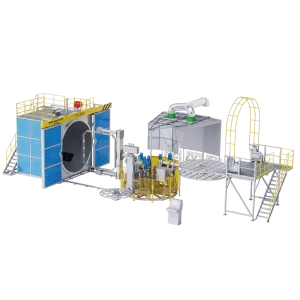
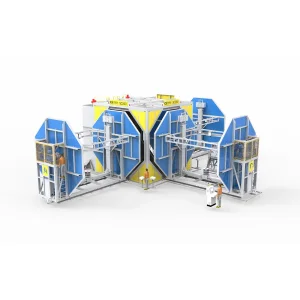
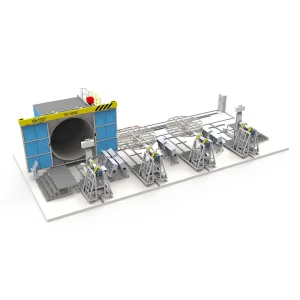
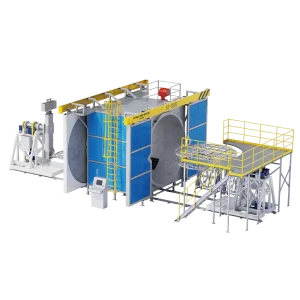
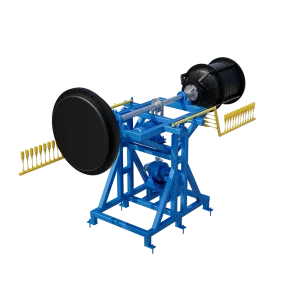
Unlike fixed-arm Carousel configurations where station indexing is governed by the longest cycle step (creating operational bottlenecks), a Shuttle Type Rotational Molding Machine operates on an asynchronous linear rail track. One central insulated heating chamber serves two or more independently actuated cart carriages. While Carriage A undergoes biaxial thermal consolidation inside the high-temperature oven, Carriage B resides in the exterior station undergoing progressive fan/water mist cooling, demolding, maintenance, and raw polymer charging.
This decoupling delivers unprecedented manufacturing agility: operators can run two radically distinct molds simultaneously—each with unique wall thicknesses, resin melt index parameters (e.g., LLDPE vs. Cross-linked HDPE vs. Polyamide PA6/PA12), and tailored biaxial rotation speed ratios (ranging from 1:1 to 8:1 via digital frequency invertors)—without compromising thermodynamic efficiency.
Constructed with high-density ceramic wool insulation (150–200mm thickness) enclosed within structural galvanized steel plating, ensuring exterior surface temperatures remain below 45°C during 300°C continuous operation.
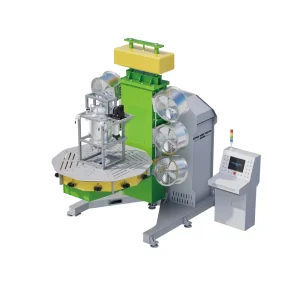
Heavy-duty forged alloy planetary gearing with direct servo synchronization on both major and minor rotational axes, eliminating backlash and facilitating precise wall-thickness distribution across deep corners.
Siemens / Mitsubishi PLC centralized architecture with touch HMI, supporting real-time data acquisition, recipe storage for up to 500 mold configurations, and PiT (Peak Internal Air Temperature) sensor loops.
How international OEM manufacturing directors and plant engineers evaluate shuttle rotomolding machines for maximum return on capital investment.
Shuttle machines require significantly lower upfront capital expenditure than multi-arm carousel lines while retaining 75–85% of their total throughput capacity for diverse product mixes.
The linear track footprint fits narrow factory bays, allowing side-by-side or in-line cell manufacturing layouts where overhead cranes can easily access mold demolding zones.
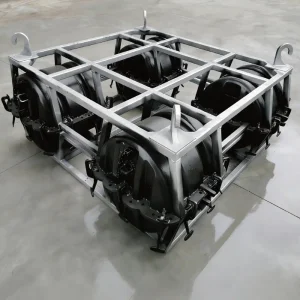
Spider-frame quick-mount clamping systems allow operators to switch molds on Carriage A while Carriage B continues production, dropping tool turnover time to under 25 minutes.
Automated chamber damper doors and variable speed recirculation fans slash gas consumption by up to 22% per ton of processed polymer compared to standard box ovens.
| Evaluation Parameter | Shuttle Type Rotomolding Machine | Carousel Type Rotomolding System | Rock & Roll Flame Machine |
|---|---|---|---|
| Target Production Profile | High flexibility, diverse SKU sizes, medium-to-high volumes | Mass production of identical/similar cycle parts | Long cylindrical tanks, low-cost commodity items |
| Cycle Independence | 100% Independent per Arm | Interlocked (Station time bound to slowest mold) | Single-arm batch processing |
| Floor Area Efficiency | Linear rectangle (Very high plant bay utilization) | Radial circle (Requires large square footprint) | Compact linear or single-station footprint |
| Mold Loading Capacity | Up to 12,000 kg per arm (StarWay Heavy-Load Series) | Up to 5,000 kg per arm | Up to 8,000 kg (Centrally balanced) |
| Energy Consumption / Kg Resin | 0.28 – 0.35 m³ Natural Gas / kg | 0.25 – 0.32 m³ Natural Gas / kg | 0.40 – 0.55 m³ Natural Gas / kg |
| Tooling Mounting Agility | Spider arms, single large mold, or multi-cavity grids | Standard multi-mold arms | Single or double longitudinal mold only |
StarWay Shuttle Rotational Molding machines produce mission-critical hollow plastic components adhering to rigorous international mechanical specifications.
Molding single-piece, seamless, stress-free vertical and horizontal storage vessels from 500 Liters up to 50,000 Liters. Multi-layer foam core structures provide thermal insulation and high burst strength for harsh industrial liquids, DEF, and agricultural chemicals.
Manufacturing complex geometry diesel tanks, hydraulic fluid reservoirs, cabin roof assemblies, engine air intake ducts, and wheel arches for leading global commercial truck and heavy agricultural machinery brands.
Heavy-duty UV-stabilized polyethylene marine navigational buoys, commercial fish farming cages, floating dock pontoons, jet-ski ramps, and leisure kayaks engineered with high impact puncture resistance.
Insulated cold-chain container boxes, heavy-duty reusable pallets, intermediate bulk containers (IBCs), chemical spill containment bunds, and rugged toolboxes engineered for extreme temperature resilience.
Urban waste collection containers, underground septic tanks, stormwater detention chambers, portable mobile toilet cabins, and utility inspection pits that resist microbial attack and chemical soil corrosion.
Ergonomic, vivid, food-grade LLDPE children's spiral playground slides, play tunnels, fitness equipment housings, illuminated outdoor designer furniture, and animal husbandry feeding troughs.
How Ningbo StarWay Roto’s R&D engineering delivers peak thermal uniformity, micro-structural density, and sub-millimeter biaxial accuracy.
Thermal distribution within the oven chamber is the decisive factor governing polymer powder sintering, melting viscosity, and bubble dissipation. StarWay shuttle machines incorporate high-capacity forward-curved centrifugal draft blowers paired with computational fluid dynamics (CFD)-optimized adjustable air discharge louvers.
By recirculating heated air at velocities exceeding 12 m/s directly across the mold cavity exterior, the convective heat transfer coefficient is doubled compared to standard gravity-flow ovens. This eliminates thermal shadowing, ensuring identical skin-layer thickness across both top crown and bottom corners of multi-cavity tooling.
Heavy-gauge stress-relieved spherical graphite cast steel arms resist high-temperature deflection and fatigue under continuous 24/7 heavy-load cantilever stresses.
Enclosed cooling chambers feature stage-controlled axial fans and atomized water mist nozzles to regulate crystal solidification without warping or internal residual stresses.
Eco-friendly direct ceramic electric heating elements engineered for zero-emission cleanroom factory environments and regions with strict NOx emission thresholds.
Pioneering the transition toward fully automated robotic demolding, energy-recovery heat loops, and circular post-consumer recycled polymer compatibility.
Integrating secondary air-to-air plate heat exchangers that capture waste thermal energy from the oven flue stack to preheat incoming combustion air, recovering up to 18% of burner input power.
Developing proprietary thermal ramp profiles and nitrogen purge injection options that prevent melt degradation in 100% Post-Consumer Recycled (PCR) HDPE and bio-derived polyamides.
Simulating heat transfer, mold thermal expansion, and polymer shrinkage via cloud-connected Digital Twins, interfaced with 6-axis robotic arms for automated mold unbolting and product extraction.
End-to-end export support ensuring rapid customs clearance, frictionless installation, and full safety standard compliance across every continent.
All electrical switchgear, safety PLCs, burner flame safeguards, and motor circuits conform to European CE Machinery Directive (2006/42/EC) and North American UL 508A certifications.
Bilingual senior field service engineers provide on-site assembly, wiring integration, dry-run validation, and full operator training in client plants globally within 7–14 days.
Equipped with secure VPN remote telemetry hardware, our core engineering team in Ningbo can diagnose PLC alarms, optimize temperature recipes, and update firmware in real time.
Disassembled into modular seaworthy shipping sections with anti-corrosion barrier wrapping, fitting standard 40HQ open-top and flat-rack containers for safe maritime transport.
Complementing our shuttle machinery with CNC-milled aluminum molds, fabricated steel tooling, and auxiliary open-flame systems.
Essential insights into machine sizing, fuel efficiency, mold pairing, and operational reliability for technical directors.
A Carousel machine locks 3 or 4 arms to a central turntable, meaning every arm indexes simultaneously at the speed of the slowest process. A Shuttle machine operates 2 or 3 arms on independent linear tracks. If Mold A requires a 22-minute cook cycle and Mold B requires 12 minutes, each arm operates strictly on its own optimized thermal profile without waiting for the other.
We provide fully engineered multi-fuel burner systems supporting Natural Gas (LNG), Liquefied Petroleum Gas (LPG), and Light Diesel with modulating proportional Italian Riello / Weishaupt burners. Additionally, we manufacture direct ceramic infrared Electric Heating systems for emission-free operations in European and North American facilities.
Our cooling stations feature multi-stage programmable cooling routines via the PLC. Operators can program initial low-velocity dry air circulation (to prevent surface skin thermal shock), followed by atomized high-pressure water mist (for accelerated core crystallization), followed by high-velocity finishing air to purge surface moisture before demolding.
Our standard shuttle machine models span spherical swing diameters from 1,600mm up to 6,500mm. For custom large-scale infrastructure applications, our heavy-duty series (including the record-setting S2-8500 platform) supports spherical mold envelopes up to 8,500mm with load capacities exceeding 12,000 kg per arm.
We handle complete seaworthy modular packing, container loading plans, export documentation, and customs HS code classification. Upon container arrival at your facility, StarWay deploys electrical and mechanical commissioning engineers to assemble the tracks, erect the oven, wire the control cabinet, and run pilot production batches with your tooling.
Yes. Our Siemens S7-1500 / Mitsubishi centralized PLCs feature standard OPC UA and Modbus TCP/IP protocols. Production cycles, fuel consumption per batch, oven temperature curves, and alarm histories can be streamed directly into your company's SCADA, MES, or Industry 4.0 cloud monitoring systems in real time.