
High-efficiency rotational moulding machinery and tooling engineered by leading Chinese manufacturing plants.
An authoritative report on polymer physics, machinery engineering, tooling economics, and global procurement frameworks.
Rotational moulding (commonly termed rotomolding or rotocasting) has emerged as a premier thermoplastic processing method for producing seamless, stress-free, hollow polymer products of extraordinary scale and geometric complexity. As global demand escalates for durable industrial liquid storage containers, off-highway vehicle components, marine vessels, and insulated cold-chain logistics gear, procurement leadership is increasingly prioritizing specialized manufacturing clusters in China. Headquartered in key manufacturing hubs such as Ningbo, Zhejiang Province, enterprise-level providers like Ningbo StarWay Roto Co., Ltd. represent the apex of Chinese rotomolding engineering—combining low-stress polymer physics, advanced CNC mold fabrication, and intelligent automation.
The strategic advantage of modern Chinese rotational moulding process companies lies not merely in raw cost efficiency, but in Information Gain: providing clients with proprietary thermal monitoring technologies, custom powder particle rheology optimization, and integrated machinery-mould co-engineering. Unlike traditional injection or blow molding processes, which subject polymer melt to ultra-high shear rates and high pressure (often inducing internal residual stresses), rotomolding operates under atmospheric pressure. Powdered thermoplastic resin coats the interior walls of a biaxially rotating heated mold, resulting in exceptional structural integrity, uniform wall thickness at sharp corners, and complete absence of weld lines.
Understanding sintering dynamics, thermal transition cycles, and structural polymer behavior inside the mold.
Micronized polymer powder (typically 35 Mesh / 500 micron LMDPE or HDPE) is loaded into a cold mold. The arm rotates along major and minor axes at low speed ratios (e.g., 4:1 or 8:1), driving powder movement over heating surfaces via gravity roll rather than centrifugal force.
As external heat (forced air, electric infrared, or open flame) penetrates the mold shell, powder particles reach sticky temperature (T_s), tacking to the wall and gradually coalescing into a homogeneous, pore-free molten layer through surface tension dynamics.
Air pockets trapped between sintered particles dissolve into the polymer matrix via internal pressure equilibrium. Intelligent thermal control (TP-Logger monitoring peak internal air temperature, PIAT) guarantees complete bubble removal without thermal degradation.
The mold transitions to a dedicated cooling bay using controlled air flow and atomized water mist. Controlled cooling maintains uniform crystalline morphology, minimizing volumetric shrinkage, warping, and internal void formation.
Why Tier-1 international OEMs source custom machinery, tooling, and finished hollow parts from Ningbo & Zhejiang suppliers.
Global procurement teams evaluating rotational moulding machinery and tooling suppliers face complex trade-offs between capital expenditure (CapEx), lead times, engineering flexibility, and long-term durability. Modern Chinese OEMs, exemplified by Ningbo StarWay Roto Co., Ltd. (operating from a 20-acre production plant with over 23 patents), have systematically overcome historical industry bottlenecks.
In traditional Western supply chains, rotomolding equipment builders and aluminum tooling foundries operate as isolated entities. This creates friction during installation, thermal matching, and arm load optimization. Leading Chinese companies offer vertically integrated engineering under one roof: from initial CAD part optimization, mold design, and CNC milling to custom arm balancing, burner tuning, and PLC control programming. This ensures seamless interoperability and eliminates vendor-blame loops.
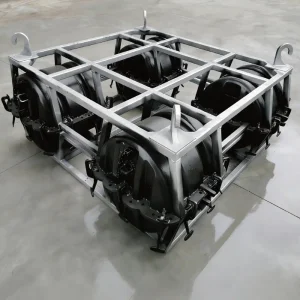
Rotomolding tooling relies heavily on high-grade cast aluminum (A356) or 5-axis CNC machined forged aluminum blocks (6061-T6), as well as fabricated stainless steel molds for large-volume vessels. Chinese industrial clusters in Ningbo maintain world-class aluminum foundry networks and dense clusters of high-precision multi-axis machining centers. This enables factory partners to deliver complex, mirror-polished aluminum molds at 40% to 60% lower CapEx compared to European or North American counterparts, while dramatically accelerating prototype delivery timelines.
High-tier Chinese rotomolding manufacturers do not merely process Polyethylene. They operate specialized R&D material laboratories equipped with Melt Flow Indexers (MFI), Impact Testing Rigs (ARM Low-Temperature Impact Test down to -40°C), Differential Scanning Calorimetry (DSC), and Tensile Testers. This enables processing of advanced engineering polymers including Cross-linked Polyethylene (XLPE), Polypropylene (PP), Polyamide 12 (PA12), and conductive/antistatic compounding formulations.
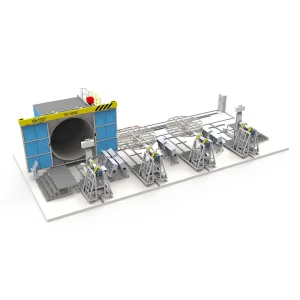
Comparative evaluation of primary machine architectures for factory planning and CapEx allocation.
| Machine Type | Kinematic Configuration | Thermal Energy Source | Optimal Product Scale | Throughput & Cycle Efficiency | Target Industrial Application |
|---|---|---|---|---|---|
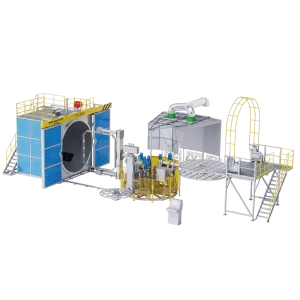
| Carousel Machine (Fixed/Independent Arms) |
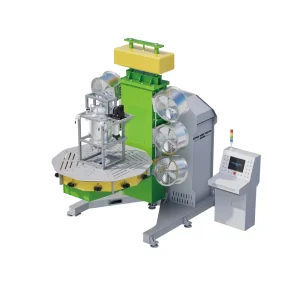
3 or 4 Independent Arms rotating around central axis | Direct Gas / Oil Forced Convection Oven | Medium to High volume standard products (< 3.5m swing) | Very High (Simultaneous Heating, Cooling, Unloading) | Water tanks, playground slides, septic tanks, traffic barriers |
| Lined Shuttle Machine (Linear Rail System) |
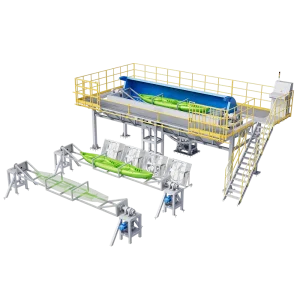
Central oven with 2 straight-line moving shuttles | Gas Burner / Electric Infrared Array | Large, long or asymmetrical hollow products | High & Flexible (Independent arm dwell times) | Agricultural sprayers, kayaks, commercial containers |
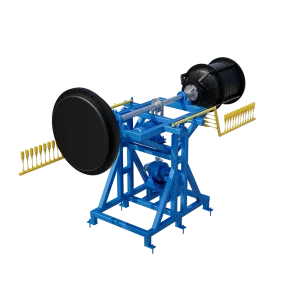
| Rock & Roll Machine (Open Flame / Oven) |
360° Major Rocking + Full Minor Axis Roll | Open Flame Gas Jets or Closed Hot Air Enclosure | Extra-Large cylindrical or linear hollow parts (> 5,000L) | Moderate (Optimized for massive single molds) | Large yacht hulls, chemical storage silos, diesel fuel tanks |
| Electric Heating Machine (Green Smart Tech) |
Arm-integrated intelligent electric heater elements | Zero-Emission Electric Radiant / Induction Heat | Precision components, cleanroom parts | High Efficiency (Direct mold thermal transfer) | Medical cases, food-grade storage, eco-sensitive factories |
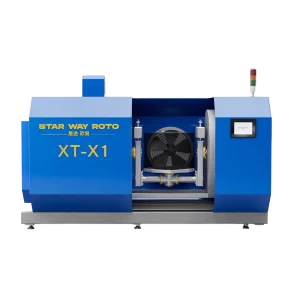
| R&D Lab Testing Unit (Small Scale Simulator) |
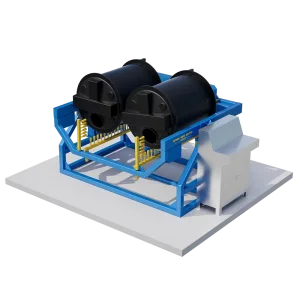
Compact Biaxial Rotational Rig with PLC logger | Electric Micro-Oven with PIAT Sensor probes | Material testing, powder quality control, color matching | N/A (Designed for R&D & Material Analysis) | Polymer compounders, resin suppliers, university labs |
Deploying specialized rotomolding technology across critical global industries.
Production of stress-free multi-layer storage tanks (up to 50,000 Liters) featuring UV-stabilized LMDPE outer jackets, foam core insulation, and chemical-resistant XLPE inner liners for aggressive acids and industrial effluents.
Seamless operator cabs, air intake ducts, hydraulic oil tanks, and fenders for construction machinery. Rotomolded PE parts replace heavy sheet metal, offering high impact strength, vibration damping, and zero corrosion.
Heavy-duty double-walled kayak hulls, leisure boats, pontoon floats, and offshore navigation buoys. Polyurethane foam-filled rotomolded structures deliver unsinkable buoyancy and maximum marine weathering resistance.
Automated feeding troughs, electronic livestock weighing housing, hygienic calf hutches, and water troughs. Non-toxic, food-grade materials prevent bacterial buildup and withstand harsh farm sanitation protocols.
How Chinese rotomolding innovators are shaping the future of low-carbon, automated polymer conversion.
The global rotational moulding industry is experiencing a profound technological transformation driven by strict carbon emission mandates, rising energy costs, and the demand for zero-defect production. Leading Chinese manufacturing partners are pioneering four key technology vector updates:
Traditional burner ovens suffer heat radiation losses up to 45%. Next-generation electric heating rotomolding machines integrate dynamic electrical heating blankets or high-efficiency infrared thermal arrays directly around the mold shell. This closed-loop configuration reduces kilowatt-hour consumption per kilogram of processed polymer by over 30%, while eliminating local greenhouse gas emissions.
Modern machine PLCs no longer rely solely on external oven air temperature timers. By utilizing wireless, heat-shielded telemetry sensors mounted on the rotating arm, the control system tracks the exact internal mold temperature profile (un-melted, melt, PIAT, crystallization). Machine arms automatically transition between heating and cooling zones precisely when the polymer reaches optimal melt viscosity.
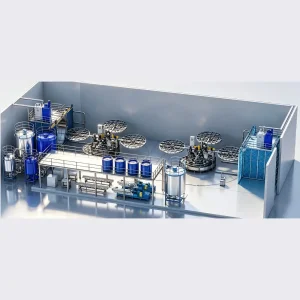
To reduce labor dependency and prevent material contamination, smart Chinese factories incorporate automated pneumatic resin conveying, gravimetric batch weighing systems, and multi-axis articulated robots for automated mold opening, part stripping, and deflashing.
Explore our complete range of specialized rotomolding machines, R&D lab units, and high-precision steel/aluminum tooling.
Expert responses to critical technical and commercial queries for international machinery sourcing.