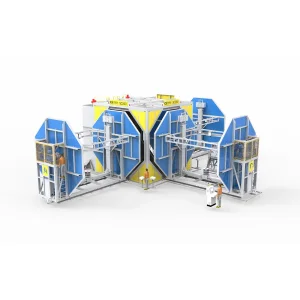
Explore specialized rotational molding machinery engineered for heavy-duty chemical containment, agricultural liquid storage, and large hollow structural vessels.
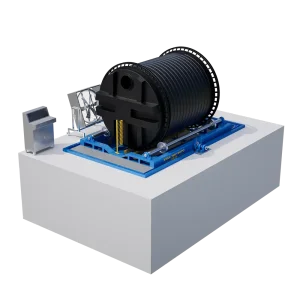
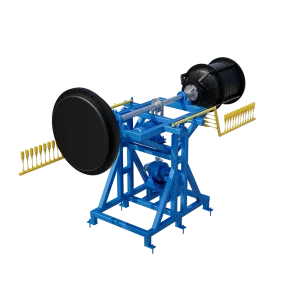
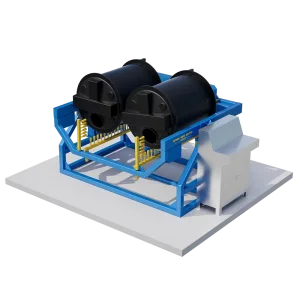
Deciphering the economic and structural shifts driving global procurement of rotational molding tank production machinery, tooling, and industrial infrastructure.
The global rotational molding market, particularly for liquid containment vessels and chemical storage tanks, is experiencing rapid structural growth. According to recent industrial intelligence, the market is expanding at a CAGR of 6.8%, driven by escalating demand for potable water infrastructure, agricultural liquid fertilizer management, industrial effluent neutralization, and underground septic systems. Modern procurement teams are increasingly seeking direct factory OEM partnerships to optimize Capital Expenditure (CAPEX) while securing high-reliability machinery capable of continuous 24/7 thermal processing.
Unlike blow molding or injection molding, rotational molding provides stress-free seamless hollow structures with uniform wall thickness at outer radiuses. When manufacturing large-capacity tanks (ranging from 1,000 to 50,000+ liters), rotomolding operates at substantially lower internal mold pressures. This drastically reduces tooling costs—often by up to 70% compared to injection molding dies—while allowing multi-layer resin wall architectures (such as UV outer layers, structural foam cores, and chemical-resistant inner barrier liners).
Enterprise buyers seeking to purchase roto mold tank machines and establish manufacturing plants must evaluate not only the upfront capital equipment cost but also the Thermal Efficiency Coefficient of the heating chamber, the mechanical rigidity of the indexing arms, and the precision of multi-zone burner control systems. Strategic sourcing directly from established China OEM factories like StarWay Roto unlocks complete turnkey line integration at optimized ROI benchmarks.
A deep engineering analysis of Rock and Roll, Carousel, and Shuttle machinery configurations used in tank fabrication.
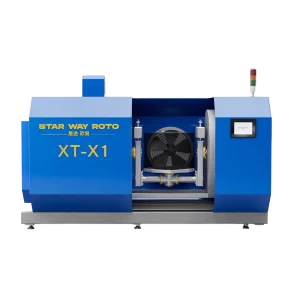
Engineered primarily for long, cylindrical, or massive horizontal storage tanks (such as septic tanks, agricultural transport tanks, and steel-lined vessels). Rock & Roll machines utilize a central rocking spindle combined with 360-degree rotational movement. Available in open-flame tracks for large steel-lined structures or enclosed insulated ovens for high-precision poly tank molding.
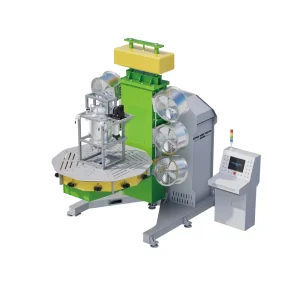
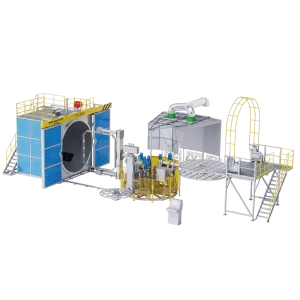
Designed for high-speed, continuous mass production of vertical water tanks, chemical containers, and IBC totes. Independent station carousels allow simultaneous heating, cooling, and loading/unloading across 3 or 4 arms. Each arm operates on an independent timer and thermal profile, maximizing station throughput and eliminating process bottlenecks.
Shuttle systems offer maximum operational flexibility for factories producing variable tank volumes. Two independent carriages share a single central heating oven, shuttling between cooling and loading bays on parallel rail systems. Ideal for medium-to-large vertical tanks where changeover times between different mold sizes vary frequently.
| Machine Type | Primary Tank Applications | Max Capacity Range | Energy Efficiency | Production Throughput |
|---|---|---|---|---|
| Open Flame Rock & Roll | Steel-lined plastic tanks, large horizontal storage | 5,000L - 50,000L+ | Moderate (Localized Heat) | Batch / Heavy Duty |
| Enclosed Oven Rock & Roll | High-precision PE septic & diesel fuel tanks | 2,000L - 25,000L | High (Insulated Chamber) | Medium Volume |
| Independent Arm Carousel | Vertical water tanks, chemical containers, drums | 500L - 10,000L | Very High (Continuous Thermal Load) | High Volume (Mass Production) |
| Linear / Square Shuttle | Custom industrial tanks, specialized vessels | 1,000L - 20,000L | High (Shared Central Oven) | Flexible Batch Production |
Understanding melt flow index, cross-linking chemistry, and structural polymer behavior under zero-shear rotational thermal dynamics.
LLDPE remains the industry workhorse for potable water storage tanks and agricultural sprayers. Standard roto-grade LLDPE features a Melt Flow Index (MFI) ranging from 3.0 to 5.0 g/10min and a density of 0.932 to 0.940 g/cm³. It provides exceptional tensile strength, environmental stress crack resistance (ESCR), and high impact toughness even at sub-zero temperatures (-40°C).
For aggressive industrial chemical storage (such as sodium hypochlorite, sulfuric acid, and hydrofluoric acid), XLPE is required. Through the addition of organic peroxide cross-linking agents during the thermal cycle, XLPE forms a 3D molecular matrix. This dramatically elevates chemical resistance, structural creep resistance, and drop-impact performance, making it the premier choice for hazardous fluid containment.
HDPE resins offer higher flexural modulus and structural rigidity, enabling thinner wall designs for large vertical water tanks. However, narrow processing windows require precise PLC internal air temperature (IAT) monitoring to prevent warpage and bubble entrapment during cooling cycles.
Used in high-temperature or hydrocarbon containment (such as automotive fuel tanks and hydraulic oil reservoirs). Nylon resins provide zero hydrocarbon permeability and high heat deflection, whereas PP provides high stiffness and chemical inertness against solvents.
Evaluating mold metallurgy, parting line tolerance, heat transfer coefficients, and venting systems for flawless tank molding.
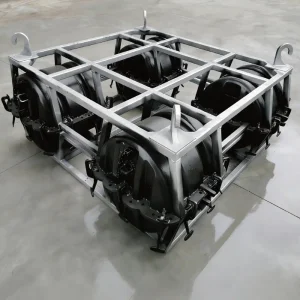
Fabricated from heavy-gauge boiler-grade steel plates (3mm to 6mm thickness), steel molds are the primary choice for large vertical water tanks, septic tanks, and cylindrical vessels exceeding 3,000 liters. They offer structural durability, rapid fabrication lead times, and easy field repairability. Modern laser cutting and 5-axis press-brake bending ensure tight parting lines to eliminate excess flash.
For smaller tanks, double-walled coolers, and complex geometry vessels with integral threads, molded-in inserts, or complex branding, cast aluminum (A356 alloy) or block-machined CNC molds are superior. Aluminum features a thermal conductivity approximately 3 times higher than steel, enabling up to 20% shorter heating/cooling cycle times and flawless surface finish replication.
During the rotational heating cycle, air inside the mold expands rapidly. Improper venting leads to internal backpressure, causing pinholes, surface blowouts, and uneven corner thinning. StarWay Roto molds integrate Teflon-lined dynamic breathing vents with synthetic wool cores, ensuring pressure equilibrium while maintaining uniform melt distribution across critical radiuses.
A financial and operational framework for establishing a turnkey roto mold tank manufacturing facility.
Includes machine acquisition (Rock & Roll vs. Carousel), mold tooling portfolio, resin pulverizing equipment (micro-pellet to 35-mesh powder), high-capacity air compressors, cooling tower systems, and crane infrastructure. Direct China sourcing reduces total equipment CAPEX by 35-50% compared to Western European alternatives.
Primary OPEX drivers are burner fuel (Natural Gas, LPG, or Diesel), electricity consumption per kilogram of processed resin, virgin polymer resin costs, and labor. Installing high-efficiency burner chambers with digital air-fuel ratio controllers yields up to 18% thermal fuel savings per cycle.
Efficient plant design prioritizes raw resin receiving, pulverizing, mold preparation bays, machine rotation zones, demolding/cooling stations, secondary machining (fitting installation, hydro-testing), and finished goods storage yards to eliminate linear material handling bottlenecks.
Rigorous testing protocols ensuring compliance with international drinking water, chemical containment, and machinery safety regulations.
Certified quality management governing precision machinery fabrication, component traceability, and factory quality audits.
Compliance with EU Machinery Directive 2006/42/EC, Low Voltage Directive, and dual-channel safety interlocks.
Verification that polyethylene tank components meet strict health standards for potable drinking water contact.
Standardized Association of Rotational Molders (ARM) dart impact testing performed at -40°C to verify ductility.
Next-generation innovations reshaping rotational molding efficiency, automation, and environmental sustainability.
Transitioning from direct gas burners to high-efficiency infrared electric heating grids and electric convection elements, allowing zero on-site carbon emissions and pinpoint thermal chamber zone control.
Wireless internal air temperature (IAT) sensors transmit live temperature and pressure curve data directly to PLC machine controllers, dynamically adjusting rotation ratios and burner output in real time.
Advanced multi-layer co-rotational molding technology enabling up to 50% Post-Consumer Recycled (PCR) polyethylene core layers sandwiched between virgin UV-stabilized outer skin layers.
Expert answers to key technical, logistical, and commercial inquiries from enterprise procurement officers.
Discover laboratory testing equipment, high-speed polymer mixers, eco-friendly electric machines, and specialized shuttle rotomolding systems.