Tooling / Steel
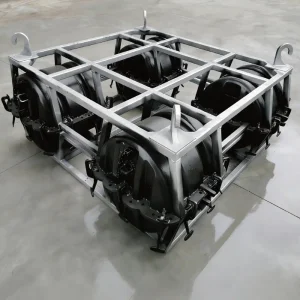
ODM Steel Mould Exporter, Products
- Heavy-duty Q235B/P20 fabrication
- Mirror finish & seamless parting

Factory-direct rotational molding machines, CNC-machined steel tooling, and auxiliary gasification systems engineered for heavy-duty industrial hollow product manufacturing.
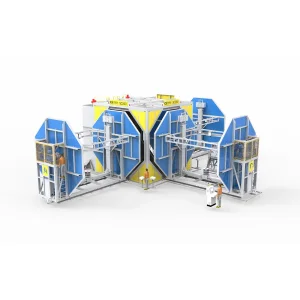
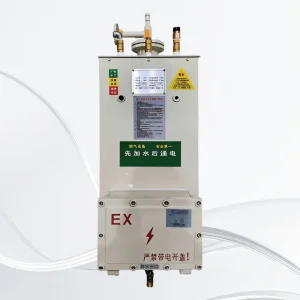
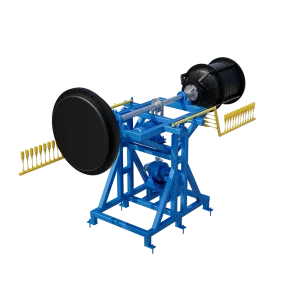
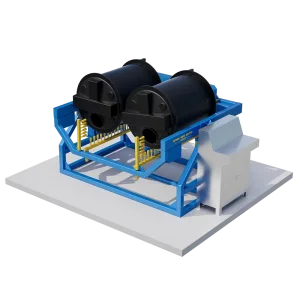
Evaluating rotational molding machinery quotes requires an in-depth understanding of bi-axial rotation mechanics, polymer powder sintering rheology, and convective heat dissipation.
The rotational molding process relies on simultaneous rotation along two perpendicular axes (major primary axis and minor secondary axis). Modern PLC-driven machinery must deliver speed ratios typically ranging from 4:1 to 1:4 with variable-frequency drives (VFD). Precision ratio regulation guarantees that thermoplastic powders (such as LLDPE, HDPE, and PA12) evenly coat complex mould walls without pooling in interior recesses or generating gravitational wall thinning.
StarWay machinery implements multi-axis servo coordination that eliminates dead zones during rotation, ensuring critical cross-sectional uniformity across asymmetrical structures, large agricultural fuel tanks, and heavy-walled septic reservoirs.
Attaining optimal mechanical properties (tensile strength, impact resistance, and elongation at break) hinges on the thermal transition curve inside the mould cavity. Sintering commences as the mold skin surpasses the polymer melting point ($T_m \approx 125^\circ\text{C}-135^\circ\text{C}$ for Polyethylene), progressing through powder densification, bubble dissolution, and full homogenisation.
Real-time internal air temperature telemetry systems track Peak Internal Air Temperature (PIAT) targeting $195^\circ\text{C}-215^\circ\text{C}$. This telemetry prevents under-curing (brittle failure) and oxidative thermal degradation (discoloration and polymer chain scission).
Oven chamber thermodynamics dictate 40% of total operational expenditure. High-efficiency rotomolding ovens incorporate high-volume, low-velocity (HVLV) recirculating airflow driven by centrifugal blowers, combined with modulating gas burners (Riello or Weishaupt) or electric ceramic infrared arrays.
Directional louvers create balanced laminar flow across all mould faces, minimizing temperature variances within $\pm 2.5^\circ\text{C}$ throughout spherical envelopes up to 8,500 mm. This thermal uniformity reduces overall heating cycle times by up to 22%.
Ningbo StarWay Roto Co., Ltd. delivered the world's largest rotational molding machine, the S2-8500. Capable of supporting mold spherical rotation diameters up to 8.5 meters with an arm payload capacity exceeding 12,000 kg, this milestone showcases our proprietary finite element stress analysis (FEA) applied to rotating cantilever arms, precision planetary gearboxes, and dual-zone modulating thermal chambers.
Our vertically integrated facility utilizes heavy-duty laser alignment to ensure zero shaft deflection during prolonged $280^\circ\text{C}$ thermal exposure cycles, setting a global standard for uptime and operational lifespan.
Selecting the optimal machinery configuration requires balancing production volume, mold dimensions, cycle independence, and capital expenditure.
| Machinery Type | Kinematic Arm Configuration | Thermal Chamber Type | Optimal Production Scale | Cycle Flexibility | Typical Industrial Products |
|---|---|---|---|---|---|
| Fixed-Arm Carousel | 3 or 4 Arms (Synchronous index) | Enclosed Forced-Air Gas/Diesel | High Volume Mass Production | Uniform Cycles | Water storage tanks (200L-5000L), traffic barriers, playground slides |
| Independent-Arm Carousel | 3 to 6 Independent Servo Arms | Dual-zone Intelligent Oven | High-Mix / High-Volume | Fully Independent | Automotive fuel tanks, complex kayaks, mixed custom industrial parts |
| Linear / Square Shuttle | 1 or 2 Heavy-Duty Traveling Carts | Central Shared Oven + Dual Stations | Medium Volume / Large Items | High Flexibility | Chemical IBCs, large insulated coolers, agricultural cabins, boat hulls |
| Rock and Roll (Open Flame) | Single Bi-axial Rocking U-Arm | Direct Flame Burner Bar | Dedicated Cylindrical Tanks | Batch Specific | Ultra-large horizontal/vertical liquid storage tanks (5,000L to 30,000L) |
| Direct Electric Heating | Modular Robotic / Shuttle Mount | Internal Ceramic Infrared Elements | Cleanroom / Zero-Emission | Precise PID Zoning | Medical enclosures, high-purity semiconductor containers, food vessels |
How Ningbo StarWay Roto leverages regional metallurgical, electrical, and precision machining clusters to deliver premium rotomolding machinery at 35%–50% CapEx savings.
Ningbo is China's premier mould-making and metallurgical center. StarWay operates dedicated in-house CNC machining centers (3-axis and 5-axis gantry milling) capable of handling cast aluminum (A356 alloy) and fabricated steel tooling up to 6 meters in length.
By controlling tooling CAD/CAM modeling, casting, CNC cavity finishing, mirror polishing, and pneumatic clamping in-house, we eliminate external subcontractor markups and compress mould delivery timelines from months to 25–35 working days.
Cost savings do not come at the expense of component reliability. StarWay standardizes electrical, pneumatic, and combustion subsystems around internationally recognized Tier-1 brands:
Rather than sourcing pulverizers, high-speed color mixers, cooling towers, and testing equipment from multiple disparate vendors, StarWay provides complete balanced factory work-cells.
Our turnkey integration ensures that resin pulverizing throughput (mesh size 30-50 mesh) matches machine oven cycle frequency, preventing material bottlenecks and lowering total installed project cost by 40% compared to fragmented sourcing.
A realistic machinery quote must account for upfront CapEx alongside 10-year thermal energy efficiency, maintenance downtime, and tooling amortization.
In rotational molding manufacturing, Initial Equipment Investment ($\text{CapEx}$) represents only 15%–25% of the total 10-year lifecycle cost. The dominant cost drivers are Polymer Raw Materials (50%–60%), Thermal & Electrical Energy (15%–20%), and Labor/Maintenance (10%):
StarWay's triple-layer rockwool insulation (density $120\text{ kg/m}^3$, 150mm thickness) reduces outer wall thermal surface temperatures below $45^\circ\text{C}$, cutting natural gas consumption by $0.08\text{ Nm}^3/\text{kg}$ of processed polymer.
When benchmarking international quotes against StarWay factory solutions, procurement teams should audit the following engineering specifications:
StarWay machines are engineered to satisfy stringent European and North American electrical, mechanical, and combustion safety regulations.
All StarWay control cabinets comply with the CE Machinery Directive 2006/42/EC and Low Voltage Directive 2014/35/EU. For North American export clients, we manufacture UL508A-certified control panels with dual-channel emergency stop circuits, category 4 safety interlocks, and Arc-Flash risk mitigation layouts.
Our gas and diesel oven chambers incorporate automated pre-purge cycles, continuous flame-monitoring UV sensors, dual automatic shut-off safety solenoid valves, and explosion-relief roof blow-out hatches adhering strictly to NFPA 86 (Standard for Ovens and Furnaces) and EN 746-2 industrial heating safety codes.
StarWay field service engineers conduct on-site mechanical erection, electrical commissioning, and trial mold testing across 40+ countries. We support our global client base with 24/7 remote IoT diagnostics, 48-hour emergency spare parts dispatch, and on-site factory training for local operators.
How StarWay's R&D division is transforming rotational molding from an empirical craft into an automated, data-driven, and eco-friendly manufacturing process.
Traditional rotomolding relied on fixed oven timer recipes, leading to quality drift from ambient temperature fluctuations. StarWay's smart telemetry integrates wireless infrared sensors and internal thermocouple transmitters mounted directly inside rotating mould assemblies.
The central Siemens PLC dynamically adjusts oven heating and cooling fan speeds in real time based on actual polymer melt stage transition events, cutting scrap rates to under 0.5%.
With global carbon border adjustment mechanisms (CBAM) and corporate ESG mandates, StarWay has developed direct electric heating rotomolding systems. By eliminating fossil-fuel open burners in favor of high-response zoned ceramic heaters, these machines operate with zero local emissions, 95% thermal transfer efficiency, and pinpoint surface temperature uniformity.
To address rising global labor costs, our latest production cells incorporate automated vacuum powder conveying, robotic volumetric powder dispensing into hot moulds, and pneumatic mold-opening assist devices. These upgrades reduce manual operator handling times by 65% and eliminate operator exposure to high oven temperatures.
StarWay machinery powers hollow plastic part manufacturing across diverse global sectors requiring high impact resistance, corrosion immunity, and complex geometry.
Heavy-duty vertical and horizontal chemical tanks (500L to 30,000L). StarWay multi-layer co-extrusion technology enables multi-wall designs with virgin XLPE inner liners for chemical corrosion resistance and UV-stabilized LLDPE structural outer skins.
Diesel fuel tanks, DEF (AdBlue) reservoirs, agricultural sprayer booms, hydraulic oil tanks, and tractor cabin roofs. Meets strict permeability standards (ECE R34) with zero internal weld lines and leak-proof threaded boss inserts.
Double-walled insulated fish tubs, dry-ice shippers, rotomolded commercial cooler boxes, and heavy-duty spill containment pallets capable of supporting 4 x 200L steel drums with full chemical compatibility.
High-stability sea kayaks, recreational fishing boats, navigation buoys, marina floating docks, and offshore aquaculture cages manufactured with foam-filled polyethylene shells for non-sinkable buoyancy.
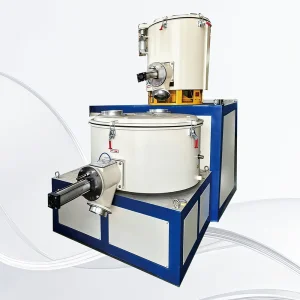
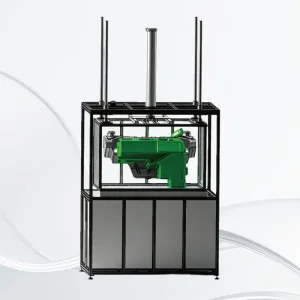
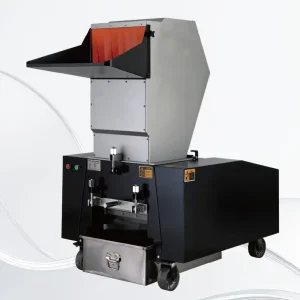
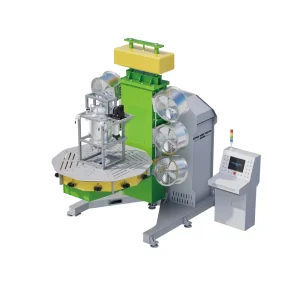
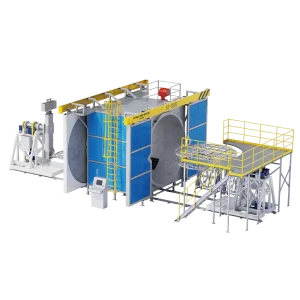
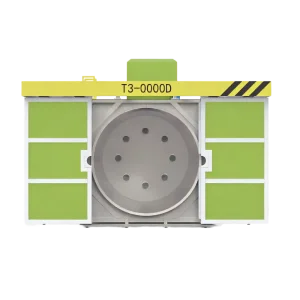
Complete your production line with high-precision testing machinery, polymer granulators, electric heating ovens, and customizable shuttle rotomolding systems.
Key answers to technical, operational, and financial inquiries commonly raised by corporate procurement directors and plant managers.
Turnkey quotes are formulated based on five core criteria: 1) Machinery envelope & spherical swing diameter (e.g., 2.0m to 8.5m); 2) Arm configuration (Carousel fixed/independent vs. Shuttle vs. Rock & Roll); 3) Thermal source configuration (Natural gas, LPG, Diesel, or Electric IR); 4) Tooling specifications (Cast A356 aluminum vs Fabricated Q235B steel); and 5) Auxiliary integration (Pulverizers, high-speed mixers, vacuum loaders, and automated demolding stations).
Cast A356 Aluminum Tooling offers superior thermal conductivity ($k \approx 160\text{ W/m}\cdot\text{K}$), faster cycle times, and the capability to capture intricate surface textures and complex draft geometries (minimum $1^\circ-1.5^\circ$). Fabricated Steel Tooling ($k \approx 45\text{ W/m}\cdot\text{K}$) is cost-effective for large, geometrically simple, high-volume hollow parts such as cylindrical water storage tanks and septic tanks, offering higher structural durability against heavy manual clamping.
Traditional Linear Shuttle machines require extensive lengthwise track space on both sides of a central oven. The StarWay Square Shuttle layout routes two or three independent mold carts through a 90-degree enclosed loop with automated corner transfer tables. This reduces the total required plant floor area by 35% while allowing one arm to cool and reload while the second arm roasts in the central oven chamber.
StarWay machinery complies fully with European CE directives (Machinery Directive 2006/42/EC, Low Voltage 2014/35/EU, EMC 2014/30/EU). For North American clients, we build UL508A-compliant electrical control enclosures with Allen-Bradley or Siemens PLCs. Our gas trains and combustion blowers satisfy NFPA 86 and EN 746-2 industrial heating safety regulations with double-block-and-bleed gas valve sets.
Standard Carousel and Shuttle machinery models average 45 to 60 calendar days for manufacturing, assembly, and factory acceptance testing (FAT). Custom multi-arm large systems (such as the S2-8500 class) require 75 to 90 days. CNC-machined and cast aluminum moulds require 25 to 40 days, including 3D CAD modeling, casting, machining, parting line hand-fitting, and initial trial sample approval.
StarWay deploys certified mechanical and electrical commissioning engineers worldwide. Our scope of on-site service covers: machine foundation leveling, electrical wiring, gas burner calibration, PLC communication setup, dry-cycle testing, trial mold heating tests, and a comprehensive 5-day on-site training curriculum covering operator safety, recipe creation, and preventive mechanical maintenance.
Our systems process all commercial rotomolding polymers, including Linear Low-Density Polyethylene (LLDPE), High-Density Polyethylene (HDPE), Cross-Linked Polyethylene (XLPE), Polypropylene (PP), Polyamide/Nylon (PA6, PA11, PA12), Polycarbonate (PC), and fluoropolymers such as PVDF. Precision zoned temperature regulation ensures proper melt viscosity control across resins with Melt Flow Indices (MFI) ranging from 2.0 to 8.0 g/10min.
Peak Internal Air Temperature (PIAT) telemetry measures the exact thermodynamic state of the internal air within the hollow cavity during rotation. By terminating the heating cycle precisely when the air reaches the polymer's optimal cure plateau ($200^\circ\text{C}-210^\circ\text{C}$ for LLDPE), our closed-loop system prevents micro-void formation, improves impact resistance at $-40^\circ\text{C}$, and eliminates thermal yellowing caused by over-baking.
Electric heating eliminates open flames and fossil fuel combustion exhaust, making it ideal for cleanroom manufacturing and jurisdictions with stringent air quality emissions caps. Electric heating elements mounted adjacent to the mould provide 95% thermal transfer efficiency, faster ramp-up rates, zero burner maintenance, and ultra-quiet plant operation.
All StarWay rotational molding machinery is backed by a 12-month full-machine structural and electrical warranty. We provide a complete initial spare parts package (seals, thermocouples, burner electrodes, proximity sensors). For ongoing operations, all machines include an integrated industrial VPN modem enabling StarWay senior automation engineers to troubleshoot PLC ladder logic, drives, and temperature controllers remotely within 2 hours.