Engineered for maximum thermal uniformity, cycle time optimization, and high-tensile polyethylene molding across touring, sit-on-top, and tandem kayak geometries.
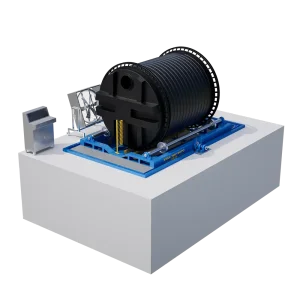
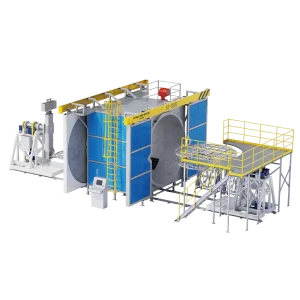
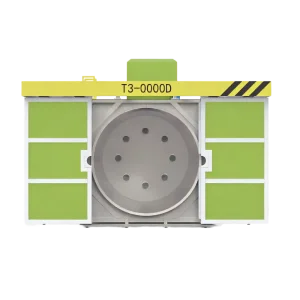
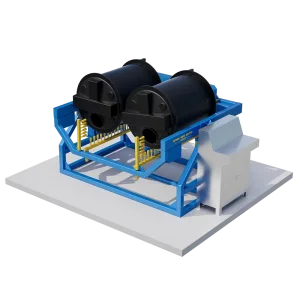
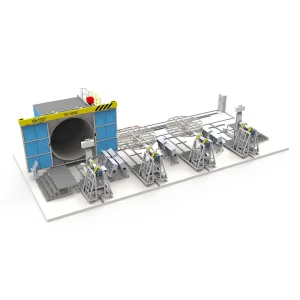
The global paddle sports and recreational watercraft industry has evolved rapidly from simple single-layer polyethylene dinghies into highly engineered, multi-chambered, rigid aquatic vessels. Modern recreational, fishing, and whitewater kayaks require complex hydrodynamic contours, integrated drainage channels, keel reinforcements, modular accessory track recesses, and specialized multi-layer sandwich wall constructions.
Producing these extended aspect-ratio vessels demands exceptional thermal balance and synchronized rotational kinemactics. Conventional rotational molding equipment often suffered from localized wall-thinning at the bow and stern, chronic warpage along the keel line, and long cook-times that degraded polymer molecular chains. Today, elite industrial factories utilize specialized Rock-and-Roll and multi-axis Shuttle machinery built with multi-zone heating chambers, internal mold pressurization, and wireless telemetry to achieve sub-millimeter wall thickness consistency.
Modern kayak manufacturing moves away from static time-temperature baking toward real-time PIAT diagnostics. By measuring internal cavity air temperatures, controllers identify the exact polymer fusion point (approx. 195°C - 205°C for LLDPE), terminating the heating cycle instantly when bubble-free densification is achieved to prevent resin embrittlement.
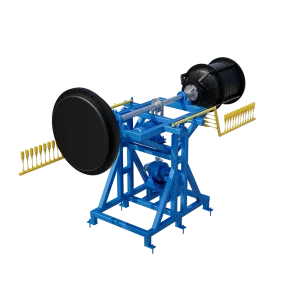
Unlike spherical or cube containers, kayak hulls measure between 2.5 to 5.5 meters in length with narrow cross sections. Rock-and-Roll machines utilize longitudinal rolling arcs up to 45° with simultaneous 360° axial rotation to force resin into bow tips and thin gunwale sidewalls without localized pooling.
Key performance indicators and critical engineering variables considered by Tier-1 outdoor recreation brands when qualifying rotomolding machinery suppliers.
Kayak molds possess large surface areas. Inefficient ovens generate thermal stratification, causing 2-4 mm wall discrepancies between keel and deck. Top-tier machines employ reversible high-CFM centrifugal blowers that maintain internal oven temperature differentials within ±2.5°C across a 6-meter chamber.
Cycle times in kayak production are bounded by mechanical handling. Heavy-duty cast and fabricated steel arms must handle dynamic payloads exceeding 3,500 kg while maintaining zero backlash during rapid direction reversal. Variable-frequency drives (VFD) allow micro-adjustments in tumbling velocity.
Global carbon reduction mandates push rotomolders to evaluate energy footprints. Top factories provide multi-fuel combustion setups compatible with Natural Gas, LPG, and high-efficiency direct electrical infrared heating arrays that cut direct carbon output to zero while offering rapid start-up cycles.
| Machine Architecture | Optimal Product Scope | Thermal Efficiency | Footprint Requirement | Mould Flexibility |
|---|---|---|---|---|
| Rock-and-Roll (Enclosed Oven) | Single & Tandem Kayaks, Canoes, SUPs (3m - 6m) | High (Insulated Rocking Oven) | Linear & Narrow (Ideal for long hulls) | Medium (1-2 large moulds per arm) |
| Open Flame Rock-and-Roll | Budget High-Volume Kayak Production | Moderate (Direct Burner Array) | Ultra-Compact & Minimal Overhead | High (Fast mold mounting) |
| Linear Shuttle (2 Carts) | High-Mix Production (Kayaks + Coolers + Tanks) | High (Isolated Central Oven) | Medium Linear Floor Footprint | Very High (Independent cycle times per cart) |
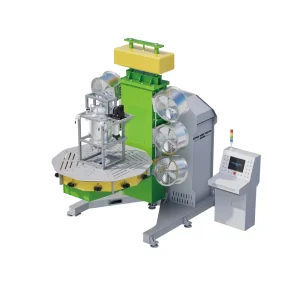
| Carousel Multi-Station | Mega-Volume Automated Marine Facilities | Maximum (Continuous indexed baking) | Large Circular Clear Floor | Strict (Balanced arm cycle required) |
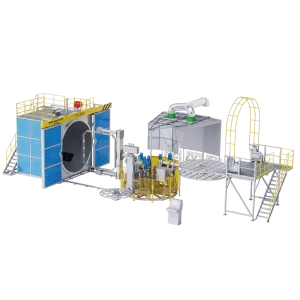
Achieving commercial viability requires more than an isolated machine. It demands an integrated production ecosystem from resin pulverizing to robotic trimming.
Precision CNC machined 6061 billet aluminum or high-density porosity-free cast aluminum molds with integrated CNC venting channels, stainless-steel clamping, and thermal parting-line seals to eliminate parting line flash.
LLDPE powder quality governs skin surface gloss and pinhole formation. Integrated pulverizing lines grind virgin and reclaimed resin down to 35 mesh (500 micron) with strict narrow particle size distribution for rapid melt consolidation.
Uncontrolled cooling causes asymmetrical shrinkage and hull bow curling. Intelligent cooling stations blend fine atomized water mists with variable airflow velocity, regulating the crystalline solidification curve.
Multi-axis articulated robot arms automatically route cockpit openings, drill hatch fastener holes, cut scupper drains, and flame-polish parting edges with 0.1 mm repeatability, reducing post-demold manual labor by 70%.
Procuring heavy industrial thermal processing equipment across international borders requires stringent compliance with electrical, mechanical, and combustion safety regulations. Premium rotomolding manufacturers build systems fully aligned with European CE machinery directives, North American UL/CSA electrical panels, and NFPA 86 industrial oven safety standards.
Our global deployment model pairs heavy machine manufacturing with localized engineering support, ensuring rapid installation, on-site commissioning, operator safety training, and continuous supply of consumable spare parts (burners, gearboxes, bearings, thermocouple assemblies).
Phase 1: Factory CAD Simulation & Power Layout: Optimized plant layouts preventing thermal cross-drafts between ovens and cooling bays.
Phase 2: On-Site Mechanical & Electrical Commissioning: Lead engineers dispatched on-site for mechanical anchoring, burner calibration, and trial mold runs.
Phase 3: Scientific Rotomolding Recipe Calibration: Formulating precise heating-cooling ramp curves tailored to your specific kayak molds and polyethylene resin melt flow index (MFI).
Pioneering Industry 4.0 digital twins, closed-loop thermal infrared sensing, and autonomous production cells for the next decade of watercraft manufacturing.
Replacing fixed cycle timers with multi-channel non-contact infrared thermal scanners mounted inside the oven. The system continuously maps the temperature gradient across the entire kayak mold, automatically throttling independent burner nozzles to equalize cold spots dynamically.
Embedded vibration sensors on main rotational drive shafts, bearing temperature transducers, and burner pressure monitors upload real-time operational telemetry to the cloud, warning maintenance crews of impending mechanical wear weeks before downtime occurs.
Next-generation shuttle machines interface directly with AGVs (Automated Guided Vehicles) and vacuum-assisted robotic mold opening frames. Multi-shot drop-boxes drop secondary foam core charges at pre-programmed internal temperatures without halting arm rotation.
Authoritative engineering insights to assist technical directors, plant managers, and procurement officers during project evaluation.
Kayaks feature high length-to-width aspect ratios (typically 3:1 to 8:1). A Rock-and-Roll machine's narrow linear footprint and tailored rocking motion (up to 45°) distribute resin along the longitudinal keel with high energy efficiency, whereas a Carousel machine requires an enormous circular chamber radius that consumes significantly more oven heating power for equivalent capacity.
Watercraft rotomolding predominantly employs High-Density Polyethylene (HDPE) or Linear Low-Density Polyethylene (LLDPE) copolymers with a Melt Flow Index (MFI) ranging between 3.5 to 5.0 g/10 min and density between 0.935 to 0.945 g/cm³. The resin must feature advanced UV8 to UV15 stabilization additives and high Environmental Stress Crack Resistance (ESCR > 1000 hrs).
Three-layer sandwich molding creates an outer solid protective skin (approx. 2 mm), a foamed PE cellular core (approx. 4-6 mm) using chemical blowing agents, and an inner solid skin (1-2 mm). This construction delivers exceptional beam rigidity and positive buoyancy while cutting total hull weight by 20-30% compared to heavy solid walls.
Warpage occurs when different zones of the long hull cool at unequal rates, inducing differential crystallization and residual thermal stress. Our machines utilize programmable multi-stage cooling bays with independently modulated airflow dampers and atomizing water mists to synchronize cooling across the thick keel and thin deck.
Camo/marbled effects are achieved by blending pre-colored polyethylene powders of differing melt flow indices or particle mesh sizes. High-precision rotation programs control initial rolling tumble speeds to distribute the accent pigments across specific mold sections before complete powder fusion occurs.
A standard single-layer solid HDPE fishing kayak (30-38 kg) has an overall cycle time of 28 to 38 minutes (16-22 min oven cook time, 10-14 min controlled cooling, and 2-4 min load/demold). With dual-arm shuttle systems, factory output reaches 30 to 45 finished hulls per 24-hour shift per production line.
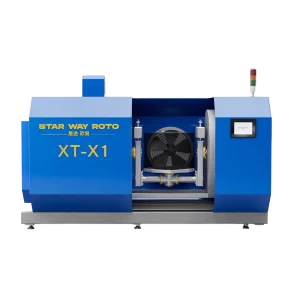
Explore our complete portfolio of CE-certified electric heating ovens, large-scale U-arm rock-and-roll units, multi-station carousel machines, and laboratory R&D systems.