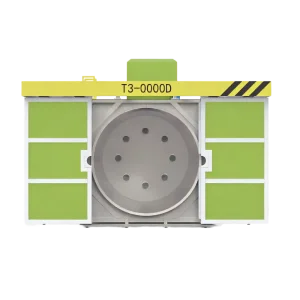
Engineered for high-volume dimensional consistency, rapid thermal cycling, and heavy-duty structural integrity.
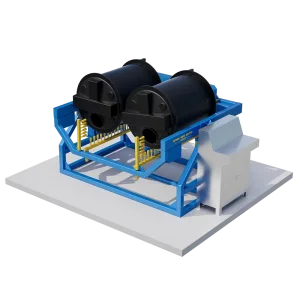
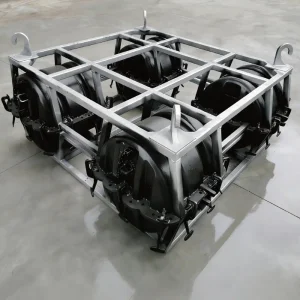
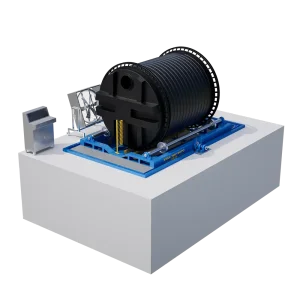
Analyzing macro market shifts, thermo-mechanical challenges, and why tier-1 manufacturers are redesigning their tooling procurement matrices.
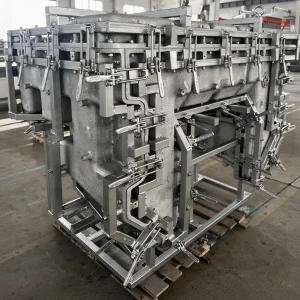
North American and European tooling shops face escalating labor bottlenecks and aging foundry infrastructures. While high-end CNC billet aluminum is viable for compact parts, large-scale custom cast aluminum moulds face extended lead times exceeding 26–36 weeks.
China—particularly the Ningbo-Zhejiang industrial cluster—has unified high-integrity CAD/CAM pattern making, automated wood/resin master milling, vacuum casting foundries, and 5-axis CNC machining within unified economic ecosystems.
Modern rotational molding cannot tolerate uneven wall thickness caused by uncalibrated thermal masses. State-of-the-art mould builders utilize finite element thermal analysis (FEA) to engineer constant-wall cast aluminum geometries.
Selecting the optimal mould medium based on part geometry, annual production runs, surface fidelity, and thermodynamic criteria.
| Engineering Parameter | Cast Aluminum Mould (A356) | Fabricated Sheet Steel Mould | CNC Billet Aluminum (6061-T6) |
|---|---|---|---|
| Primary Application | Complex aesthetics, kayaks, coolers, auto ducts | Large cylindrical tanks, IBCs, septic systems | Micro-precision medical, aerospace enclosures |
| Thermal Conductivity | 150 – 170 W/m·K (High) | 45 – 55 W/m·K (Moderate) | 160 – 190 W/m·K (Superior) |
| Geometric Complexity | High (Deep undercuts, compound curves, ribs) | Low to Moderate (Prismatic, axisymmetric) | Ultra-High (Tight radii, micro-textures) |
| Dimensional Tolerance | ±0.5 mm to ±0.8 mm | ±1.5 mm to ±3.0 mm | ±0.1 mm to ±0.3 mm |
| Tooling Weight & Thermal Mass | Optimized constant wall (8–12 mm) | Heavy structural framing (2.5–4.0 mm plate) | Moderate to Heavy depending on pocketing |
| Typical Tool Life | 80,000 – 150,000+ cycles | 30,000 – 60,000 cycles (weld fatigue) | 200,000+ cycles |
| Relative Cost Index | Moderate (Excellent long-term ROI) | Low (Fast entry for large volume storage) | High (Premium upfront CapEx) |
How Ningbo StarWay Roto Co., Ltd. bridges advanced metallurgy, proprietary machinery design, and seamless export capabilities.
In standard international procurement, buying a rotomolding machine from Company A and moulds from Company B leads to systemic misalignment: thermal transfer imbalances, flange mismatching on spider arms, and contentious warranty disputes regarding cycle efficiency.
Ningbo StarWay Roto Co., Ltd. (operating since 2009) eliminates this friction. Founded on 23+ years of accumulated engineering expertise and holding 23 proprietary patents across carousel, shuttle, and rock-and-roll configurations, StarWay integrates tooling design directly with machinery kinematics.
From extreme environmental endurance to ultra-hygienic certifications, our tooling powers global infrastructure.
Smart sensors, electric direct heating, and circular polymer engineering are transforming factory floors.
Next-gen moulds feature embedded wireless temperature probes (measuring Peak Internal Air Temperature - PIAT) transmitting real-time thermodynamic data to the machine PLC to dynamically calibrate arm rotation and cycle timing.
Replacing fossil-fuel gas ovens with StarWay’s proprietary CE-certified electric heating elements integrated directly onto the mould exterior. This delivers 35% energy savings and zero direct carbon emissions on the factory floor.
Mould cavities are chemically treated with proprietary fluoropolymer release coatings to accommodate high-percentage rHDPE and rPP compounds without pinholing, surface degradation, or uneven shrinkage.
Use this 6-point framework when vetting international rotomolding mould companies and custom manufacturing factories.
Demand certified A356.2 aluminum ingots with degassing treatment to prevent micro-porosity during CNC polishing.
Ensure parting lines are fully 5-axis CNC machined with matched tongue-and-groove seals to eliminate manual flash trimming.
Confirm PTFE or silicone breathers are calculated according to hollow volume displacement (13 mm ID per 1 m³ volume standard).
Verify structural steel frames undergo rotational static and dynamic balancing to minimize gearbox stress on carousel arms.
Require actual hot-shot trial moldings with CMM dimensional reports and wall thickness ultrasonic mapping prior to dispatch.
Confirm mounting plates, burner clearance, and cooling fan airflow paths integrate seamlessly with your plant's existing machinery.
From our foundation in 2009 to pioneering the world’s largest rotomolding machines, our track record defines industry authority.
Founded Jinlei Rotomolding Co., Ltd. in Ningbo, China, initiating proprietary R&D into specialized hollow plastic moulding machinery and tooling.
Successfully engineered and delivered our first proprietary industrial rotomolding machine, setting new benchmarks in thermal containment.
Established Changzhou Yuanhuai Rotational Molding Co., Ltd., scaling up cast aluminum pattern casting and large CNC mold finishing capacity.
Founded Taizhou OE Technology Co., Ltd. to accelerate automated auxiliary equipment, high-speed pulverizers, and intelligent PLC control systems.
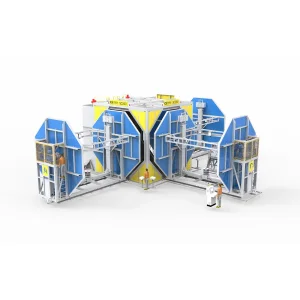
Manufactured and successfully commissioned the world’s largest shuttle rotomolding machine—the S2-8500—delivering unmatched high-load capabilities.
Formally recognized as a National High-Tech Enterprise by the Chinese government, holding 23 authorized technical patents.
Unveiled the StarWay Future Series, featuring fully automated electric heating ovens, Industry 4.0 cloud connectivity, and zero-flash tooling solutions.
Comprehensive answers addressing core engineering, financial, and operational procurement considerations.
When cast from certified A356 alloy and operated under standard oven cycles (200°C–280°C), a properly maintained cast aluminum mould lasts between 80,000 to over 150,000 cycles. Periodic maintenance involves re-coating with release agents, servicing spring-loaded clamp assemblies, and cleaning venting systems.
Shrinkage varies by resin choice: Linear Low-Density Polyethylene (LLDPE) typically shrinks by 2.0%–3.0%, High-Density Polyethylene (HDPE) by 2.5%–3.5%, and Cross-Linked PE (XLPE) by 1.8%–2.2%. At StarWay, our CAD engineers apply volumetric shrinkage compensation algorithms specific to the exact grade and melt index of your target polymer.
Standard lead time for a custom cast aluminum mould ranges from 4 to 8 weeks. This timeline includes 3D CAD design review, wooden/resin pattern CNC milling, foundry casting, 5-axis CNC parting line finishing, surface texturing, clamp assembly fabrication, and initial factory hot-shot sample testing.
Imprecise parting lines cause molten resin to flash out between mould halves, requiring manual trimming, de-burring, and flame finishing. StarWay utilizes precision 5-axis CNC-machined tongue-and-groove parting lines with silicone seals, ensuring zero-flash production and saving substantial post-processing labor costs.
Yes. Shuttle and carousel machines can support both tooling types simultaneously on different arms, provided the machine PLC allows independent cycle time, oven temperature, and rotation speed programming per station. Spider arms are customized to accommodate specific mounting hole patterns.
Our factory validation protocol entails three rigorous steps: 1) Coordinate Measuring Machine (CMM) dimensional verification against the client's 3D CAD model; 2) Non-destructive ultrasonic wall thickness and porosity testing; 3) Trial rotomolding production in our own hot ovens with full physical part inspection reports.
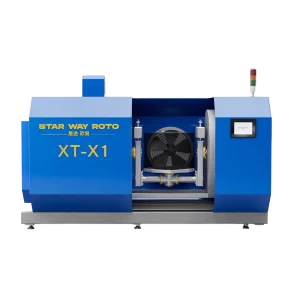
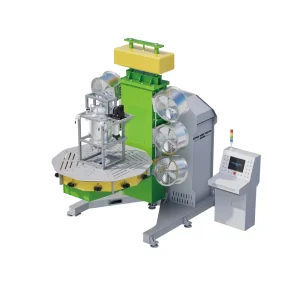
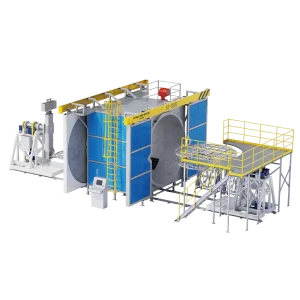
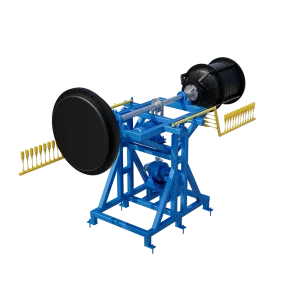
Explore our lineup of CE-certified electric heating ovens, rock-and-roll units, laboratory testing systems, and high-load shuttle machines.