The 2026 Top Aluminium Casting Mould Manufacturers Guide examines suppliers shaping modern die-casting and permanent-mould production. Demand is rising with automotive lightweighting, electric vehicles, renewable-energy equipment, and industrial automation. The World Foundry Organization’s latest census reported global casting production above 100 million tonnes, confirming the scale of this manufacturing ecosystem. Aluminium remains important because it combines low density, corrosion resistance, and practical recyclability.
Performance depends on more than a supplier’s catalogue. A reliable Aluminium Casting Mould manufacturer should demonstrate controlled steel selection, heat treatment, machining accuracy, cooling-channel design, and documented inspection. On a production floor, these details appear clearly: stable filling, clean ejector-pin marks, fewer soldering defects, and consistent parts after thousands of cycles. ISO 8062 provides useful guidance for casting dimensional tolerances, while ISO 9001 certification can support traceability and process discipline. Still, certification alone does not prove excellent mould performance.
Energy and material efficiency also deserve attention. The International Aluminium Institute states that recycled aluminium requires roughly 5% of the energy used for primary aluminium production. Better mould life can reduce scrap, replacement steel, and machine downtime. Market research firms, including Grand View Research and Fortune Business Insights, forecast continued growth in aluminium-casting applications, although their market boundaries and methods differ. That limitation matters.
This guide compares manufacturers through engineering capability, tooling materials, cooling design, quality systems, lead time, after-sales support, and total lifecycle cost. No ranking is perfect. Supplier claims require verification through drawings, trial reports, sample parts, and customer references. The strongest choice is rarely the cheapest quotation. It is the partner that delivers repeatable mould performance under real production pressure.
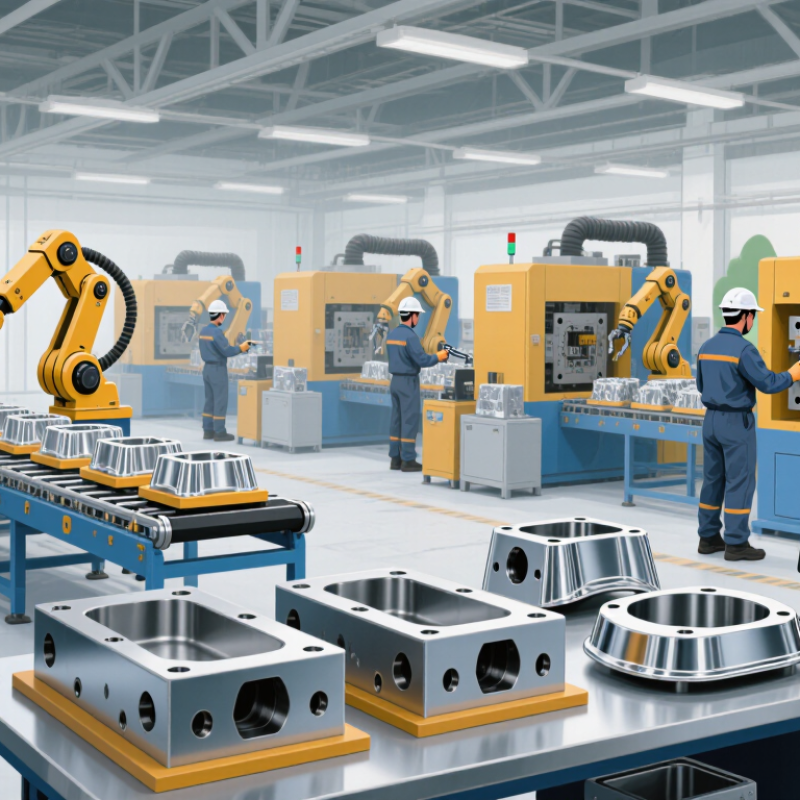
An aluminium casting mould is a shaped cavity that gives molten aluminium its final form. It may be made from hardened steel, iron, or specially prepared sand. The choice depends on production volume, surface finish, and part complexity. A mould contains more than a cavity. It also includes gates, runners, vents, and sometimes risers. These channels guide metal and release trapped air.
The working process starts with controlled mould preparation. Operators clean the cavity, apply a suitable release coating, and preheat the tool. Molten aluminium then enters through gravity, pressure, or a mechanical injection system. Heat moves from the metal into the mould walls. Solidification follows, usually from the outer surface toward the centre. Cooling must remain balanced. Uneven temperatures can create shrinkage, cracks, or distorted edges.
Small details matter. A blocked vent may leave a pinhole inside the casting. Excessive release agent can mark the surface. Practical inspection often includes checking dimensions, flash, porosity, and ejection marks. Mould designers use draft angles so the solid part can leave without sticking. Still, no mould performs perfectly in every cycle. Material changes, worn surfaces, and operator adjustments can alter results. That uncertainty deserves careful recording and review.
Check experience with your alloy, casting method, part size, and production volume. Ask for case evidence. Review dimensional reports, mould photographs, and trial results.
Different alloys create different shrinkage, temperature, and cracking risks. A mould designed for one process may fail under another process. Confirm compatibility before machining begins.
Ask about cooling-channel layouts, venting, shrinkage allowances, and expected tool life. The engineering team should explain these details clearly. Vague answers deserve caution.
Inspect the mould surface under strong light. Look for consistent polishing, clean parting lines, and smooth ejector movement. Also review maintenance records and sample tooling.
Request steel certificates, hardness results, heat-treatment records, and dimensional reports. Critical dimensions should receive coordinate-measuring checks. Traceability matters.
Compare total cost, not only the initial price. Include mould life, repairs, replacement inserts, maintenance access, and delivery control. The cheapest quotation may become expensive after repeated repairs.
Yes, a small pilot run can reveal hidden weaknesses. Request measurable tolerances and trial-shot data. A mould may pass one test, then fail after 20,000 shots.
Communication affects quality and production stability. Ask how the team handles drawing changes, delays, cracks, porosity, and flash. Fast replies help. Clear responses matter more than polished presentations.
Be careful when evidence is missing, lead times seem unrealistic, or inspection records lack detail. A polished website proves little. I can still trust attractive samples too quickly, and that is a weakness worth checking.
Use staged approvals, technical audits, sample trials, and a written defect-response plan. Review the supplier again after production begins. Their response to an unexpected defect may reveal the truth.
This guide explains what an Aluminium Casting Mould is, how it shapes molten aluminium, and why its design directly affects dimensional accuracy, surface finish, production efficiency, and mould service life. It outlines the main factors for evaluating manufacturers, including engineering capability, material selection, tooling precision, production capacity, quality control, customization support, lead times, communication, and after-sales service. It also presents a practical framework for comparing leading manufacturers in 2026 without relying solely on price or promotional claims.
Readers will learn how to compare manufacturing technologies such as CNC machining, heat treatment, surface finishing, and inspection systems, while also considering relevant quality standards, testing procedures, and traceability practices. The final section provides a clear supplier-selection approach based on product requirements, expected production volume, casting process, budget, tolerance needs, and long-term cooperation goals. By using these criteria, buyers can reduce technical risks, improve casting consistency, and choose an Aluminium Casting Mould supplier that offers reliable performance and sustainable value.

